 by
by At the end of 2025, Renault demonstrated an impressive result in the field of electric vehicle efficiency. Its ultra-aerodynamic single-seater prototype traveled over 1,000 kilometers on a single battery charge. This event took place on a high-speed track where the car maintained an average speed of over 100 km/h.
Key Details of the Achievement
After completing the run, the battery still had 11% charge remaining. According to engineers’ calculations, this energy would have been sufficient for approximately another 120 kilometers of travel at the same average speed, potentially extending the maximum range to 1,083 kilometers.
The Path to the Record
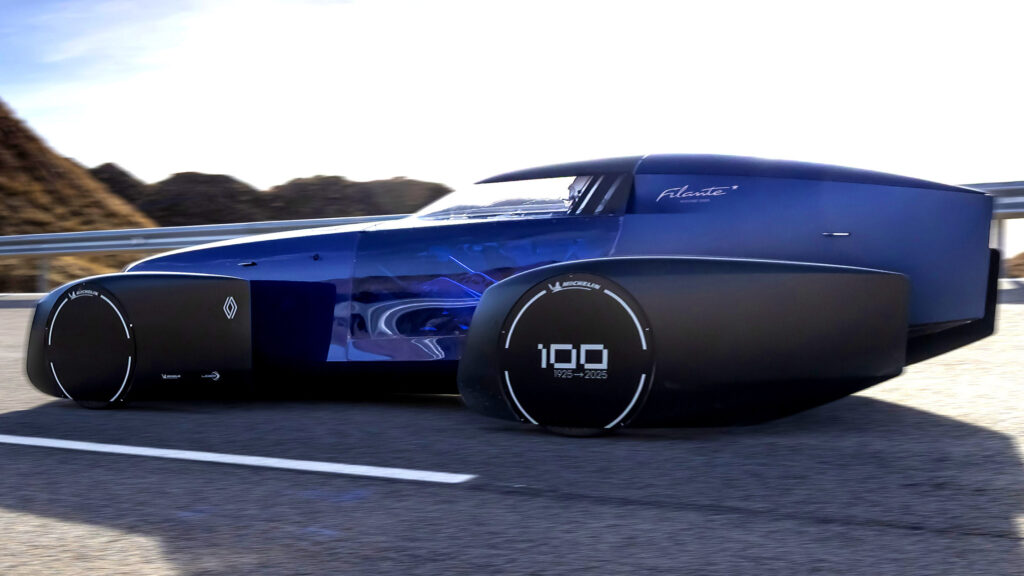
The car in question is the Filante Record 2025, a concept specifically created to set a record. It was first presented back in January, but an attempt to set the record in July failed due to difficulties in achieving the required aerodynamic performance.
By October, the prototype was ready; however, the weather in France once again forced adjustments. Finally, the team moved to Morocco, where the final tests were conducted on December 18 at the UTAC high-speed track.
Renault Filante Record 2025 (top) compared to the original prototype (bottom).

The car’s design was inspired by Renault’s past record-breaking models, particularly the 40 CV from 1925 and the L’Étoile Filante from 1956. However, many elements of the original prototype had to be refined in the wind tunnel to achieve the set goals.
The changes involved removing the futuristic LED lighting, reducing the number of air intakes, and refining the shape of the wings. At the same time, key features remained untouched: the elongated hood, transparent canopy, aviation-style tail, driver seating position like in Formula 1 cars, and ultraviolet-blue paint.
Engineering Solutions
The engineering work was not limited to aerodynamics alone. The team also aimed to reduce rolling resistance and the car’s weight. For this purpose, carbon fiber, aluminum alloys, and parts made using 3D printing with Scalmalloy were used.
Michelin provided special low rolling resistance tires, and the steering and braking systems operated on a ‘by-wire’ principle (without mechanical linkage).
The French company Ligier was responsible for the platform, chassis, and carbon fiber monocoque, integrating an 87 kWh battery pack into it. For comparison, a battery of the same capacity is used in the mass-market Scenic E-Tech crossover.
The Record Day
On the day of the record attempt, three drivers took turns behind the wheel of the single-seater car. They completed 239 laps on the 4.2 km long Moroccan track in 10 hours. There were no stops for charging, only brief pauses for technical checks and driver changes. Such stability allowed for maintaining an average speed of 102 km/h.
Energy consumption was only 7.8 kWh per 100 km. This is almost half of the official WLTP figure for the Scenic E-Tech with the same battery, which consumes 14.1 kWh/100 km in standard tests. Unlike laboratory figures, the Filante Record test was conducted at real highway speeds.
Project Goals and Prospects
Renault developed the Filante Record 2025 not only to celebrate its heritage of record-breaking prototypes but also to explore ways to improve the efficiency of mass-produced electric vehicles, especially over long distances.
It is hoped that the knowledge gained from this project will be used in future Renault models, helping drivers travel further as battery and electric motor technologies evolve.
This experiment clearly demonstrates the significant potential for efficiency improvement inherent in modern electric vehicle technology. Although the Filante Record is an extreme prototype, its technologies, such as ultra-lightweight materials, ultra-low tire rolling resistance, and refined aerodynamics, are gradually finding their way into mass production. Such projects stimulate the industry, showing that the boundaries of what is possible are constantly expanding, and thousand-kilometer electric journeys without stopping could become common practice in the coming years.