 by
by Leapmotor Unveils Its First Electric Minivan, the D99
The Chinese automaker Leapmotor, backed by the Stellantis group, continues to expand its lineup and enters a new market for itself with its first fully electric minivan. The new D99 model is available in two variants: fully electric (BEV) and with a range extender (EREV). This allows the brand to compete with models such as the Xpeng X9, Zeekr 009, and Li Auto Mega.
The D99 was unveiled during a special event dedicated to the brand’s 10th anniversary. The car features a sleek, flowing design characteristic of other Leapmotor models. The front end is distinguished by a very short hood and a windshield that extends beyond the front axle, which is intended to provide the driver with excellent visibility.
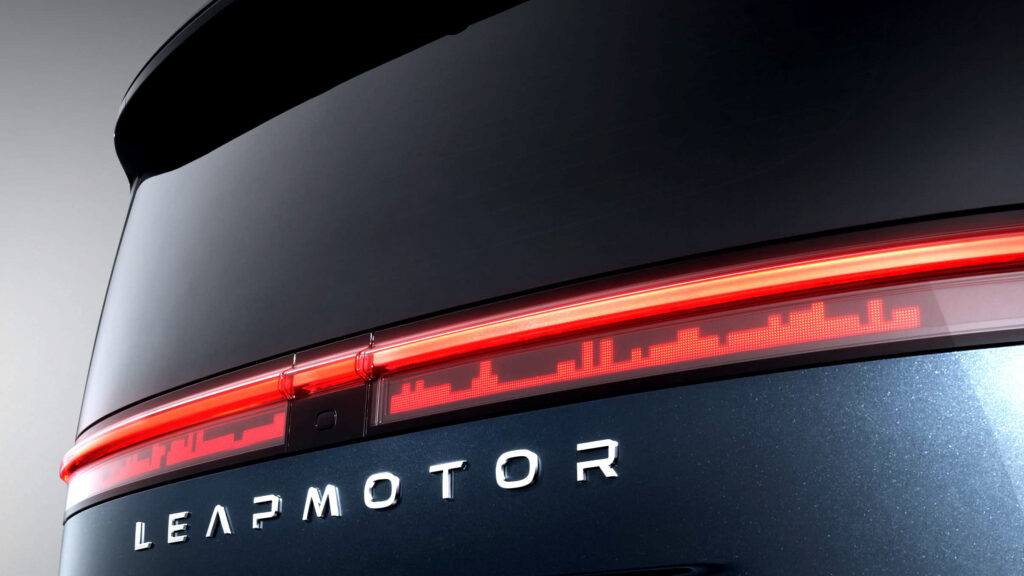
Among other design details are retractable door handles (although such solutions are gradually being restricted by regulators in China) and darkened B and C pillars, which visually blend with the side glass. The rear is adorned with a futuristic full-width LED light bar.
Powerful Technical Specifications and Record-Breaking Batteries
The real ace up the D99’s sleeve is its technical side. The model is built on an 800V platform. The range-extender version is equipped with an 80.3 kWh battery, which is the largest capacity among all hybrids on the market today.
This gives it a clear advantage over the Zeekr 9X hybrid with a 70 kWh battery, as well as the upcoming Xpeng X9 with a range extender, which will receive a 63.3 kWh battery.
According to the manufacturer, the D99 EREV is capable of traveling up to 500 kilometers (311 miles) on electricity alone. Details about the internal combustion engine, which acts as a generator, have not yet been disclosed, but it will likely be a 1.5-liter four-cylinder unit, similar to the one installed in the Leapmotor C10 REEV.
The fully electric version of the D99 uses a 1000V architecture and an even larger 115 kWh battery from CATL. The claimed range for this modification is 720 kilometers (447 miles).
Interior and Market Positioning
Images of the interior have not yet been released; however, judging by Leapmotor’s latest models, the interior is expected to be equipped with high-quality displays and comfortable seating. The manufacturer positions the D99 not just as a family car, but as a vehicle for passengers who prefer chauffeur-driven travel over driving themselves.
Additional details, including the price on the Chinese market and potential availability outside of it, are expected to be announced in the coming weeks.
The emergence of the D99 demonstrates how dynamically the electric minivan segment is developing in China, where space, comfort, and high technology are combined. Large batteries and advanced electric platforms are becoming the standard for premium models, forcing European manufacturers to seek new ways to compete, often through partnerships, as in the case of Leapmotor and Stellantis. The success of this model could significantly influence the global expansion strategy of Chinese EV brands.