 by
by The Brightest GT-R at the 2026 Tokyo Auto Salon
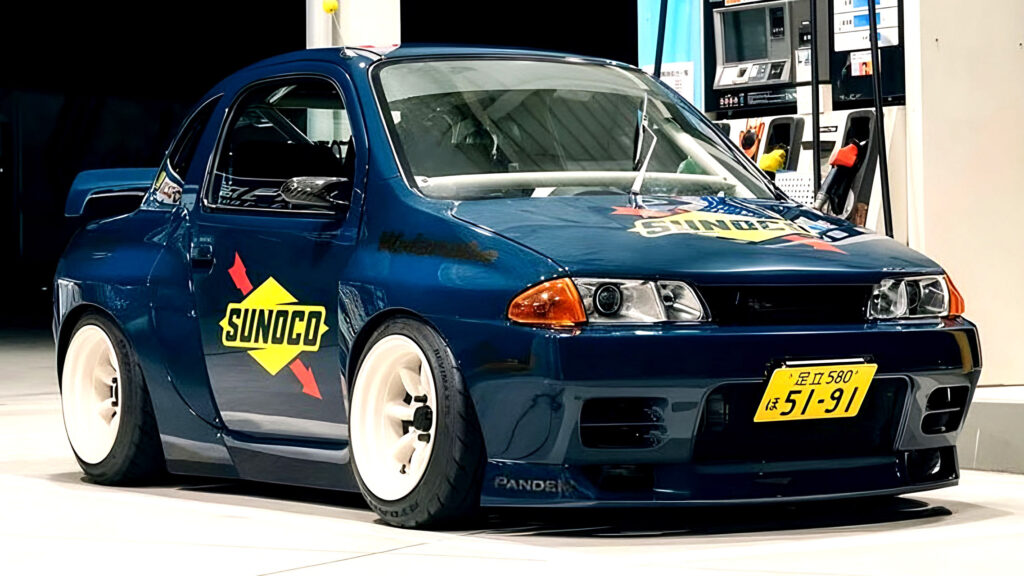
What if you were told that the most impressive car resembling a Nissan GT-R at the 2026 Tokyo Auto Salon isn’t even a real Nissan? At first glance, it might seem like an image created by artificial intelligence, but no — this is a real car made of metal, fiberglass, and a large dose of humor.
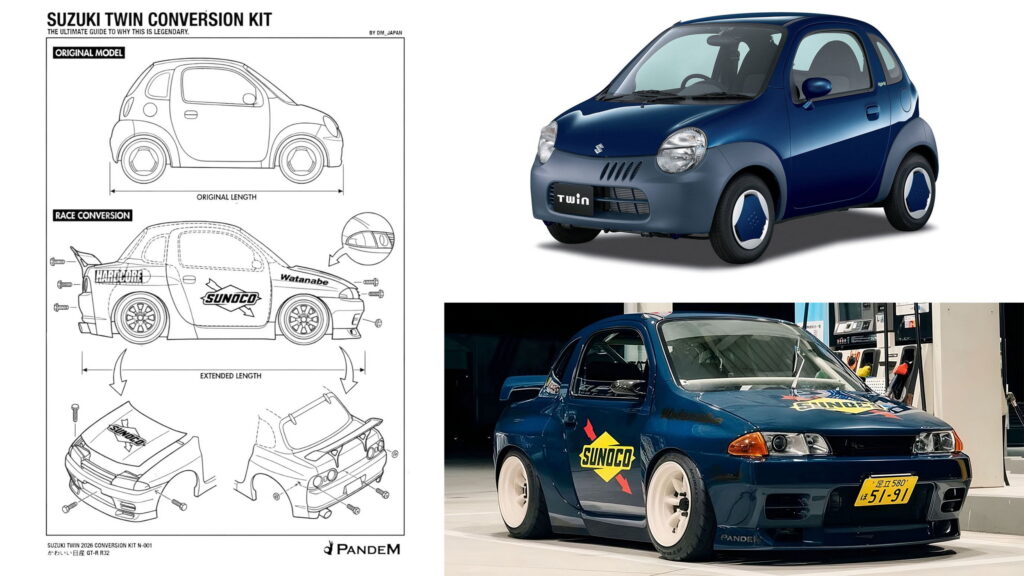
Before you is the Suzuki Twin, transformed by the inventive team Pandem Rocket Bunny in collaboration with Takahashi Jun and the J Beat Custom Shop from Saitama Prefecture. Initially presented as a concept in 2002, the Suzuki Twin was a round and rather inconspicuous kei car. Now, thanks to creative reinterpretation, it has been given a second life under the name “Pocket Bunny”.
When a Kei Car Meets “Godzilla”
Pocket Bunny doesn’t hide its inspiration. It actively borrows features from the legendary R32 Skyline GT-R, but distorts the proportions to resemble a living caricature. Imagine a GT-R in the style of a Chibi anime. Except for the doors, glass, and roof, everything else has been completely reworked or changed. The resemblance to the R32 is sometimes striking, and sometimes surreal.
The custom kit from Pandem replaces the front and rear body parts with GT-R-inspired components. Bumpers, hood, fenders, rear doors, and spoiler — all are unique elements scaled to fit the narrow chassis of the kei car. Even the headlights and taillights have been modified to convincingly mimic the originals.
Although the car retains the compact dimensions of the Twin, its silhouette now screams vintage Nissan, as if seen in a funhouse mirror.
Serious Bodywork Overhaul
To make all these parts work together, serious “surgical” work was required. According to the creators, the transformation involves cutting the original body and sealing the inner fenders. Practically, this means the transformation is irreversible. After installing the kit, returning to the factory look is no longer possible.
The fiberglass panels look best when combined with new alloy wheels and lowered suspension. The show car is equipped with an electromagnetic air suspension from Airmext Japan. It also has a roll cage, bucket seats, a three-spoke steering wheel, and an aftermarket multimedia screen.
Tiny Power

As for performance, the car retains its original 658cc three-cylinder engine, which in its best years produced 27 horsepower. The Suzuki Twin was available in standard and hybrid versions, both with front-wheel drive via a five-speed manual transmission. However, this project may not stay that way for long.
Automotive photographer Larry Chen reports that the team behind Pocket Bunny plans to install a rotary engine and convert the car to rear-wheel drive. This ambitious upgrade will give it significantly more “bite”.
Can You Buy It?
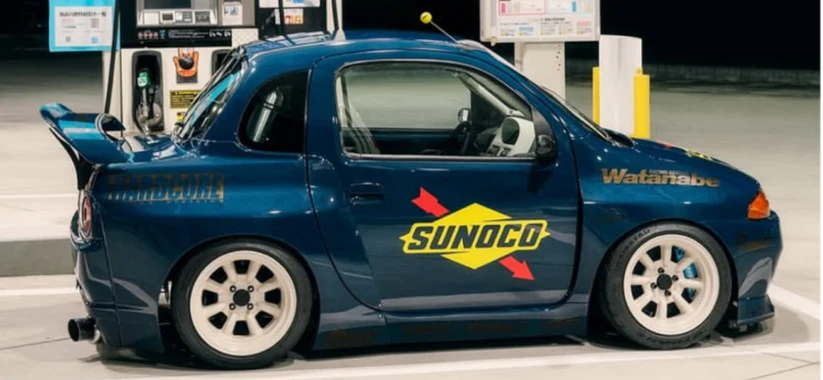
Yes and no. The conversion kit itself cost approximately 3,622 euros, excluding painting and installation. At the time of writing, it is officially marked as sold out, although the company promised a new batch would be available soon. Given the hype around this project, they should hurry.
A post from the official Rocket Bunny Pandem distributor on social media showcases this unique project and generates excitement among car enthusiasts.
Projects like Pocket Bunny demonstrate how deep car culture can be and what incredible things are born at the intersection of nostalgia, humor, and craftsmanship. They don’t just copy iconic cars; they reinterpret them, making them accessible to a new audience and in a new format. It’s a reminder that a car is not just a means of transportation, but also a canvas for creativity that can evoke emotions and smiles, even if there are only 27 horsepower under the hood. The future of this particular example with a rotary engine promises to make it even more interesting, combining the look of a legend with unconventional technical underpinnings.