 by
by A Significant Update, Not Just a Facelift
Mercedes-Benz is preparing to unveil the next iteration of the S-Class by the end of January. If we are to believe the company’s CEO, this is far from a routine mid-lifecycle model update with minor changes. Everything points to much more extensive work.
In a new teaser video ahead of the car’s world premiere on January 29, CEO Ola Källenius describes the future flagship as one of the most comprehensive modernizations in the model’s history. Judging by his words, it is the most advanced S-Class of all.
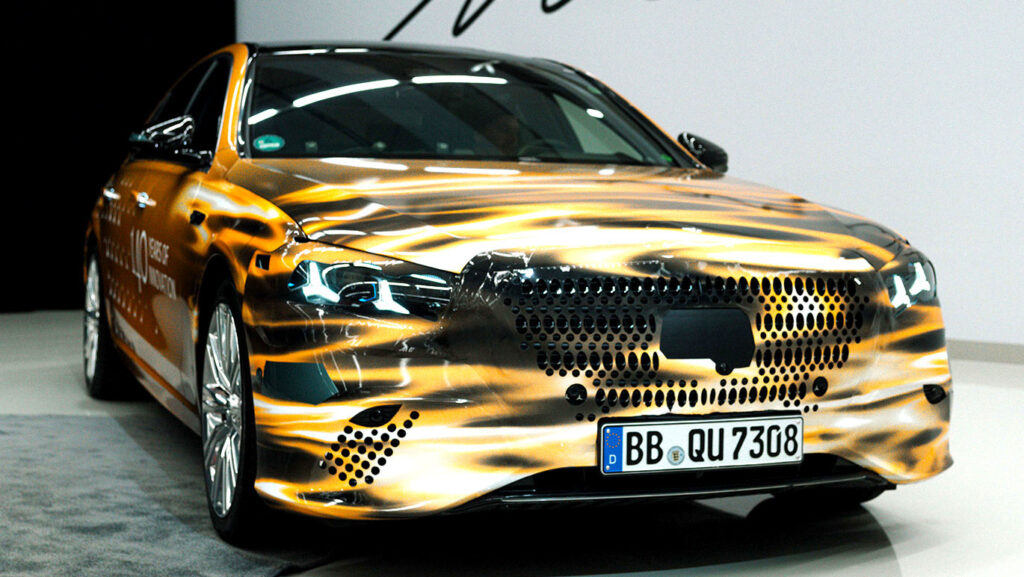
The teaser shows the new sedan completely camouflaged. Källenius notes that the car has about 2,700 new components. This constitutes over half of the vehicle, confirming the thesis that this is not just a regular facelift.
Larger Grille and New Design
Visually, the car aims for a more expressive look than the previous version. The changes are not a complete body rebranding but a series of new details. Källenius reports that the radiator grille has become 20% larger. The classic Mercedes star returns to the hood and receives LED illumination.
Software Becomes Key
Inside, the main novelty will be the debut of the Mercedes-Benz Operating System (MB.OS), making the S-Class the first model with the brand’s fully proprietary software architecture. The system integrates 27 sensors, enhanced voice control, and deep personalization. Källenius describes this as “technology for the sake of people,” not just for the sake of novelty.
Comfort remains the car’s calling card, especially in the rear seat, which Källenius repeatedly calls “the best seat in the house.” Updates include redesigned seats with improved ergonomics, expanded MANUFAKTUR customization options, and further refinements to the AIRMATIC pneumatic suspension, which now more intelligently adapts to long, undulating roads common in the USA and Southern Europe.

In fact, a feature has appeared that records the GPS coordinates of particularly bad road sections or sharp bumps. This data is then uploaded to a server where this car and other Mercedes with the same software can use it to proactively prepare the suspension to handle that spot on the map the next time.
Physical Buttons Still Matter
Källenius emphasizes that everything ultimately comes down to the human, and intuition is key.
We have very large, very beautiful high-resolution high-tech screens. But we have the necessary buttons. Just look at the steering wheel, he said. What’s most important on the wheel? For volume – it’s a roller. For your cruise control – it’s a switch… But in the digital environment, if you want to listen to a specific song, you don’t want to touch anything. You tell the car: ‘Play me this song.’ And it understands you and does it.

Gasoline Engines Aren’t Going Anywhere
He also clarified that, despite the development of new EV technologies, the brand does not intend to abandon gasoline engines anytime soon.
I used to work at AMG, I’m a car enthusiast, I love V8s, I worked in Formula 1. No one needs to convince me of a passion for motorsport… The V12 will be available in the foreseeable future… Technology never stands still; it always moves forward. In parallel, we developed an entirely new V8 to meet extremely stringent European emission standards. [It’s] the cleanest V8 in history. You have a choice, you are the customer. So we won’t dictate to you what you like. You decide what you like, and we provide it.
We will see the full unveiling of the S-Class on January 29. For now, we can only wait and discuss Källenius’s comments and how promising the new model seems.
Mercedes’ approach to updating its flagship demonstrates an interesting balance between revolution and evolution. Instead of a complete platform replacement, the company is betting on a deep modernization of the existing one, focusing on software as the new battlefield for the customer. This indicates a shift in priorities in the premium segment, where “hardware” is increasingly becoming a carrier for the car’s “digital soul.” The retention of powerful gasoline engines alongside the development of electricity underscores a strategy focused on buyer choice, which could prove key during the automotive industry’s transitional period. The success of this updated S-Class could set the tone not only for subsequent Mercedes models but for the entire industry as a whole, showing how traditional luxury brands are adapting to the digital era.