 by
by Key Changes in Stellantis’s Strategy
The automotive conglomerate Stellantis has announced a radical “reboot” of its business model. The company is making a sharp turn, moving away from aggressive electrification and betting on giving customers the freedom to choose their powertrains. This shift is accompanied by colossal financial losses, which could reach $24.8 billion in the second half of 2025.
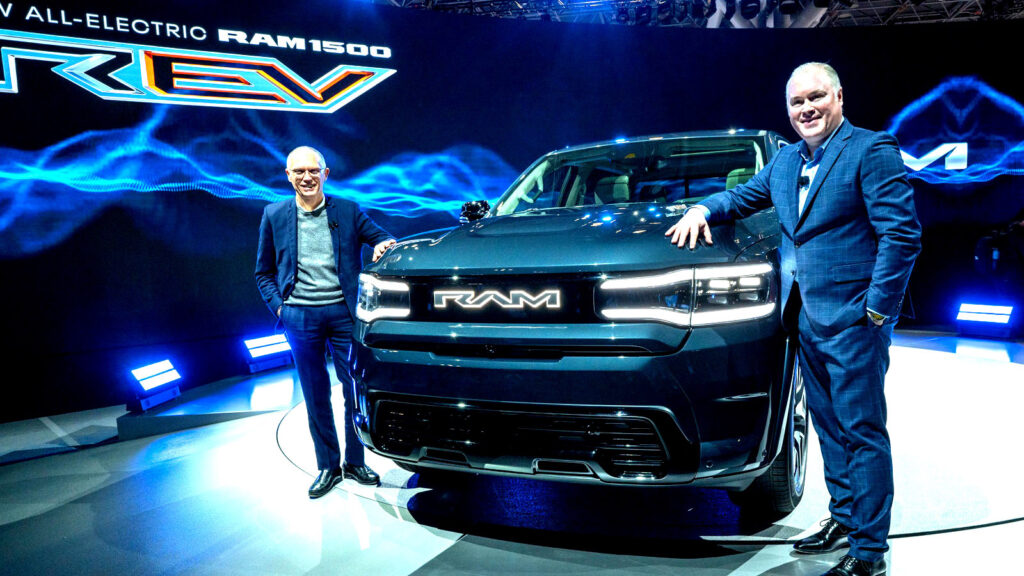
These decisions are part of major changes within the company following the dismissal of former CEO Carlos Tavares. Among other steps are the discontinuation of plug-in hybrid production for the North American market and the cancellation of the fully electric Ram 1500 REV pickup. Instead, Ram has brought back gasoline engines like the 5.7-liter Hemi V8 and the supercharged 6.2-liter V8 for the TRX model.
Financial Consequences of the New Course
The strategy change is costing Stellantis enormous sums. The automaker announced an impairment charge of $26.2 billion, primarily linked to the shift towards the “freedom of choice” policy. This policy means buyers themselves will be able to choose the type of powertrain among internal combustion engines, hybrids, and electric vehicles.
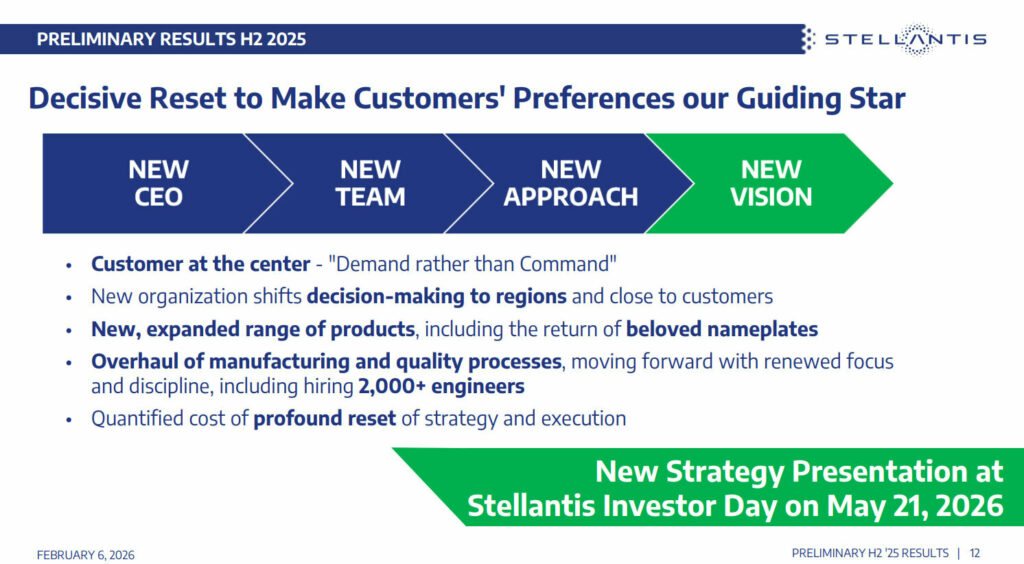
The company’s new CEO, Antonio Filosa, commented on these decisions. He stated that the announced reboot is part of a decisive process started in 2025 to once again make customers and their preferences the primary focus. Filosa added that the massive impairments largely reflect the cost of reassessing the pace of the energy transition, which had distanced the company from the real needs, capabilities, and desires of many car buyers. He also criticized his predecessor’s actions, noting the consequences of past operational mistakes.
Details of the Financial Impairments
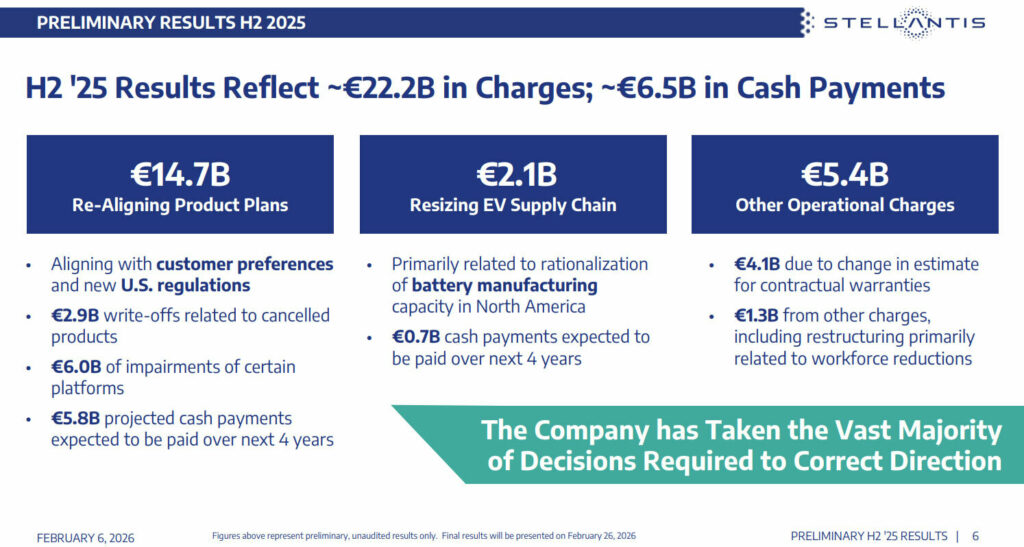
Stellantis detailed the composition of the billion-dollar expenses. Specifically, $17.4 billion is related to revising product plans to align with customer preferences and new US environmental regulations, as well as significantly lowered expectations for fully electric models (BEVs). Separately, the company is writing off $3.4 billion due to the cancellation of a number of projects.
Another $2.5 billion is for scaling up the electric vehicle supply chain, and $6.4 billion is related to other operational changes, such as workforce reductions in Europe.
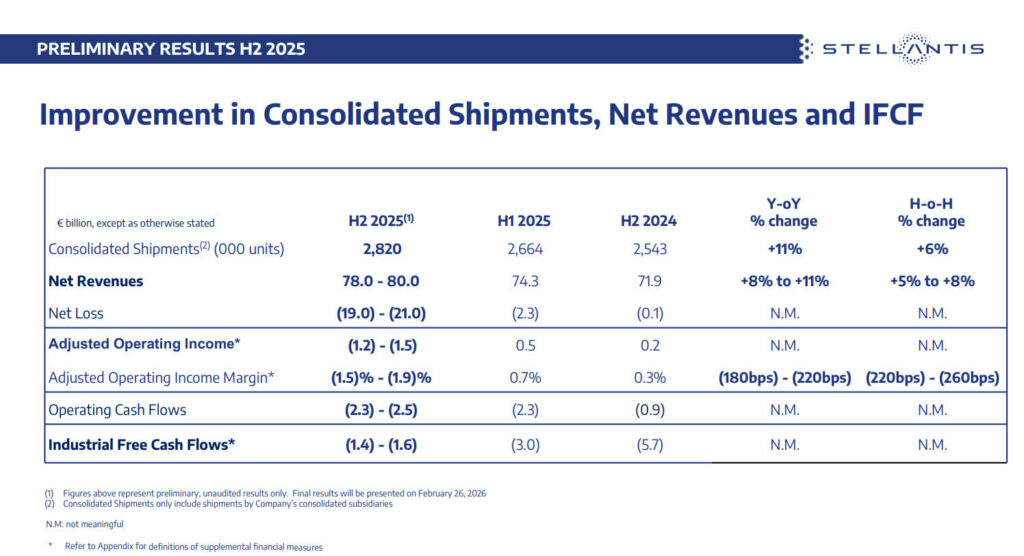
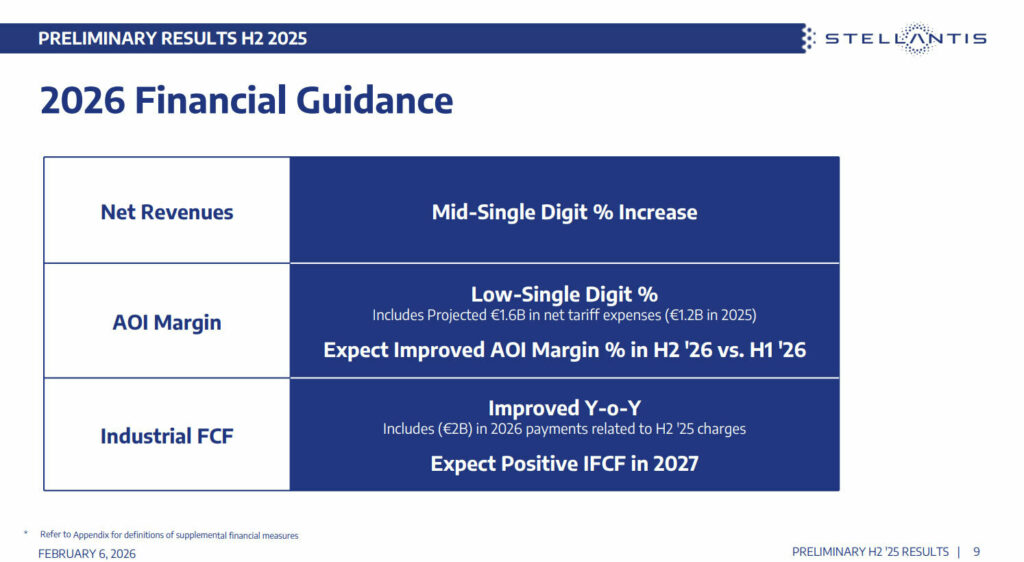
Forecasts for the second half of 2025 also look mixed. Expected revenue in the range of $92.2-94.6 billion is accompanied by a projected net loss of $22.4-24.8 billion.
In response to the scale of these losses, the decision was made to cancel annual dividends for 2026. The Board of Directors also sanctioned a bond issuance of up to $5.9 billion. Investors reacted sharply: Stellantis shares plunged by an impressive 23.69%, closing at $7.28 per share.
Positive Signals Amid Negative News
Despite the stream of bad news, the Stellantis report also contains positive points. Vehicle deliveries in the second half of the year increased by 11%, to 2.8 million units. The company recorded growth in a number of key regions, including North and South America, Europe, China, the Middle East, and Africa.
Furthermore, the company is making progress in addressing quality issues. The number of vehicle complaints within the first month of operation has decreased by more than 50% in North America and by over 30% in Europe since the beginning of 2025. This was facilitated by improved working methods and strengthened engineering teams.
Hopes for New Models
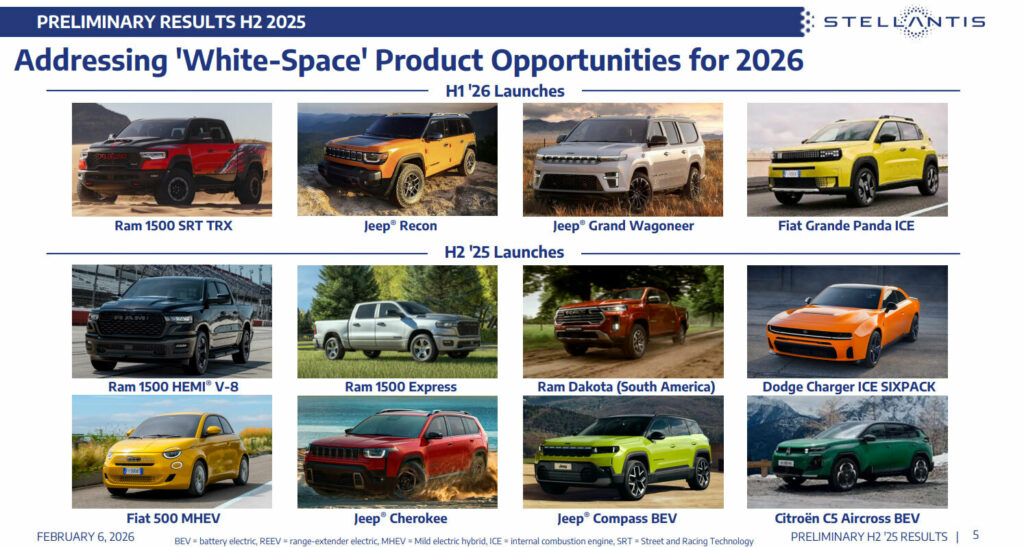
Stellantis places high hopes on a series of new and updated models expected to drive future sales growth. Among the key new products are the new generations of the Jeep Cherokee, Compass, and Recon, as well as the updated Grand Cherokee and Grand Wagoneer. Sales of the Dodge Charger are expected to be boosted by a new turbocharged inline-six engine, and the Ram 1500 with the Hemi engine is already showing popularity.
The announced changes point to a deep transformation in the automotive industry, where the initial enthusiasm for a rapid transition to electric vehicles is colliding with the reality of market demand and economic feasibility. Stellantis’s experience could be indicative for other players balancing environmental goals, regulatory requirements, and consumer preferences. The success of the company’s new course will depend on how effectively it can manage a diverse portfolio of technologies and respond promptly to global market conditions in the coming years.