 by
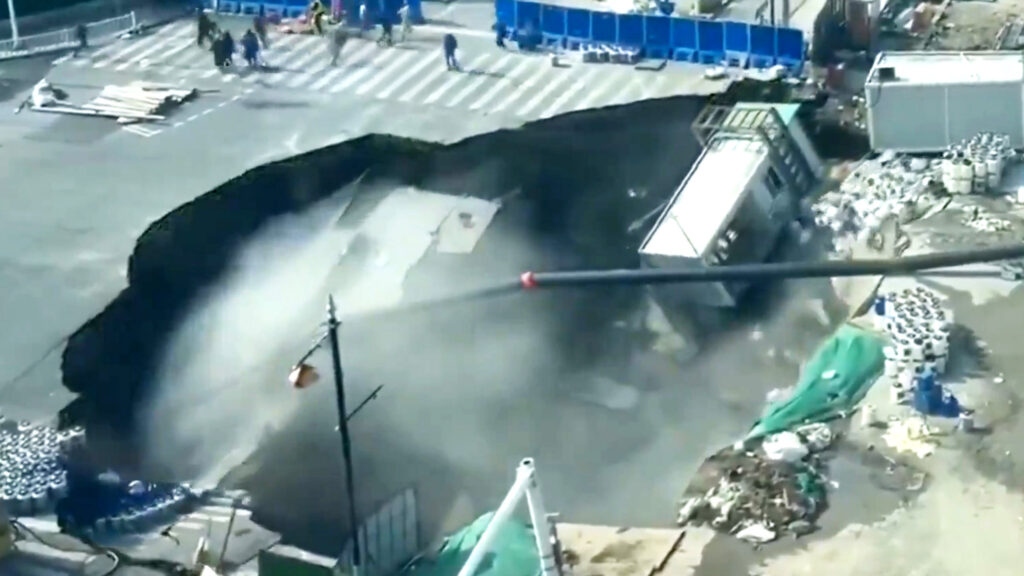
by Earlier this week, a giant sinkhole suddenly opened up at a major intersection in Shanghai, China. This event could have had catastrophic consequences, but fortunately, there are no reports of injuries or fatalities. The sinkhole swallowed construction machinery but resulted in no casualties.
Circumstances of the Event and Timely Precautions
The karst sinkhole formed near Qixin Road in the Minhang district during construction work. Ironically, the timing was fortunate: the area was already occupied by workers, not traffic flow, so no vehicles fell into the chasm.
Local crews detected a water leak during excavation work related to the construction of the adjacent Jiamin metro line, a day before the incident. In response, authorities closed the intersection to traffic and began pumping out the water. This precautionary measure likely prevented significantly worse outcomes.
Event Dynamics on Video
Video footage captures the sinkhole tearing through the ground along the right side of the road, gradually swallowing barriers, materials, and heavy construction machinery. More than a dozen workers stand just a few steps from the edge as the surface beneath them collapses.
What is striking is how long they remain in place. For nearly 20 seconds, several individuals continue to watch the earth disappear, as if waiting for a signal that this is not the best moment to stay nearby. Only then do they finally rush to escape, jumping to safety as the crater continues to expand.
A moment after the soil stopped collapsing, a flow of water can be seen in the sinkhole, likely from the leak detected the day before.
Geological Causes of the Phenomenon in Shanghai
Local media point out that Shanghai is located in the Yangtze River Delta, where water-saturated soils and fine-grained quaternary clay predominate. Under such conditions, soil stability is always a matter of delicate balance.
Sinkholes are not uncommon for a city of 25 million residents and are often caused by underground construction work, as was likely the case here. A 2023 study showed that about 87 percent of sinkholes in Shanghai have opened up in urban areas. This statistic speaks volumes about what happens when rapid development meets soft, waterlogged soil.
Similar incidents worldwide, from Vancouver to Shanghai, remind us of the hidden risks beneath our cities. The successful prevention of a disaster in this case is a combination of timely problem detection (the water leak) and swift administrative decisions (closing the intersection). This demonstrates how critical thorough geological surveying and monitoring are during large-scale infrastructure projects, especially in regions with complex hydrogeology. Urban infrastructure is aging, and climate change may intensify such phenomena, making investments in soil condition monitoring and modern early warning systems not just a desire, but a necessity for the safety of megacity residents.