 by
by Threat to Three-Wheeled Vehicles
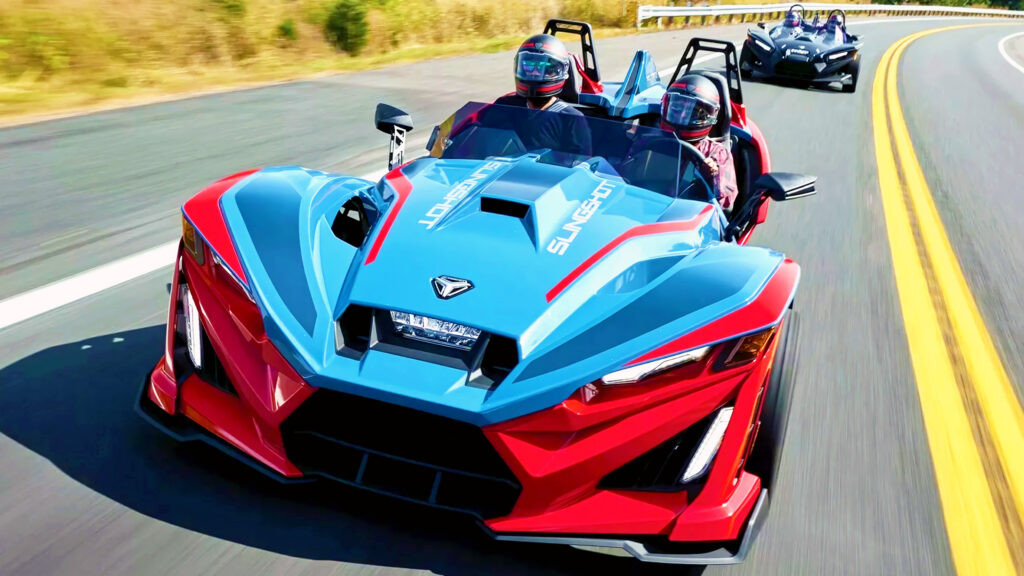
A new bill introduced in the lower house of the US Congress could put an end to the existence of three-wheeled vehicles like the Polaris Slingshot, Vanderhall Carmel, and Morgan 3-Wheeler, potentially stripping them of their right to be registered as motorcycles.
If passed, the law would narrow the federal definition of a motorcycle in a way that excludes these vehicles. In states that rely on this federal definition, they could lose the ability to be registered and find themselves without any viable regulatory category. Rumors about the bill have sparked sharp opposition from the motorcycle industry.
Fun Fact: This $36,999 Polaris Looks Bright Blue Until It Becomes a Different Color
Current and Future Definition
Currently, the federal definition of a motorcycle is very broad. A motorcycle is defined simply as “a motor vehicle with a seat or saddle for the use of the rider and designed to travel on not more than three wheels in contact with the ground.” Under US House Resolution 3385, Congressman Derrick Van Orden wants to change this.
As reported by Hagerty, the revised wording would require a motorcycle to have a seat or saddle on which the rider “sits astride.” It would also be mandatory to have “steering using a handlebar, acceleration and braking controlled from the handlebar, and foot controls.” In other words, if a vehicle doesn’t feel like a traditional motorcycle in terms of seating and control, it may no longer qualify as one.

Registration Issues in States
In some states, vehicles like the Polaris Slingshot are called “autocycles” and must meet state regulations. However, 15 states, such as Alabama, Florida, and Illinois, use the exact federal definition of a motorcycle. If this definition is changed, operating these three-wheeled vehicles could become illegal.
Implications for Safety and Manufacturing
Since the Polaris Slingshot, Vanderhall Carmel, and other similar models are considered motorcycles at the federal level, they do not have to meet the same safety standards as cars, nor are they obligated to adhere to the same strict emission standards.
Removing these vehicles from the motorcycle classification would leave them in a legal vacuum. This is happening despite the fact that both the Slingshot and the Carmel are manufactured in the United States, providing hundreds of jobs.
Last month, the Motorcycle Industry Council sent a letter expressing concern about the proposal, stating that the legislation “threatens to eliminate an entire category of innovative American products from commerce and jeopardize thousands of domestic jobs,” adding that it would amount to a “de facto ban of an established and successful segment of the motorcycle market.”
The potential legislative changes highlight the complex interplay between technological progress, regulation, and the protection of domestic manufacturing. The story of three-wheeled vehicles demonstrates how a single formal definition can have far-reaching consequences for entire industries, consumers, and the market. While arguments about safety and rule unification may have merit, it is important to consider the economic and innovative context to avoid halting the development of promising transportation solutions. The future of such niche products often depends not only on their technical advantages but also on the flexibility of the legal system, capable of adapting to new realities.