 by
by BYD Tests a 1500 kW Ultra-Fast Charging Network
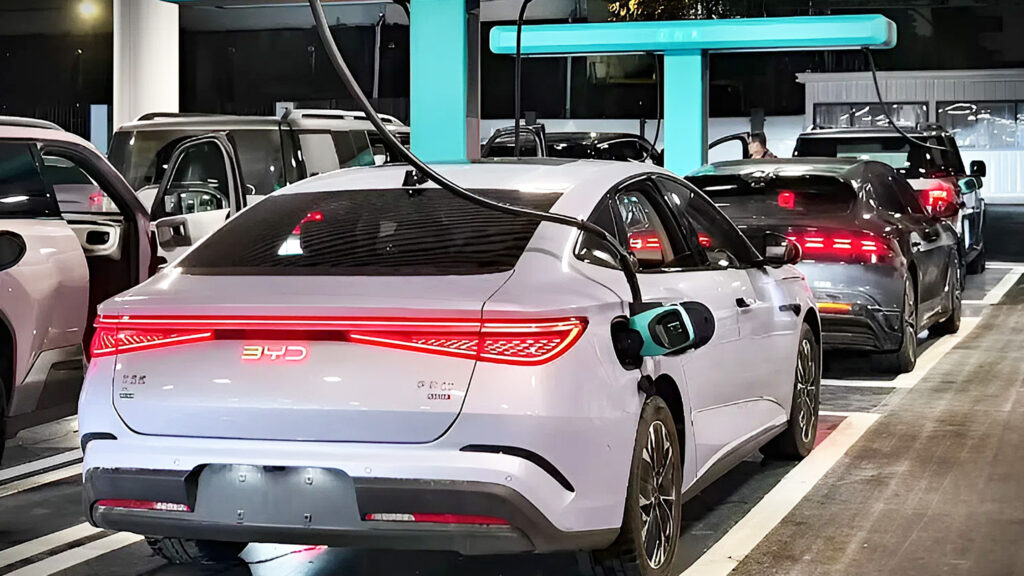
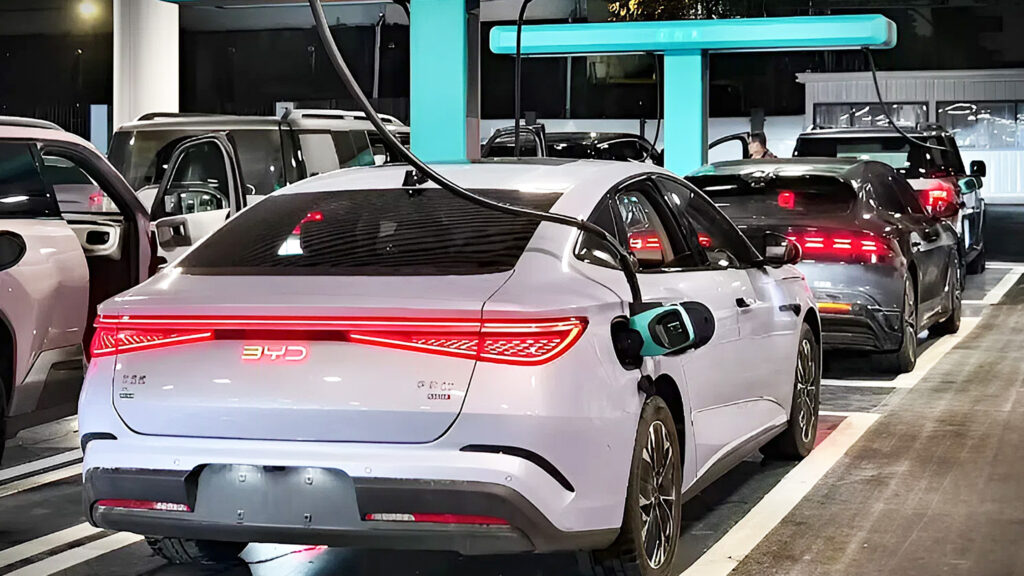
The Chinese automaker BYD, known for the rapid development of electric vehicles, is now working on next-generation charging devices that make current charging stations seem low-powered. The company is testing a “megawatt” flash charging network in Shenzhen. Interestingly, the arrangement of charging columns at the demonstration site resembles a traditional gas station, not a typical parking lot with charging stations.
The site is equipped with liquid-cooled charging guns and T-shaped structures lined up like regular gasoline pumps. This allows drivers to pull up, “refuel” the car, and move on without a long wait.
Technical Specifications and Comparison
According to information, the peak charging power can reach 1500 kW at a voltage of 1000 V. Such a system is theoretically capable of replenishing a range of 400 kilometers in just 5 minutes. For comparison, the fastest public chargers in Europe and the US typically have a power of around 350 kW, and many electric vehicles are not even capable of sustaining such a level.
During testing, according to Car News China, access is only granted to specific BYD models marked with Flash Charge, including future variants of the Tang, Song, Seal, and Denza. The charging process begins approximately 10 seconds after connection, without the need to scan QR codes or use apps.
Economic Aspects and Prospects
At the demonstration site, the price per kilowatt-hour is approximately 1.3 yuan, equivalent to 0.18 US dollars. This figure may surprise Western EV drivers, where the cost of charging is significantly higher. There are rumors that buyers of compatible cars will receive 1000 kWh of free electricity annually, although the final details of this policy have not yet been confirmed.
Potential Market Impact
The main idea is not only the record charging speed, but also the changes it could bring. The ability to quickly replenish hundreds of kilometers of range makes oversized battery packs unnecessary. Smaller batteries mean lighter, more affordable, and more efficient cars with better dynamics. Furthermore, fast charging can make using an electric vehicle more spontaneous and less like a complex logistical operation.
BYD plans to deploy over 4000 of its own flash charging stations in China, and involving partner networks could significantly increase this number. Internal tests are currently ongoing, but it is already possible to see how the world of electric vehicles could change in a few years, not only in China but worldwide.
The development of such technologies could become a key factor for the mass transition to electric transport. Reducing charging time to a level comparable to refueling a conventional car removes one of the main psychological barriers for potential buyers. BYD’s success in this direction could stimulate global competition and accelerate the emergence of similar solutions in other markets, ultimately leading to lower technology costs and their widespread adoption.