 by
by Exclusive Porsche 911 S/T Inspired by Racing Legend
For many, owning and driving an exclusive car like the new Porsche 911 S/T is a dream. However, for those seeking something even more unique, there is the Porsche Sonderwunsch program. It offers virtually unlimited personalization possibilities, transforming an already extraordinary car into something truly one-of-a-kind.
This 911 S/T is one of the latest projects to emerge from the Special Wishes program. The modern 911 S/T got its name from the iconic model produced in the late 1960s and early 1970s. The owner of this particular example drew design inspiration from one of the original models. It’s not just any S/T, but the 1972 model that was raced by the Canadian team Equipe de Course Marc Dancose in the Camel GT Challenge series.
This car was adapted for motorsport use and painted in a special shade of Phoenix Red with a bright yellow front bumper. It competed in 27 races before being written off after a crash in 1978.
The History of the Camel GT Challenge Series
The Camel GT Challenge was a racing series for sports cars and prototypes sanctioned by IMSA. It ran from 1971 on tracks in the USA and Canada and included everything from short sprints to 24-hour marathons. By 1972, the title sponsor became the tobacco company Camel, which explains both the series name and the camel motifs in this project.
As Porsche notes, tobacco advertising may have been ubiquitous in the 1970s, but “this theme is somewhat taboo when it comes to a Sonderwunsch model built in 2025.” Nevertheless, the camel still made it into the design, just without the cigarettes.
Just like the original, this 2025 model is painted in the corresponding shade of Phoenix Red with Signal Yellow on the front bumper. Unlike other Sonderwunsch 911 S/T models that precisely reproduced the liveries of cars that competed at the 24 Hours of Le Mans, this one does not replicate the original decals and racing graphics.
Modernity Combined with Classic
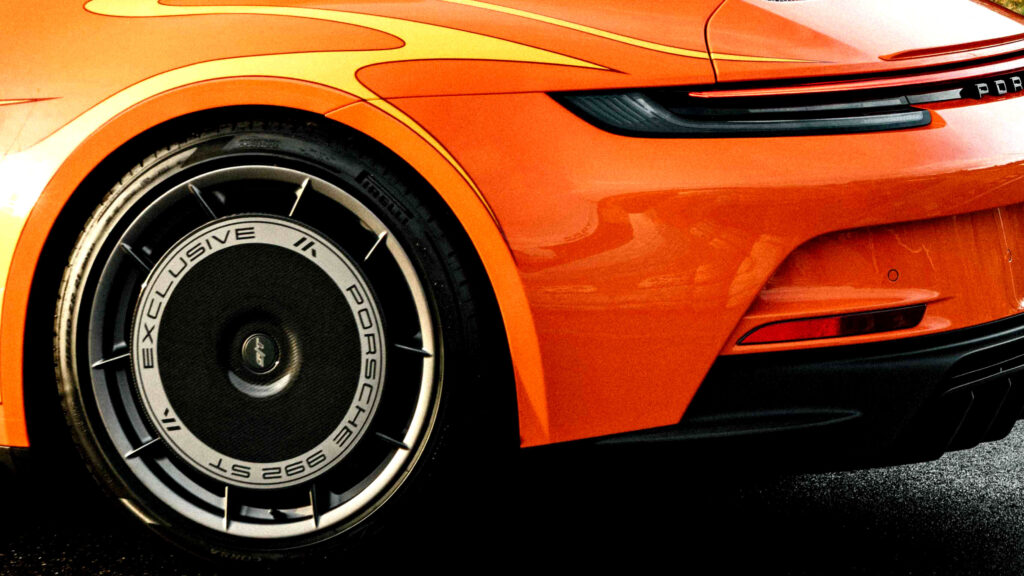
Instead, the car features a smooth graphic pattern that blends Phoenix Red with Signal Yellow, stretching across the hood and along the sides. The car is also equipped with rear aerodynamic discs developed by Manthey Racing for the 911 GT3 RS. Since they are not officially approved for the S/T, they have to be removed every time the car is driven on public roads.
Moving to the interior, the unique details continue inside. The seat headrests feature an intricate embroidered composition outlining the contours of the tracks at Sebring, Daytona, Indianapolis, and Lime Rock Park, alongside the iconic yellow Camel logo. The camel motif also appears on the center console lid and on the projection lamps illuminating the door sills.
Porsche does not disclose how much this level of personalization costs. But if you have to ask, the Sonderwunsch program is probably not for you.
This project perfectly demonstrates how modern technology and manufacturer craftsmanship can bring history to life, creating not just a car, but a moving artifact. Referencing the past through color, details, and symbolism, but using the most modern materials and techniques, makes such cars a bridge between eras. They become not only a means of transportation but also a piece of art that tells a story, while preserving all the advantages and thrill of a modern sports car. Such initiatives highlight the importance of cultural and historical context in automotive design, showing that heritage can be a powerful source of inspiration for innovation.