 by
by Track Testing
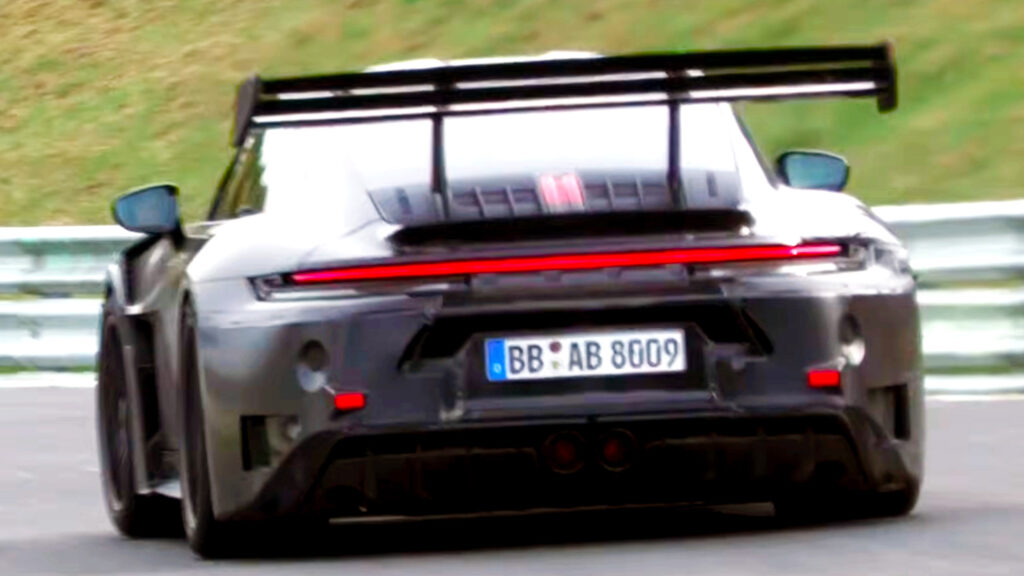
It is believed that Porsche is simultaneously testing the updated 911 GT3 RS and an all-new GT2 RS, each occupying the top of the sports lineup as the most race-oriented version of the 911. That’s why such footage from the Nürburgring generates so much interest. It’s hard to say for sure which model we are seeing, but regardless, the car looks incredibly focused and fast.
Prototype Details
This prototype looks the same as the one we saw during winter testing in January and is equipped with many panels from the current GT3 RS. Among them are the familiar rear wing with DRS system, aerodynamic fins along the sides, and the same hood.
One of the most interesting details is located at the rear. Like the current GT3 RS, it has two centrally positioned exhaust tips and a large diffuser. However, upon closer inspection, two additional exhaust outlets can be seen inside the diffuser, which are not present on the existing model. Combined with the characteristic front bumper, this detail may indicate that what we see is not an updated GT3 RS, but an early prototype of the future GT2 RS.
The Engine Question
The most important clue in the video is the sound of the engine. It is clearly devoid of the sharpness characteristic of the 4.0-liter naturally aspirated flat-six engine that defines the GT3 and GT3 RS. Instead, the sound is more muted, which has led to speculation about the use of a turbocharged flat-six engine. Such a configuration is more fitting for a GT2 RS than a GT3 RS.
If this is the case, then perhaps Porsche is testing a new engine installed on a GT3 RS chassis, with no intention of selling it in a GT3 version. It is also unlikely that the updated GT3 RS will make a radical switch to a turbocharged engine, especially considering that the 992.2 generation GT3 retains the 4.0-liter naturally aspirated flat-six engine and has undergone minimal changes.
Developing new high-performance versions is always a balancing act between tradition and innovation. Porsche has long preserved naturally aspirated engines for the GT3 lineup as a sacred cow, while the GT2 has traditionally received turbocharging for incredible power. Using body panels from one model to test the technical components of another is a classic practice among automakers to conceal the final design. The sound of the engine on the track often becomes the most reliable indicator of future technical solutions, even if the car is visually disguised as a known model.