 by
by Skoda electric crossover beats legendary 80s supercars in drag racing
Those who grew up in the 80s now live in a completely different world. Back then, no one would have believed that iconic Ferrari and Lamborghini cars would one day lose to a family SUV. Technology is constantly improving acceleration figures, and the latest proof of this is an experiment organized by Skoda, the budget brand of the VW group.
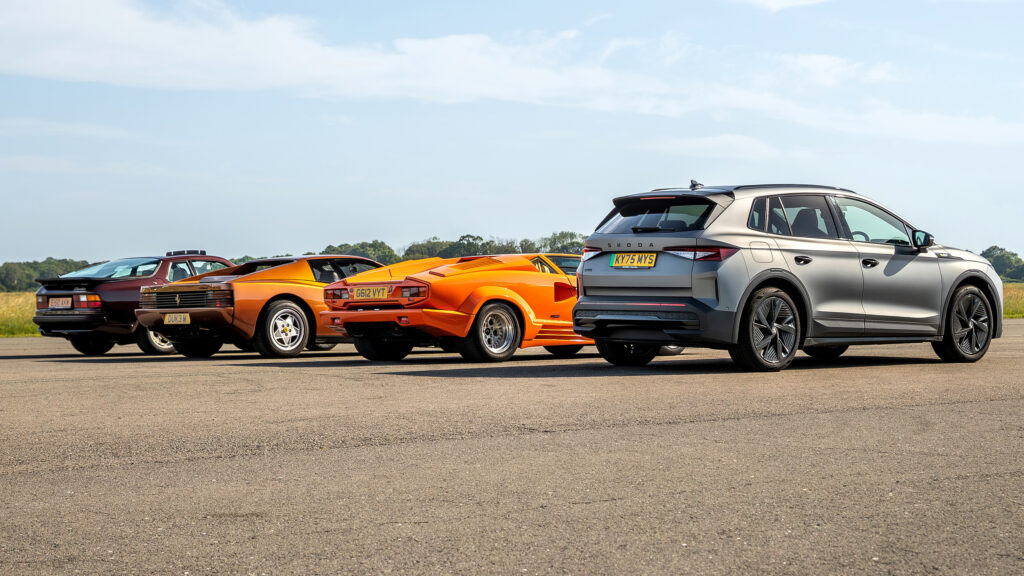
The automaker took its fastest production model, the Skoda Elroq vRS, and pitted it against some of the most famous sports cars and supercars of the 80s for a straight-line race. The rivals were a brown Ferrari Testarossa, an orange Lamborghini Countach 25th Anniversary, and a burgundy Porsche 944 Turbo.
Review: 2026 Skoda Elroq — right decisions in the complex and mistakes in the simple
In their day, these cars were the undisputed kings of the road. However, nostalgia for internal combustion engines cannot compare with the instant torque of modern electric vehicles, and the crossover won the drag race by a wide margin, leaving the legends behind.
A careful viewing of the video gives an idea of the results of the four cars on the Dunsfold track. It is unknown how carefully the drivers handled the clutches of these valuable classic models, but the finishing order reflects their real starting dynamics quite well.
More: 9,000-pound camera truck overtook Ferrari and Ford GT as if they were standing still
The Skoda Elroq vRS crossed the finish line in 19.19 seconds, followed by the Ferrari in 20.08 seconds, the Lamborghini in 21.22 seconds, and the Porsche in 22.10 seconds.
Although this drag race had a clear winner, it is worth noting that all three classic cars would easily beat the electric vehicle over a longer distance. Skoda limits the Elroq’s top speed to 111 mph (179 km/h), which is significantly lower than the Porsche’s 162 mph (261 km/h), the Ferrari’s 180 mph (290 km/h), and the Lamborghini’s 188 mph (303 km/h).
Technical specifications and practicality
In any case, the flagship version of the family electric vehicle with a dual-motor all-wheel drive delivers 335 hp (250 kW / 340 PS), allowing it to accelerate to 100 km/h in 5.4 seconds. For comparison, the 5.2-liter V12 Lamborghini produced 449 hp (335 kW / 455 PS), the 4.9-liter flat-12 engine of the Ferrari — 385 hp (287 kW / 390 PS), and the turbocharged 2.5-liter four-cylinder Porsche engine — 247 hp (184 kW / 250 PS) when it left the factory.
More: Skoda Peaq debuts as a three-row flagship electric vehicle with a range of 402 miles
Another advantage of the Skoda Elroq vRS over the classic models is the spacious five-seat cabin and a roomy trunk with a volume of 470 liters (16.6 cubic feet), making it significantly more practical for daily use combined with the standard Dynamic Chassis Control system. Despite its larger body, it is also significantly more aerodynamic than the wedge-shaped supercars, with a drag coefficient of 0.26 cd.
Emotions and subjectivity
Performance is one thing, but a quiet electric drive cannot compare to the glorious sound of the 12-cylinder engines of the past. Additionally, appearance may be subjective, but we seriously doubt that anyone would choose a Skoda over a Ferrari, Lamborghini, or Porsche in a beauty contest.
Ultimately, it is interesting to know that a modern family SUV can outpace the coolest supercars of the 80s. In fact, if you drive a Tesla Model Y Performance, you can likely outperform supercars from the 2000s. But which car would you want in your garage?
This Skoda experiment clearly demonstrates how technological progress has changed perceptions of speed. Although electric vehicles like the Elroq vRS can impress with their dynamics on short distances, they still fall short of classic supercars in top speed and, more importantly, in the emotional pleasure of driving. The choice between the practicality and performance of a modern car and the spirit and sound of legendary machines of the past remains purely personal.