
 by
Waymo has temporarily suspended commercial rides on highways in the US. The reason was problems with how driverless cars respond to construction zones and emergency vehicles. After several high-profile incidents in California, the company announced the suspension of commercial operations on freeways across the country. This situation, as well as the slower-than-expected rollout of Tesla’s robotaxi service, demonstrates how difficult it is to achieve flawless operation of such technologies.
Ban in California after two incidents
Earlier this week, the California Department of Motor Vehicles (DMV) banned Waymo robotaxis from operating on highways in the state. The decision was made after two notable cases that drew public and regulatory attention.
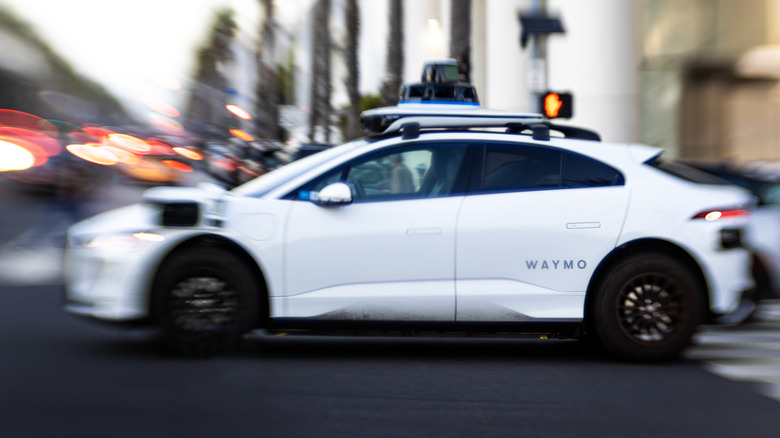
On November 6, a video appeared showing a white Waymo Jaguar I-Pace trying to overtake two police cars on a San Francisco freeway. To stop the driverless car, law enforcement officers had to sharply swerve their vehicles in front of it. The day before, three Waymo robotaxis drove into a construction zone. It was these cases that became the basis for the regulator’s decision.
“The Department has concluded that Waymo’s driverless trips on highways pose an immediate threat to public safety due to repeated entries by vehicles into active construction zones where workers, equipment, and machinery are present,” said California DMV spokesperson Jonathan Groveman, according to AP News.
It is currently unknown whether paying passengers were in these cars at the time of the incidents. Waymo continues testing on highways, but now trained human specialists must be behind the wheel. The company’s service continues to operate on city streets, including in Denver, Las Vegas, and Dallas.
Floods also became a serious test for robotaxis
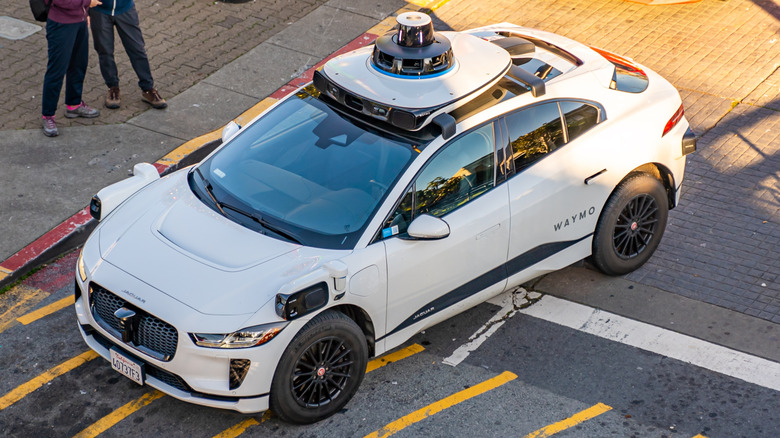
Waymo’s problems are not limited to construction zones and police cars. Earlier this week, heavy rains hit the San Francisco Bay Area, causing flash flooding across the city. A video was circulated on social media showing one Waymo I-Pace stopping in the middle of a flooded road. In another recording, a Zeekr-built robotaxi got stuck at an intersection. Due to the high water level, Waymo temporarily suspended service until conditions improved.
These are not Waymo’s first difficulties related to floods. Since the beginning of the year, the company’s robotaxis have encountered similar situations. In May, a Waymo vehicle drove onto a flooded road in Atlanta and got stuck. In April, another robotaxi in San Antonio, Texas, was swept into a stream after it entered a flooded area. This led to the recall of almost 4,000 robotaxis across the United States. Obviously, the company’s vehicles still cannot always act correctly during sudden floods.
What this means for the further development of robotaxis
The situation shows that even leaders in the autonomous transport market face limits that are not always visible during ordinary city tests. Construction zones are especially difficult for driverless cars, because they change quickly, have temporary signs, machinery, workers, and non-standard traffic trajectories. Police cars and emergency vehicles also require instant and unambiguous recognition, yielding on the road, and predictable behavior. If the system is not confident in a situation, it must either stop safely or act as cautiously as possible, but on a high-speed freeway even a few seconds of delay can have serious consequences.
Floods add another level of complexity. Water hides depth, road markings, and road boundaries, and reflections on the surface can confuse sensors. For robotaxis, this means the need to improve not only cameras and lidars but also decision-making logic: it is better to cancel a trip or stop than to risk the lives of passengers and pedestrians. At the same time, suspending commercial operations on freeways does not mean a complete halt to Waymo’s business. The company retains its city service and continues testing with people behind the wheel, which gives it time to collect data and refine its systems.
For the industry as a whole, this is a signal that scaling robotaxis depends not only on technological progress but also on the trust of regulators and the public. Every public incident increases pressure on companies and can lead to new restrictions. That is why Waymo, Tesla, and other developers are forced to combine ambitious plans with a more cautious approach: expand geography gradually, work through complex scenarios, and respond quickly to recalls and software updates. The story of the suspension of highway operations shows that autonomous cars are already capable of performing many routine tasks, but it is atypical situations that remain the main barrier to a full and safe nationwide launch of the service.