 by
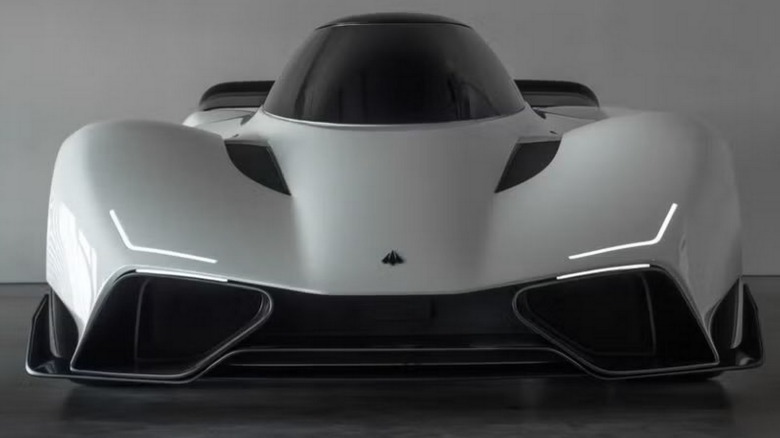
This supercar is not for those looking for ordinary sensations. The Dutch company Sanrivatti has shown the first images and details of its One model. At first glance, it is another exotic car with a familiar set of promises: advanced engineering, high power and a track focus. But the One stands out not only for its design or engine, but also for the very layout of the cabin. Instead of a traditional cockpit, there is a single seat for the driver, with the person positioned headfirst in a way that resembles a motorcyclist more than the driver of an ordinary supercar.
Non-standard layout
Sanrivatti positions the One as a machine created primarily for the track. This means the manufacturer is not obliged to adapt the design to all the requirements that apply to road cars. That is why the engineers could afford to rethink the driver’s position and overall ergonomics more boldly. According to the company’s founder, Santiago Sanchez, he wanted to bring into the car that feeling of unity with the machine that a motorcyclist experiences while riding.
In the One, the driver essentially straddles the seat, lies on his chest and reaches with his hands to the steering wheel. Such a scheme looks unusual even for the world of supercars. Similar ideas had previously appeared in the Chevrolet and McLaren Vision Gran Turismo concepts, so the idea itself is not entirely new. However, Sanrivatti insists that the One could become the first production car offered with such a radical solution for the driver.
Exterior and track purpose
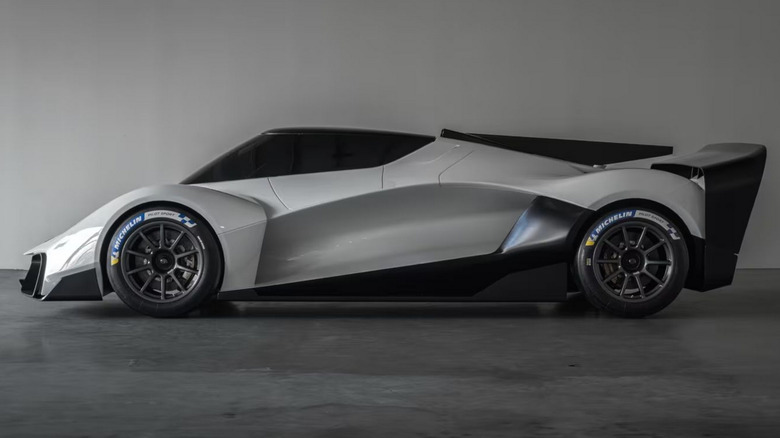
Visually, the One meets expectations for an exotic supercar created by a small company. It has a low nose, aggressive aerodynamics, prototype-inspired elements, a shark fin, a large rear wing and a diffuser. This entire construction is subordinated to speed and on-track behavior, not comfort for daily driving. The car should look like a machine born for the track, and this explains the freedom in packaging that an ordinary road model could not afford.
Driver position
The main feature of the One is not just a single-seat cabin, but the very principle of control. The driver is positioned not as in most racing cars, but almost horizontally, face forward. The arms are stretched out to the steering wheel, and the body resembles a person’s position on a motorcycle. For a small company, this is a bold step, because such a solution affects safety, visibility, seating and emergency exit from the car. At the same time, it is precisely this scheme that should create a feeling of direct connection between the driver and the machine.
Powertrain
Despite the unusual layout, the power unit of the One promises to be quite traditional for the world of high-performance cars. Sanrivatti plans to use a naturally aspirated 5.5-liter V10 from the British racing company Judd. This manufacturer already has experience creating loud and powerful engines: it developed the 5.2-liter V10 for the limited-series McLaren Solus GT. So cooperation with Judd should add technical credibility to the project.
According to preliminary data, the 5.5-liter engine will produce about 800 hp and 700 Nm of torque. It will work with a six-speed sequential Hewland gearbox, and drive will be sent to the rear wheels. Thanks to lightweight materials, the car’s dry weight is planned to be kept at around 1,100 kg. Sanrivatti promises a top speed of 330 km/h, although there is no precise acceleration data yet.
Challenges of series production
Showing one full-size mock-up and promising extreme performance is only the beginning. It is far more difficult to establish production of a car that is so radical in design. History knows many cases when high-profile supercar concepts appeared with ambitious claims and then disappeared without ever reaching customers. Sanrivatti will have to find serious financing, prove the reliability of the design and convince buyers that such an unusual car will be not only spectacular but also suitable for real track use.
In addition, the One will require very bold customers. This is a car for people who are ready to accept an unusual driving position, limited comfort and a high price for the sake of a unique experience. For a small manufacturer, this means a narrow niche, but it is precisely such a niche that can become its advantage. If Sanrivatti manages to bring the project to series production, the One will have a chance to be remembered not simply as another supercar, but as a car that truly changed ideas about the driver’s position.
What stands behind the project
The material reveals a certain discrepancy: the original subheading mentions a 5.5-liter V8, while the main text refers to a V10. For assessing the project, what matters more is that Sanrivatti is betting on a naturally aspirated Judd engine and a track concept, rather than a mass-market road car. This approach gives engineers more freedom, but at the same time narrows the circle of potential buyers.
A radical driver’s position is not just a design gesture. It poses a number of practical questions for the designers: how to ensure safety, visibility, ventilation, ease of control and rapid evacuation. If these questions can be convincingly resolved, the One could become an interesting experiment in the world of extreme track machines. If not, the project risks remaining a bright promise, of which there have already been many in the small supercar segment.