
 by
Genesis bets on EREV to ease buyer concerns
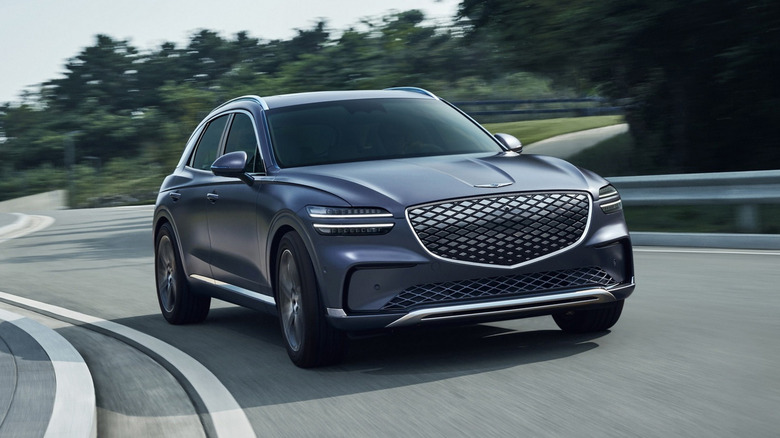
Demand for purely electric vehicles in the U.S. has cooled noticeably, and Genesis has decided to respond with a new strategy: luxury EVs with extended range, where a gasoline engine works as an auxiliary power source. This approach should remove two main barriers for EV buyers — charging anxiety and the fear that range will not be enough when needed.
For the American market, these two factors have indeed become a serious brake on EV adoption. Genesis hopes that the new model with EREV technology will help overcome both limitations. If all goes according to plan, such a vehicle could reach the market earlier than Scout Motors models. According to Hyundai’s current product roadmap, the new Genesis EREV SUV should appear in the first half of 2027. Some details about this vehicle were revealed by the company during a roundtable at the Los Angeles Auto Show, which CarScoops also attended.
Much remains unknown: what exactly the model will be called, what it will look like, and how much it will cost. However, one thing is already clear — Genesis wants to achieve a total range of 640 miles, or approximately 1,030 km. While the company does not name a final U.S. delivery date, Genesis head of product planning Ash Corson gave journalists a few clues worth considering. Below is what is already known about the EREV, which could well hit the roads long before Scout.
What is known
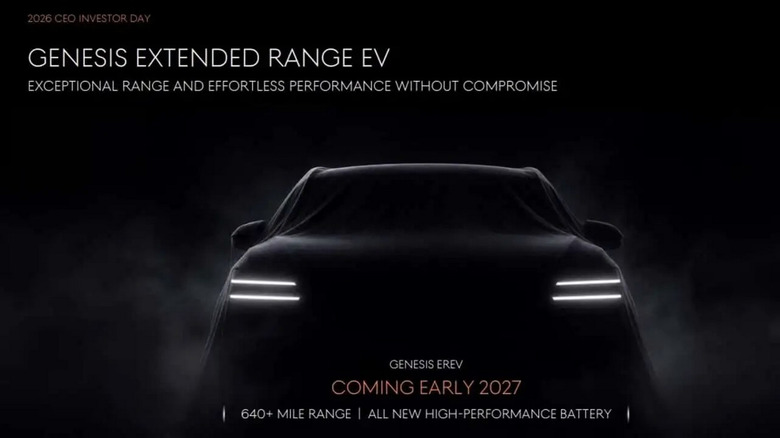
Both Genesis and Hyundai plan to launch EREV models in early 2027. In Hyundai’s case, it will be the Santa Fe, and such a launch will be part of the company’s Alabama plant expansion. Genesis has not yet revealed the name of its future EREV, but it has shown a teaser image. It cannot be stated with 100 percent certainty, but in the photo the vehicle looks very much like the GV70. The brand previously said it did not rule out creating a GV90 EREV, but that model is expected to debut next year only as an EV. It is also important that Genesis mentioned a D-segment SUV as a future EREV product, and this could be either the GV70 or the GV80.
Hyundai openly says that its EREV platform will use less than half the battery capacity compared with a conventional EV. Despite the smaller battery, the company expects a total range of more than 640 miles. According to the manufacturer, this will be achieved in part thanks to new battery cells of its own development, which should provide enough power for dynamics comparable to conventional EVs.
Ash Corson explained that the advantage of an EREV is that such a vehicle becomes more accessible to people who want an electrified car but do not have the ability to charge at home or do not drive short distances every day, which would make a conventional EV more practical for them.
“Some people have a garage, and that’s great, because you can charge an EV there. It’s a wonderful experience. Many people do not have that opportunity. Some live in more rural areas where distances between filling stations — whether chargers or gas stations — are longer. So I think the key is to give the customer a choice of powertrain that suits them.”
This is how Corson outlined the logic of the new strategy: EREV is not trying to force all buyers to switch to pure electric immediately, but offers a compromise for those who need flexibility. For Genesis, this is also important because the brand seeks to maintain appeal in the luxury segment, where buyers are especially sensitive to ease of use and the absence of restrictions during long trips.
What is an EREV?
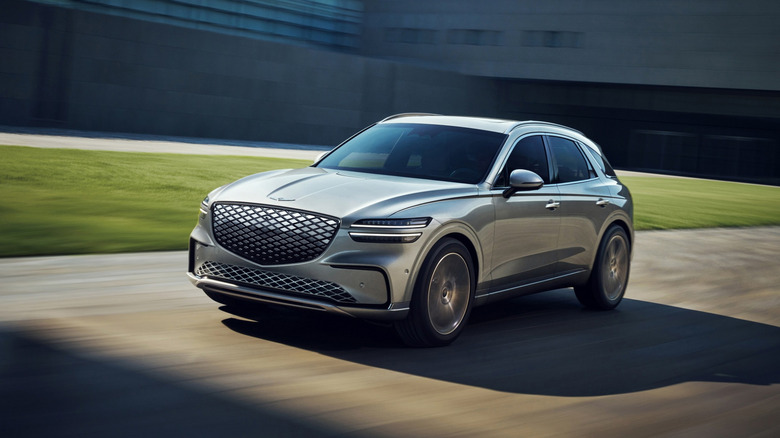
The basic idea here is quite simple. An extended-range EV, or EREV, remains essentially an electric vehicle. The owner can charge it just like any other EV — at home or at a public charging station. The difference is that the EREV platform additionally has a gasoline engine that turns on to increase range. Its only job is to charge the battery, so the gasoline engine does not drive the wheels. In effect, it is an onboard generator.
This is fundamentally important, because such a scheme effectively removes concerns about charging station availability and charging speed. Those who can conveniently charge at home, at work, or elsewhere are able to drive constantly in pure electric mode and not use fuel. Those who do not have that opportunity can fill up with gasoline and know that while driving the engine will charge the battery. Both groups of buyers also gain an advantage on long trips: a quick stop at a gas station is enough to continue the journey without a long wait at charging terminals.
What this could mean for future buyers
For Genesis, an EREV is a way not to abandon electrification but also not to require the customer to immediately change habits. In the luxury segment, buyers are often willing to pay for comfort and confidence, not compromises. Therefore, a model with a gasoline generator could become a transitional solution for those who want to get electric smoothness, cabin quietness, and modern technology, but are not yet ready to rely solely on charging infrastructure.
Competition also matters here. If Genesis truly brings the EREV to market in the first half of 2027, the brand could gain an advantage over Scout Motors and offer buyers an alternative before competitors’ corresponding models become mainstream. At the same time, much will depend on price, real-world specifications, fuel consumption in generator mode, and how conveniently the vehicle operates in pure electric mode.
Another important aspect is positioning within the Hyundai Group. EREV technology is to become a shared platform used by different brands of the group. For Genesis, this is a chance to preserve its own identity as a luxury brand while using Hyundai’s engineering developments. If the company can combine a smaller battery, significant range, and the freedom of refueling with gasoline that buyers are accustomed to, the EREV could become not a temporary compromise but a quite practical solution for the transition period in the EV market.