


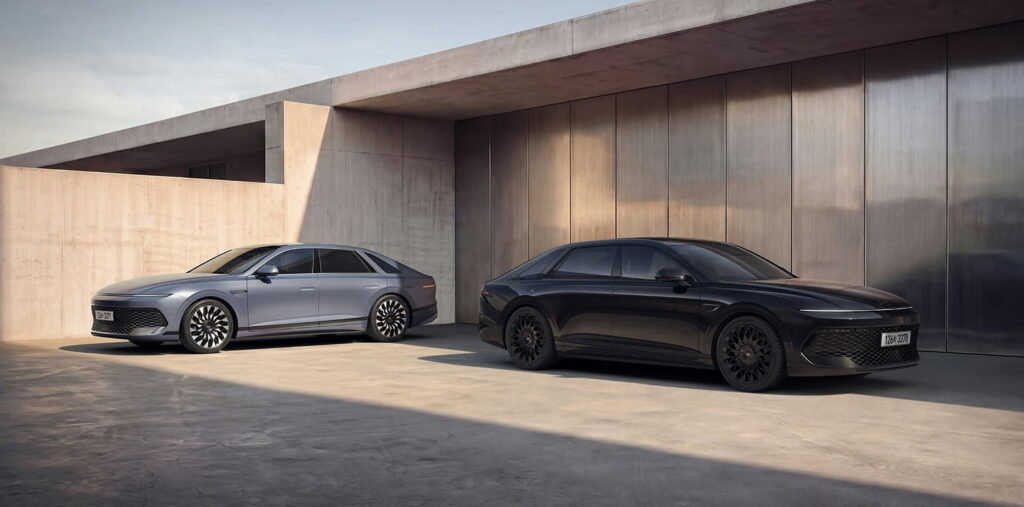
Hyundai Introduces Updated 2027 Grandeur in South Korea
Hyundai has introduced an updated version of the seventh-generation Grandeur in South Korea. This update marks the model’s 40th anniversary. The flagship sedan has received moderate exterior changes and a completely redesigned interior, bringing it closer to Genesis level.
Americans last saw this model under the name Azera before Hyundai discontinued sales of large sedans in that market. In Korea, the Grandeur remains an iconic vehicle. The current model debuted in November 2022 and has since been Korea’s best-selling sedan and the second most popular car after the Sorento.
Exterior Changes
The most noticeable change is the new “Shark Nose” front end, which looks cleaner. The full-width LED strip has become thinner, the main headlights have shrunk significantly, and the radiator grille and air intakes are combined into a single unit with generous chrome trim.
The car’s profile remains almost unchanged, but Hyundai has added new alloy wheel options and a fresh Artistic Burgundy color with a gloss or matte finish. The rear also looks familiar, but upon closer inspection, updates are noticeable: the turn signals, previously located on the rear bumper, are now integrated into the LED strip. There is also thinner black plastic on the bumper and new chrome accents around the diffuser.
In terms of dimensions, the Grandeur now has a length of 5,050 mm, which is 15 mm longer than its predecessor.
Interior Updates
The centerpiece of the interior is a 17-inch touchscreen, which replaces the previous 12.3-inch infotainment display and a separate 10.25-inch climate control panel. It runs on Hyundai’s new Pleos Connect software, built on Android, which supports third-party apps and the Gleo AI voice assistant. A thinner digital instrument cluster is placed further on the dashboard along with a head-up display.
Although the center console has physical buttons for essential functions, Hyundai has introduced electric ventilation vents, whose direction and airflow intensity are controlled via the touchscreen. This solution was chosen primarily for style, as the vents are now hidden in the redesigned dashboard.
The 2027 Grandeur also features a “Smart Vision Roof”, which can switch between opaque and transparent states, and an Active Load Noise Control system for quieter driving. Depending on the trim, equipment may include “Ergo Motion” seats for the driver, rear seats with recline and ventilation functions, tri-zone climate control, a Bose audio system, and a built-in air purifier on the seatback.
Creating a premium and cozy atmosphere are quilted upholstery, a “sofa pattern” on door cards, wood inserts, Nappa leather, metal accents, and ambient lighting.
Technical Improvements
Although this is only a mid-lifecycle update, Hyundai engineers claim the Grandeur has received significant improvements in hybrid system efficiency, handling, and rear passenger comfort.
The platform has become stiffer thanks to a thicker cross member, reinforced front struts, and hydraulic rebound stops in the suspension.
The Preview Electronic Control Suspension system, which adjusts damping based on camera data, is now available for versions with 19- and 20-inch wheels. This is complemented by a new Highway Body Motion Control system that suppresses vertical movements during acceleration and braking. The updated exterior has become more aerodynamic, contributing to reduced wind noise.
Engines
The self-charging hybrid powertrain has been upgraded for better performance and efficiency. It consists of a turbocharged 1.6-liter gasoline engine, a starter, and an electric motor, providing a total output of 237 hp.
The traditional 2.5-liter GDI gasoline engine remains the entry-level option in the Grandeur lineup, producing 195 hp. Finally, the flagship 3.5-liter V6 continues to offer 296 hp and is available with the HTRAC all-wheel drive system.
Prices
The updated Hyundai Grandeur is already available for order in South Korea. The price starts at 41,850,000 won (approximately $28,100), which is 3,870,000 won ($2,600) more than its predecessor. In the top Black Ink trim with all-wheel drive and the V6, the price reaches 64 million won ($42,900), surpassing the cost of the entry-level Genesis G80 in the domestic market.
American buyers would consider this a bargain. The base Grandeur in Korea costs about the same as the base Sonata ($27,450) in the U.S., even though it is a full class higher.
Interestingly, by updating its flagship sedan, Hyundai is deliberately bringing it closer to the premium Genesis brand, which may indicate a strategy of gradually elevating the model’s status. At the same time, the significant price increase for the base version may be justified by the substantial interior and technology upgrades, which now offer a level of comfort and features previously available only in more expensive cars. For the U.S. market, where large sedans have given way to crossovers, the Grandeur remains an interesting example of how a manufacturer can evolve a traditional format, making it more technological and luxurious.