 by
by Legendary Concept
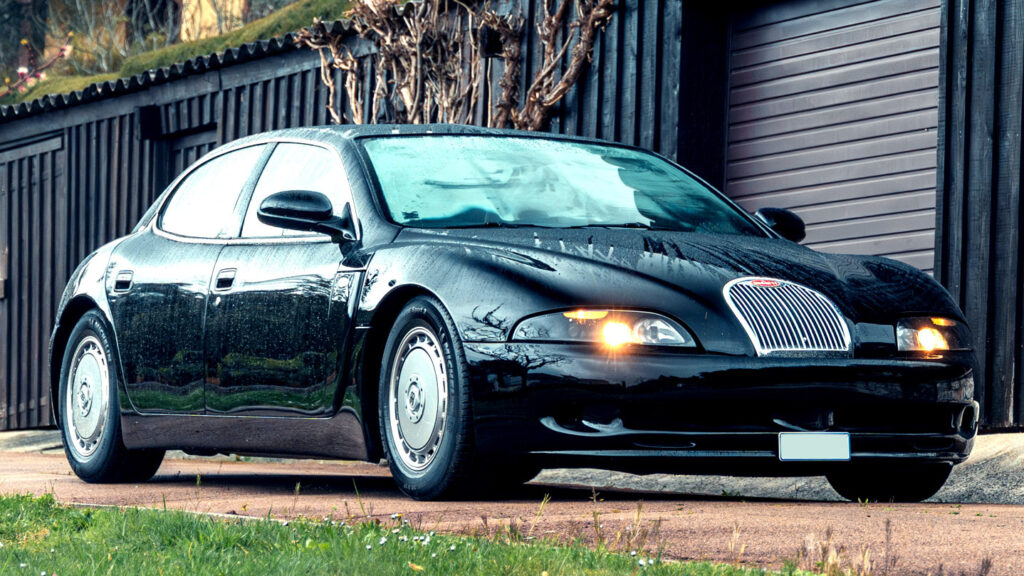
A few years after the EB 110 appeared and long before the Veyron, Bugatti tried its hand at creating a four-door concept called the EB 112. It emerged at a time when the brand was still redefining itself. Giorgetto Giugiaro was commissioned for its design, seemingly without a real intention to put it into series production. The result became something of a mythical car, and now one of only three built examples could become yours.
Italian Brand Revival
The EB 112 has its roots in the Italian revival of Bugatti under Romano Artioli, who purchased the brand in 1987 and aimed to create both a supercar and a luxury sedan. This model was intended to be the sedan, drawing inspiration from Bugatti models of the 1930s. Artioli founded Bugatti Automobili SpA in 1989 and built a specialized factory in Campogalliano, Italy, to bring these ideas to life.
Bugatti almost made this sedan with a W16 engine its only model.
Just a couple of years after the EB 112 was unveiled in 1993, Bugatti declared bankruptcy. However, many of the company’s assets were sold, including three unfinished EB 112 examples. They were purchased by Gildo Pallanca Pastor, who tasked his firm, Monaco Racing Team, with completing the construction and selling the cars.
Initially, there was only one working prototype and two non-functional design models. Through Pastor’s efforts, all three were transformed into fully functional road cars.
Simon Gosselin/RM Sotheby’s
Auction Specimen
This particular example remained in Pastor’s ownership until his death in 2015. It is still registered in Monaco and has covered only 388 km since production. The auction house RM Sotheby’s will offer it for sale during its Monaco auction at the end of this month, where it is expected to sell for between $1.75 and $2.3 million. The car comes with custom luggage and a special umbrella styled after Rembrandt Bugatti’s elephant sculpture.
Exotic V12 Power
The EB 112 is built on the same carbon chassis as the EB 110 but uses a naturally aspirated 6.0-liter V12 engine instead of the EB 110’s quad-turbo 3.5-liter unit. The engine is located behind the front axle, and the all-wheel-drive system uses a 38:62 torque split. It is believed to produce 456 hp and 590 Nm of torque. A six-speed manual gearbox sends power to all four wheels.
Period data indicates a 0-100 km/h acceleration time of 4.3 seconds and a top speed of 300 km/h. It was a true high-performance luxury supersedan, unlike any other available at the time.
Simon Gosselin/RM Sotheby’s
Luxury Interior
A look inside the cabin shows that most surfaces are upholstered in high-quality black leather with matte metal accents on the door panels, dashboard, and parts of the center console. The EB 112 was built as a strict four-seater, with a small television unit located in the center of the second-row seats.
Bugatti almost built a four-door heavyweight with a V12 engine, and then simply… didn’t, which somehow makes this example even cooler. It is equally an unrealized opportunity and a moving artifact.
Simon Gosselin/RM Sotheby’s
The history of the EB 112 is a vivid example of how ambitious projects can fall victim to economic circumstances, leaving behind only a few unique artifacts. This car not only showcases Bugatti’s technical capabilities of the late 20th century but also embodies a certain philosophy—the desire to combine the incompatible: the extreme performance of a supercar with the comfort and space of a premium sedan. Its appearance at auction is a rare opportunity to acquire not just a vintage car, but a fragment of the alternative history of one of the most iconic automotive brands, a history that could have taken a completely different path.