


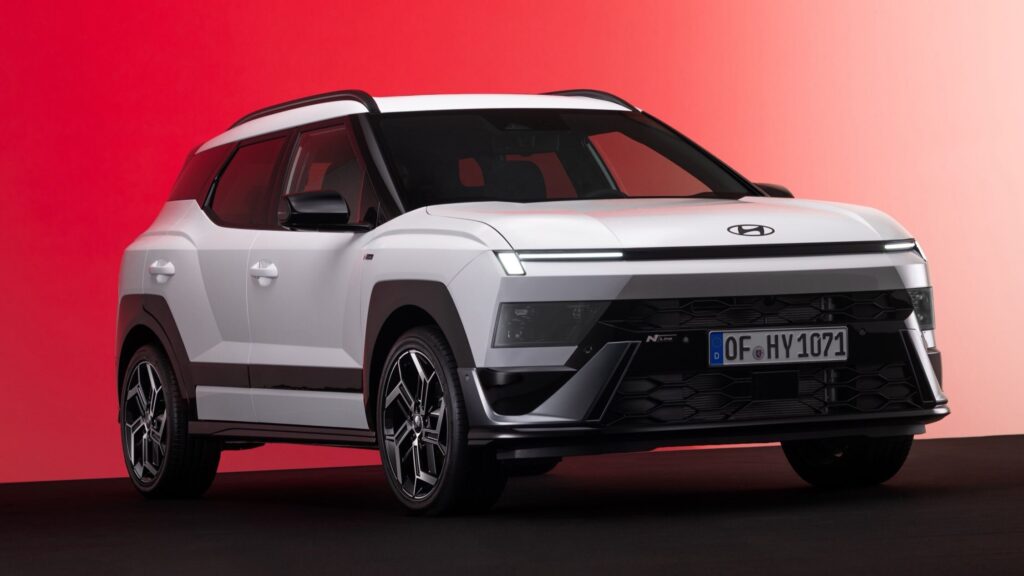
Hyundai Bayon changes the rules of the game
The world is full of small crossovers that quickly fade from memory, but the Hyundai Bayon no longer wants to be among them. The younger brother of the Kona debuted back in 2021, and at this year’s Paris Motor Show Hyundai showed its completely new generation. This model has clearly aimed to finally create serious competition for the Ford Puma.
The main weapon of the newcomer is a radical change in design, which should correct the predecessor’s main drawback: a lack of expressiveness on the road. Hyundai tried to make the original Bayon more masculine with the 2024 update, but the new generation has gone much further. It has received a completely new exterior inspired by the Art of Steel design language, which also shapes the current Tucson presented earlier this year.
Tucson-style design
The Tucson influence is clearly visible in the distinctive hockey-stick-shaped daytime running lights, the raised bonnet line, the squared wheel-arch extensions and the large model-name lettering beneath the Hyundai badge on the tailgate. If you choose the N Line trim, which is now available for the first time, the buyer gets a sporty body kit, 18-inch alloy wheels, twin exhaust outlets and special N interior details, including red stitching and metal pedals.
Larger outside and more practical inside
Thanks to these more rugged exterior changes, the Bayon looks significantly larger than its predecessor. Inside it should also feel roomier, as the wheelbase has been increased by 20 mm to 2600 mm. It is a small but pleasant step forward. Two 12.3-inch screens are optionally available, along with options usually found in higher-class cars: surround-view cameras, ventilated seats and a panoramic roof.
Hyundai Digital Key 2 is also offered, allowing the car to be unlocked and started using a smartphone, along with a premium Bose audio system. It is nice that a normal block of physical buttons has been retained on the centre console. True, the climate-control buttons here are touch-sensitive, and it looks as if they will not be very convenient to use. Even worse, the Bayon appears not to have received Hyundai’s new Pleos operating system.
SUV looks without all-wheel drive
The newcomer also does not have an all-wheel-drive option. All Bayons are front-wheel drive, so do not be confused by its off-road image. The base engine is a 1.0-litre four-cylinder T-GDI producing 89 hp. It works either with a six-speed manual gearbox or with a seven-speed dual-clutch automatic. You can move up to the version of the same engine with 114 hp and the same transmission options, and many will probably do so. Acceleration from 0 to 100 km/h drops from a rather slow 14.1 seconds to a more acceptable 10.8 seconds.
A true hybrid for the first time
But the biggest change is the arrival of a true hybrid for the first time in the model’s history. The 1.6-litre HEV version is known to produce 136 hp, is equipped only with a six-speed dual-clutch automated gearbox, and the intensity of brake energy recuperation can be adjusted with steering-wheel paddles. Hyundai confirms that the hybrid hardware reduces boot volume, but kerb weight and dynamic performance have not yet been announced.
When it will appear and where it will be sold
The Bayon will appear at Hyundai’s European dealers in early 2027. At the same time, it will again be unavailable in the USA, where the Kona remains Hyundai’s smallest model.
What this means for the small crossover segment
For Europe, the new Bayon could become a more serious rival to the Ford Puma, Renault Captur, Volkswagen T-Cross and other compact crossovers. Hyundai is clearly betting on expressive design, greater visual scale and technologies that were previously available mainly in more expensive models. The arrival of the hybrid is especially important, as buyers in this class are increasingly looking for economy without switching to a fully electric car.
At the same time, the lack of all-wheel drive and unimpressive base versions may limit the model’s appeal for some buyers. But if Hyundai keeps prices competitive, the Bayon has every chance of finally ceasing to be just another small SUV and becoming a noticeable player in its segment. Ukrainian buyers should probably keep an eye on the importer’s official plans: if the model reaches our market, it could interest those looking for a compact crossover with a hybrid powertrain and modern equipment.