


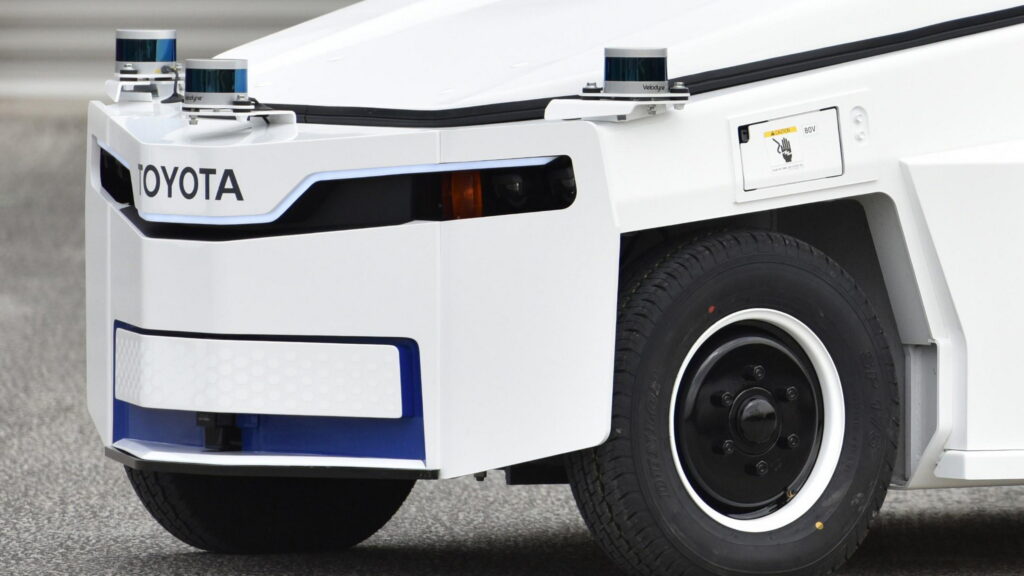
Japan’s busiest airport, Tokyo Haneda, has begun using state-of-the-art autonomous baggage tractors under the Toyota brand. These driverless vehicles are already in operation on the line.
Autonomous Driving Technologies
These vehicles are equipped with Level 4 autonomous driving technology. They independently determine their position in space and detect obstacles around them. In complex situations that may arise near runways, a remote monitoring system is in operation.
The project was announced back in the spring of 2021, and trial operation began in the autumn of the same year. Development was handled by Toyota Industries Corporation in collaboration with All Nippon Airways (ANA). For its design, the tractor received the iF Design Award in 2022.
Scale of Implementation
Since December 2025, three autonomous tractors have been servicing domestic flight operations. By the end of March 2026, three more such machines are planned to be added. This is the first practical application of Level 4 autonomous driving in a closed area of a Japanese airport. Demonstrations of Level 3 technologies have been conducted at regional airports since 2019.
The main task of these machines is to transport baggage and cargo containers from the terminal to aircraft and back.


Design and Equipment
The exterior of the production vehicles is similar to the early prototypes, but with minor changes to the front bumper and sills. The nose features the Toyota emblem, LED headlights, and a two-seat cabin. Numerous sensors, including lidar, are installed on the fenders, nose, and sides. This allows the tractor to scan the surrounding environment for safe movement.
Technical Specifications and Route
Details regarding the fully electric powertrain and batteries have not yet been disclosed. In autonomous mode, the maximum speed is limited to 15 km/h, and the load capacity is 13 tons. If a human is at the wheel, these figures increase to 25 km/h and 27 tons, respectively.
The main route between the terminal and the cargo hangar is approximately 1.5 kilometers, with two traffic lights located along the way.
Fleet Management
Toyota and ANA have also launched a new Fleet Management System (FMS). It is designed to issue transport instructions to multiple vehicles simultaneously, allocating departure and arrival lanes, and coordinating their movement with traffic lights.
The implementation of such technologies is a step towards full automation of airport logistics, which can significantly improve the efficiency and accuracy of operations. The speed limit in autonomous mode is dictated primarily by safety requirements in the semi-closed airport environment, where people and other equipment can be present simultaneously. The success of this project could become a model for similar initiatives at major transport hubs worldwide, demonstrating how autonomous systems can integrate into clearly structured, yet dynamic, workflows.