


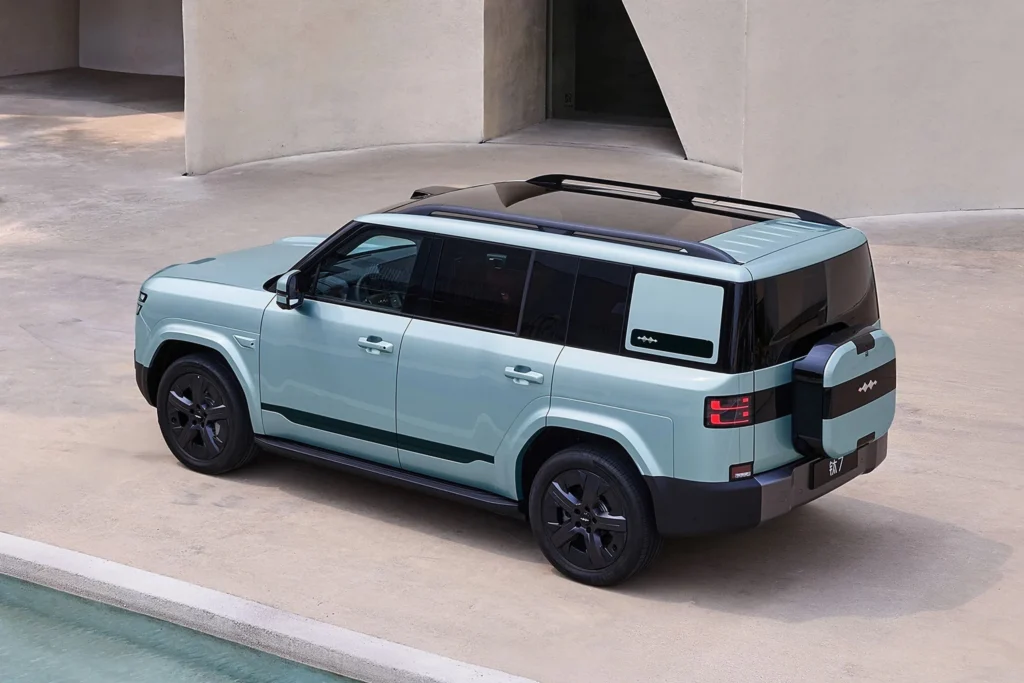
BYD Ti7: The new seven-seat SUV challenging the Land Rover Defender
It seems there is no segment of the automotive market that BYD is not trying to conquer. Their latest model, the Ti7, has become the company’s first seven-seat vehicle to venture beyond China. This new SUV is entering the global arena to compete with giants like the Toyota Land Cruiser and the Land Rover Defender 110.
Read: This Chinese SUV is a mix of Lexus, Land Rover, and a touch of G-Class
Unveiled last year in Thailand under the Fangchengbao brand, and later confirmed for release in the UK as a BYD model, the Ti7 looks very similar to the B5 and B8 models that Fangchengbao already sells in China. The key difference lies under the hood. Those two models feature a ladder frame construction, while the Ti7 is built on a unibody chassis, similar to the modern Land Rover Defender. This choice likely costs it some off-road credibility compared to the B5 and B8, but should improve on-road behavior.
Slightly larger than the Defender 110
The Ti7 measures 5,146 mm in length, 1,995 mm in width, and 1,865 mm in height, with a wheelbase of 2,920 mm. This makes it longer and slightly narrower than the Defender 110 — precisely the comparison BYD likely wants buyers to make.
When the model arrives in the UK, it will be the first vehicle from the Chinese brand equipped with the DM-p powertrain. It includes a turbocharged 1.5-liter engine, a pair of electric motors, and an LFP battery with a capacity of 35.6 kWh. Total output is expected to exceed 600 hp, with BYD claiming a 0-100 km/h time of 4.8 seconds and an electric-only range of up to 127 km.
The Chinese know how to make ‘rugged’ vehicles
In its home market, Fangchengbao also offers the Ti7 as a fully electric version, although Europe is not yet on the list for this variant. The Chinese electric version is available either as a rear-wheel drive with 402 hp or as an all-wheel drive dual-motor variant with 691 hp. Buyers there can choose between 92 kWh and 105.7 kWh batteries.
Visually, the Ti7 looks quite appealing. The front features narrow split LED headlights, small black air intakes, and a darkened bumper. It also has squared-off wheel arches, chunky mirrors and door handles, a panoramic glass roof, and a rear spare tire carrier on the tailgate.
The interior is reminiscent of other BYD family models: a large central infotainment screen, a digital instrument cluster, and a chunky four-spoke steering wheel. There are also two wireless phone chargers, plenty of soft leather, and ambient lighting.
Thus, the BYD Ti7 is positioned as a direct competitor to premium body-on-frame SUVs, but with an emphasis on comfort and technology thanks to its unibody platform. The launch in the UK and other countries signals the Chinese manufacturer’s serious intentions to establish itself in the large family vehicle segment, traditionally dominated by European and Japanese brands. The hybrid powertrain with a substantial electric range could be a significant advantage for those seeking a powerful and spacious vehicle with low emissions in the city.