


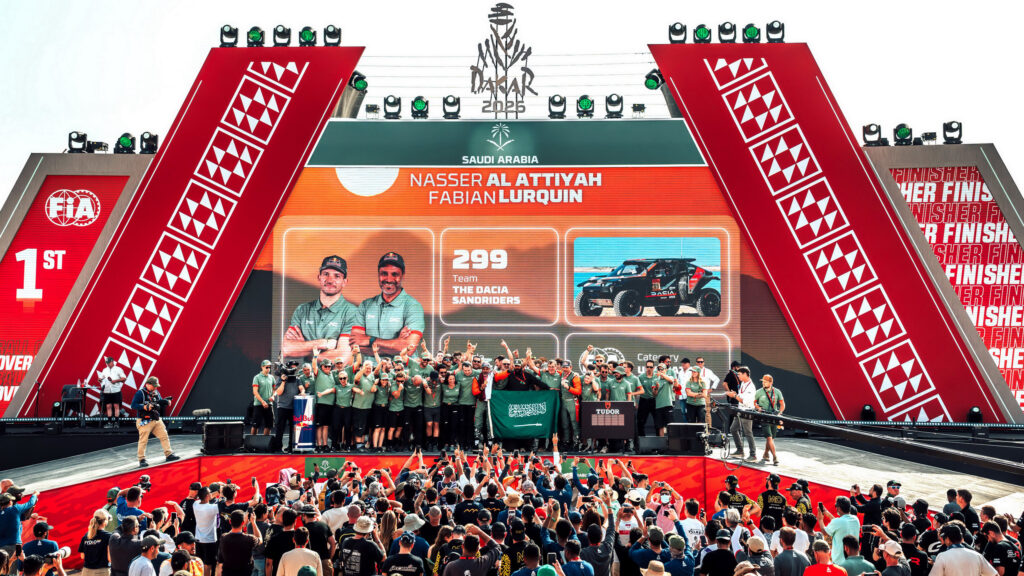
Dacia’s Victory at Dakar and Land Rover’s Success in the Production Class
The 48th Dakar rally raid has just concluded, and celebrating the victory from the top step of the podium is not Porsche, Audi, or another famous name in the world of motorsport. The overall victory was won by the brand Dacia, known for affordable cars, while Land Rover took first place in the production class with the competitive version of its Defender Octa.
After 13 grueling stages across Saudi Arabia, the Dacia Sandrider finished as the absolute winner. Qatari ace Nasser Al-Attiyah and co-driver Fabien Lurquin had a solid lead before the final day and navigated it cautiously, securing the victory with a margin of nine minutes and 42 seconds. For Al-Attiyah, this became his sixth Dakar win, and for Lurquin, his first career victory.
Tough Battle and Crew Consistency
Nearly 5,000 miles (8,000 km) of rocks, sand, dunes, and challenges separated the start from the finish. Dacia secured two stage wins and demonstrated impressive consistency, only once finishing outside the top three. Four Dacia cars finished in the top 11 of the overall standings, a result that experienced teams dream of.
Ford Raptors driven by Nani Roma and Matthias Ekström took second and third places, while Sébastien Loeb in his Sandrider narrowly missed the podium, finishing just 37 seconds behind third place after a furious final push.
Lucas Moraes on his debut with the team finished seventh, and Cristina Gutiérrez climbed to 11th position. For a brand better known for sensible hatchbacks, this achievement seems almost unreal.
Land Rover Defender’s Success in the Production Class
While Dacia celebrated the overall victory, Land Rover fans also had something to cheer about. In the Stock class, intended for cars close to production models, the Defender Rally team dominated from start to finish. Rokas Baciuška and Oriol Vidal won the class, Sara Price and Sean Berriman finished second, and Stéphane Peterhansel and Mika Metge took fourth place.


Throughout the event, the trio of Defender D7X‑Rs finished first, second, and third on 10 out of 13 stages. Unlike the purpose-built racing Dacia Sandrider, the Defenders begin life on the same assembly line as regular customer cars and retain the main body architecture and powertrain layout, although they are obviously modified to make them more suitable for Dakar than the production Octa.
These results could change the perception of the brands in the world of motorsport. The success of Dacia, which is only participating in Dakar for the second time, demonstrates that for victory, not only resources are important, but also effective teamwork and technical reliability. Land Rover’s victory in the production class underscores the strength and endurance of a production platform adapted for extreme conditions. Such events often become a catalyst for increased consumer interest in these brands, as success in the world’s toughest race serves as powerful proof of the quality and technical capabilities of the cars.