


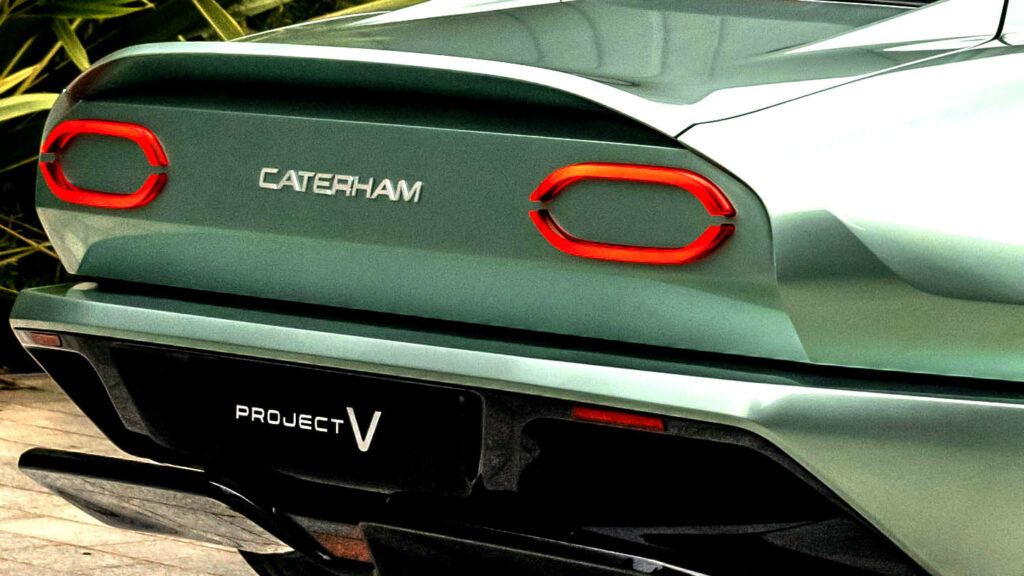
Preparation Stage for Production
It has been over two years since the presentation of the fully electric Caterham Project V concept, and now the project is approaching the serial production stage. The car is being showcased at the CES consumer electronics show in Las Vegas, and later this week a working prototype will debut at the Tokyo Auto Salon. For American sports car enthusiasts, there is another encouraging piece of news.
Serious Intentions for the US Market
Caterham has always been a niche brand outside of Europe, but that is set to change. During a presentation at CES, company representative Justin Gardiner confirmed plans to launch Project V in the US market, and this will not be a mere formality.
“We’ve ignored America as a market for 50 years, and that’s silly because you guys are all wealthy. We’re going to start taking America very seriously from this week. We plan to sell a lot of these cars here.”
Project V will be sold alongside the legendary Caterham Seven, but, according to Gardiner, the company must “secure its future,” preparing for the day when it can no longer produce the Seven.
Electric, but on Caterham’s Terms
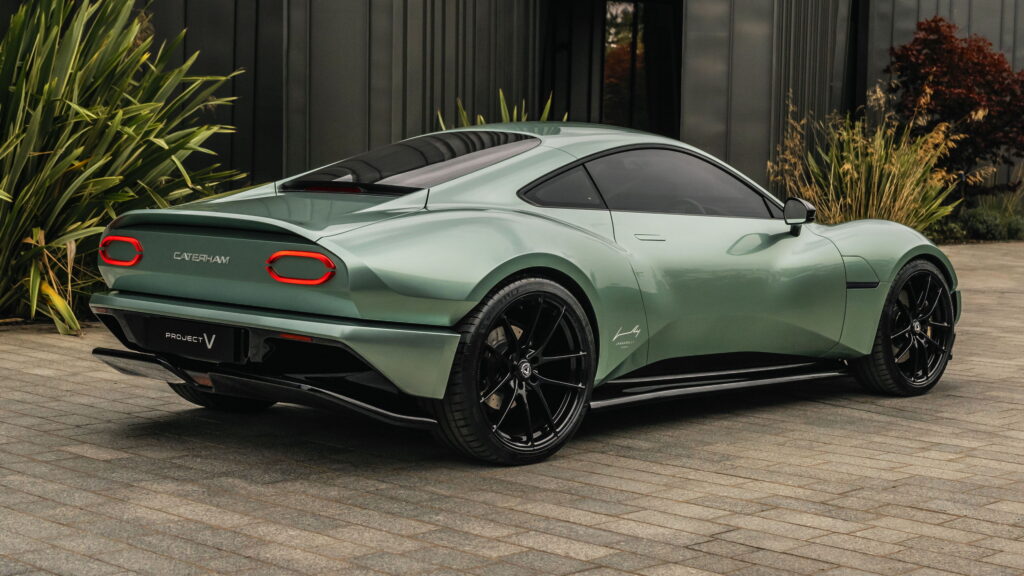

Remaining true to its philosophy of pure driving sensations, Caterham designed Project V to be agile and lively at the wheel. Instead of using the typical ‘skateboard’ battery layout, the company chose a more unconventional approach.
Two liquid-cooled battery packs from Xing Mobility are placed at the front and rear of the car, helping to distribute weight in a way that mimics the dynamics of the Seven model. Together, the packs provide just over 27 kWh of energy and power a 268-horsepower electric motor from Yamaha.
“While every other EV manufacturer strives to place batteries in a ‘skateboard’ platform, we intentionally placed the driver’s seat as low to the ground as possible. While every other automaker wants to centralize weight, we intentionally shifted it forward and backward, because that’s how the Seven is set up, and that’s what makes it fun to drive. It’s the concept of polar moment, and we are intentionally putting that polar moment into this car.”
Powertrain Priorities
The battery system is cooled using a dielectric fluid, which helps control heating under aggressive driving conditions. Despite a relatively modest maximum charging power of 100 kW, Caterham is not overly concerned with recharge speed.
As Gardiner notes, the emphasis is on how quickly the battery can discharge energy, not on how quickly it can charge. A potential buyer of this car is not thinking about long daily commutes; they are more interested in how aggressively this car can be driven on a winding road or track.
As for the price, a final figure for the US is not yet available, but Gardiner expects Project V to cost around $135,000 when it goes on sale.
The brand representative’s statement that Americans are ‘wealthy’ certainly grabs attention, but it also indicates a shift in the company’s strategy, which for decades has focused on the European market. Entering the American market with a high-budget electric car is a bold step for a niche manufacturer like Caterham. The success of Project V may depend not only on its driving qualities but also on whether the brand can convince US buyers that its interpretation of an electric sports car is worth such an investment, especially amid growing competition. The emphasis on driving feel, rather than maximum range or the fastest charging, is a testament to loyalty to the brand’s DNA, which could be both its greatest advantage and a challenge for mass adoption.