


Every year, we are promised that another breakthrough in battery technology will finally make electric vehicles more affordable. In reality, this has already begun to happen – albeit at the production level. According to a new study from Germany, global battery costs have fallen by approximately 35% in real terms since 2020. However, those who have recently looked at electric vehicles have probably noticed: they have not become much cheaper. Moreover, the median recommended price has even increased. Let’s figure out why.
What the ICCT study showed
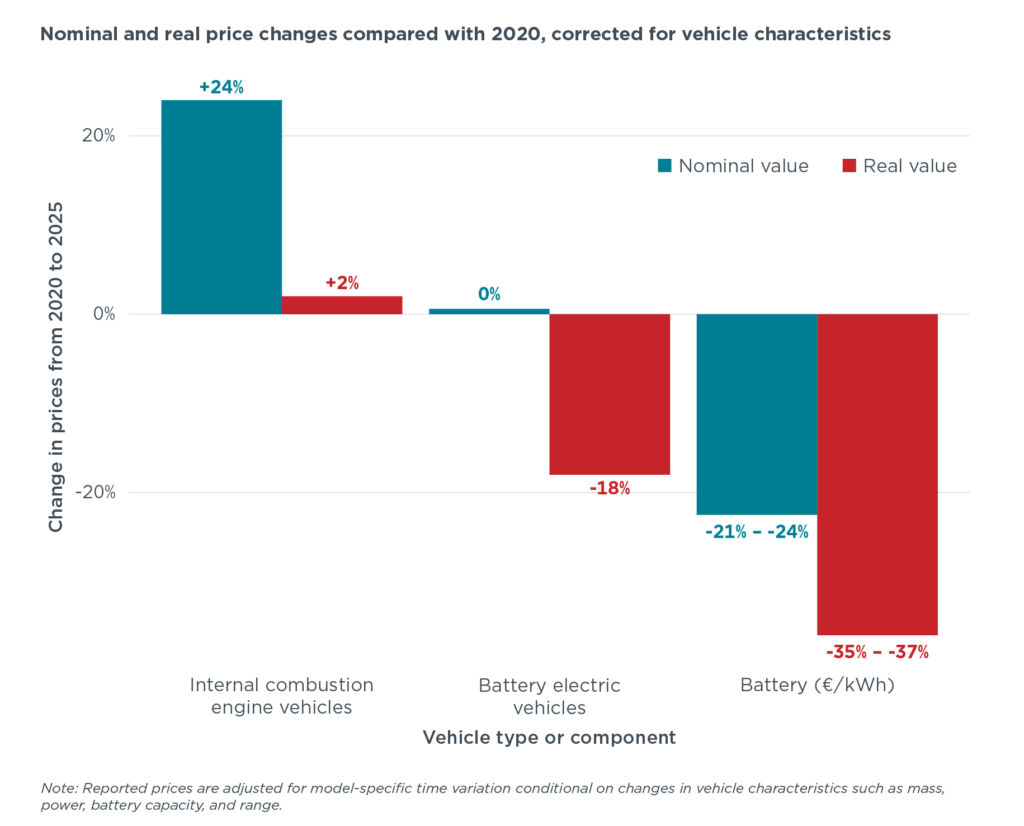
Researchers from the International Council on Clean Transportation (ICCT) analyzed over 100,000 configurations of passenger cars sold in Germany from 2020 to 2025. Comparing equivalent models while accounting for inflation, weight, power, battery capacity, and range, they found that prices for battery electric vehicles in real terms fell by about 18% over the five-year period. Yes, prices dropped by nearly a fifth. At the same time, internal combustion engine vehicles became about 2% more expensive.


Researchers attribute a significant portion of this reduction to cheaper batteries. Particularly interesting is the gap between the approximately 35% drop in battery costs and the only 18% reduction in vehicle prices. Manufacturers seem to have used some of the savings not to lower price tags, but to increase range, improve performance, or cover research and development costs.
Why the median price increased
Furthermore, the overall market picture is even more intriguing. The study confirms that individual electric vehicle models did indeed become cheaper, while the median advertised price across the entire German market rose – from about €38,000 ($44,000) in 2020 to €54,000 ($62,000) in 2025.

The reason is a sharp increase in the number of available models: from 38 to 159 over the study period. A significant part of this growth came from larger and more expensive cars in the lower-middle, middle, and upper-middle segments. Buyers looking for smaller and more affordable electric vehicles have a relatively small selection – mini and small-class models make up only 14% of all BEVs available on the market.
It is worth noting that the data reflects the German market, not the US, where incentives, taxes, and consumer preferences differ significantly. Nevertheless, the report highlights an important reality for those expecting a sharp drop in electric vehicle prices: lower battery costs do not automatically translate into lower price tags. Sometimes it translates into greater range, richer equipment, or simply more expensive cars.


So, while consumers wait for affordable electric vehicles, manufacturers are channeling technological progress toward the premium segment. A similar dynamic is observed in other markets: cheaper batteries do not yet mean cheaper cars for the buyer. Instead, we see the model lineup expanding with expensive crossovers and sedans, while budget options remain rare. This creates a paradox: electric vehicles are becoming cheaper to produce but not to buy, and the main reason is manufacturers’ strategy to maximize profit rather than volume.