


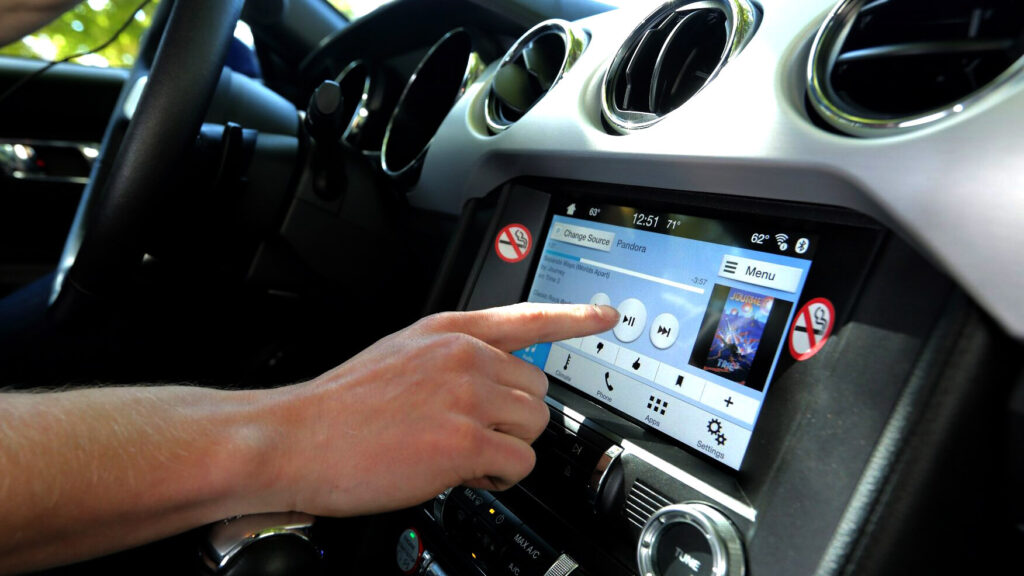
New research confirms what many drivers have long suspected: searching for needed functions through touchscreen infotainment systems while driving a car is not only irritating but also genuinely dangerous. This is especially relevant for those who have tried to change a playlist or adjust the climate control during a trip.
The Evolution of Interiors and New Risks
Over the past twenty years, large, tablet-like screens have gradually replaced traditional buttons and knobs, and in some cases, as with Tesla models, completely replaced them. Many manufacturers now advertise their spacious digital displays as a key advantage.
Research conducted by the University of Washington and the Toyota Research Institute provides concrete figures confirming a well-known truth: these screens can be incredibly distracting and dangerous when used while driving.


Research Methodology
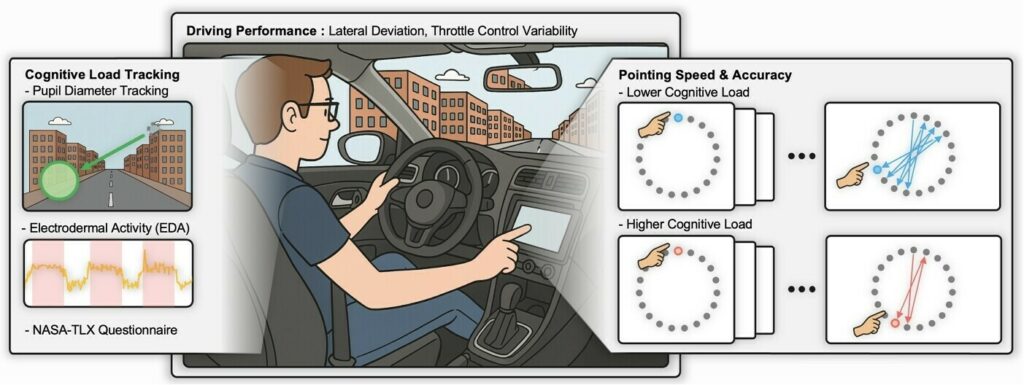
The study titled “Touchscreens in Motion: A Quantitative Assessment of the Impact of Cognitive Load on Distracted Drivers” was published in September 2025. Sixteen participants were placed in a high-fidelity driving simulator, where researchers tracked eye and hand movements, pupil dilation, and skin conductance.
Drivers were asked to interact with the car’s touchscreen and perform memory-based tasks to measure mental workload. Pupil size and electrodermal response provided key data on how hard the brain was working.


Simulation Results
When drivers were asked to perform routine tasks on the touchscreen while navigating a simulated urban environment, their ability to control the car and the accuracy of their screen interaction noticeably deteriorated. The more complex the task, the more performance dropped.
It is important to note that this is not about texting on social media. The research focuses on everyday tasks that manufacturers expect drivers to perform through layers of digital menus: adjusting audio, sending or listening to messages, navigating media. Tasks that were previously performed by turning a knob or pressing a button now require simultaneous engagement of eyes, hands, and cognitive resources.


Participants drove through a simulated city while working with the touchscreen. Researchers measured a range of driver performance indicators and physiological markers, from eye movements and steering stability to reaction time and stress signals.
The results were disappointing for proponents of large tablet-like systems. Interacting with the touchscreen reduced the accuracy and speed of taps by more than 58 percent compared to conditions when the driver was not operating the car. At the same time, lane deviation increased by more than 40 percent after starting interaction with the screen. In other words, drivers simultaneously became worse at controlling the car and worse at using the screen.
Searching for Solutions and Future Interfaces
One might think the solution lies in simply returning to physical buttons. Unfortunately, that ship has probably sailed. While some automakers are willing to bring back some physical switches, screens are so cheap and convenient for manufacturers to produce and sell that they will continue to be a significant part of cars.
How then can automakers improve safety? The study offers several ideas.

First, it suggests manufacturers reduce the number of menus required to perform functions that are frequently needed while driving. This can be achieved by adding direct access to these functions somewhere on the screen at any time. Furthermore, systems could become smarter by learning to anticipate certain user actions and making some buttons larger and brighter for the eye.

Finally, the study believes that manufacturers could use load-sensitive systems to detect high cognitive load on the driver and then respond accordingly, temporarily limiting some functions or alerting the driver to the need to refocus on the road.
Ultimately, the study concludes that interfaces should be designed for how people actually behave, not how manufacturers would like them to behave.


This work clearly demonstrates the technological gap between the marketing advantages of “digital cockpits” and their practical safety. While legislation lags behind the pace of innovation in the automotive industry, the responsibility for balancing modernity and safety falls on engineers and designers. The future likely belongs to hybrid solutions where critical functions are duplicated by physical controls, and screens receive adaptive interfaces that reduce driver load in complex road conditions. The success of these systems will be determined not by their complexity, but by their ability to seamlessly integrate into the driving process without demanding excessive attention.