


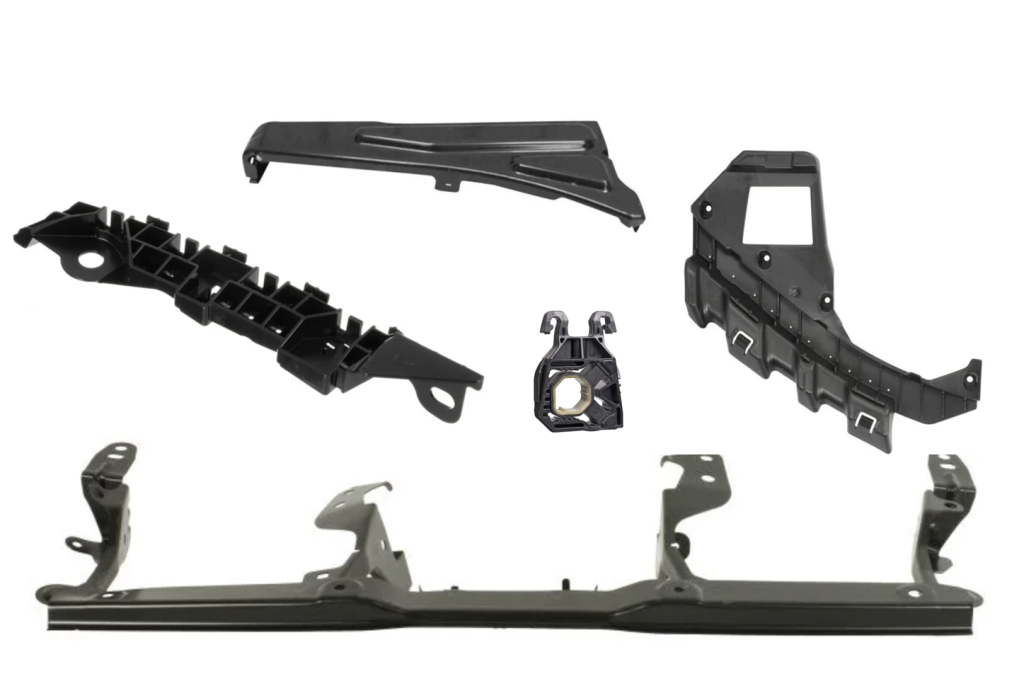
Spring is the time when many of us finally get to what was put off all winter: replace the bumper, align the fender, install a new headlight. You buy a new part, pay for the work — and suddenly it turns out the bumper sits crooked, there’s a gap near the headlight, or the corner “pops out” at speed. Sound familiar?
The problem is often not the part or the mechanic. The problem — is the fasteners that remained old.
What happens upon impact — and why it’s not immediately noticeable
Even a minor impact or pressing the bumper against a curb transfers the load further. Not only the visible parts suffer, but also what’s inside:
Plastic fasteners — connect the bumper to the fender and headlight. After an impact, they may have micro-cracks that are invisible to the eye but no longer hold the angle.
Metal brackets — set the position of the bumper and fender. Even 2–3 mm of deformation results in a noticeable misalignment.
Clips — small retainers that often break when removing the bumper. Most of them are designed for a single installation — after disassembly, they no longer secure as they should.
Externally, all these parts may look fine. But they are what determines how the new bumper will fit.
How to tell the fasteners are no longer up to the job
Here are simple signs to look out for before the repair:
- the bumper corner “pops out” near the headlight
- there is a gap between the bumper and fender
- the bumper vibrates or wobbles while driving
- the headlight sits unevenly
- the wheel arch liner catches the wheel when turning
- the bumper sags on one side
If at least one of these is present — even the best new bumper won’t be saved by old fasteners.
Why saving on fasteners can cost more in the long run
The situation is typical: you buy a new bumper for 3,000–5,000 UAH, pay for the work — and a week later you see an uneven gap or hear vibration on the highway. The mechanic looks at it and says the brackets need replacing, which should have been replaced from the start.
The result: you pay twice for labor, plus the cost of the fasteners. And the fasteners themselves are usually 200–800 UAH depending on the car and trim. Something to compare.
Can you replace the fasteners yourself?
Clips and plastic retainers — yes, it’s possible to do it yourself if you have a basic set of tools and a few hours of time. Metal brackets are more difficult: lifting the vehicle and understanding body geometry is required. If in doubt, it’s better to trust a mechanic, but at least know what needs to be replaced and be able to oversee the work.
How to choose the right fasteners
The main rule: fasteners are not universal. They differ in shape, angle, and type of fixation for each model. After a facelift, parts can change even within the same car.
To select exactly, you need to know:
- the model, year, and trim of the car
- which specific part is being fastened (bumper, fender, headlight, wheel arch liner)
- the OEM number or a photo of the original fastener
In the Kyivparts fasteners catalog, you can select a car — and see all suitable items with photos and descriptions. If you’re unsure about your choice, it’s easier to contact support with the VIN — they will select by OEM.
Summary
Before replacing the bumper, it’s worth checking the fasteners — it takes 10 minutes, but can save you from a repeat repair.
A new part won’t sit flush on deformed or broken brackets. Fasteners are not a “triviality,” but part of the entire front end’s geometry. And they cost significantly less than redoing the mechanic’s work.