


The Return of “Badge Engineering” in the Automotive Industry
The phenomenon of “badge engineering,” where automakers release practically identical models under different brands, is gaining momentum again. This is becoming a way for companies to reduce costs. A prime example is the partnership between Toyota and Subaru, who will soon be offering four almost identical crossovers.
In the past, such practices were very common, especially within the General Motors conglomerate. Today, even if models are based on the same platform, they often receive unique designs. However, the trend is changing once again.
Shared Platforms of Toyota and Subaru
The collaboration between Toyota and Subaru, which began with the Scion FR-S (Toyota GR86) and Subaru BRZ models, has significantly expanded. It now includes the bZ4X and Solterra electric crossovers, as well as the new Toyota C-HR, bZ Woodland models and their Subaru “twins” — the Uncharted and Trailseeker. The differences between them are minimal, making them akin to “reheated leftovers.”
The market is seeing more and more nearly identical cars that differ only in the emblem on the grille.
European Alliances and Their Consequences
In Europe, Ford is also actively using a partnership strategy to develop its electric lineup. The company introduced versions of the Volkswagen ID.4 and ID.5 under its own names, the Explorer EV and Capri. However, these models have not gained popularity, forcing Ford to cut production in Germany. Despite this, the automaker continues its course of collaboration, planning to release two new electric vehicles based on Renault platforms by 2028.
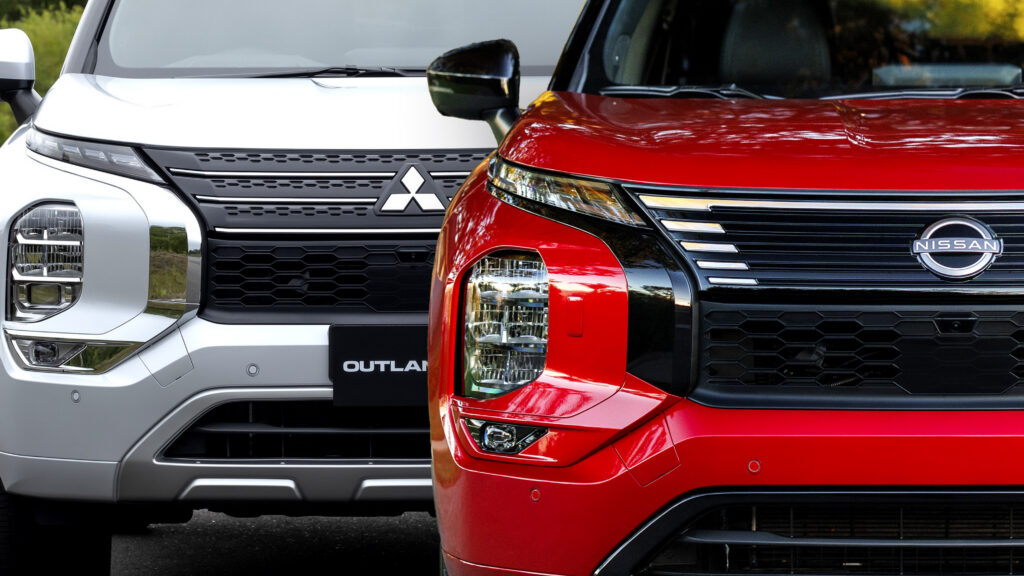
The New Nissan Rogue PHEV — A Rebadged Mitsubishi
Another example is the recently unveiled 2026 model year Nissan Rogue Plug-in Hybrid. This is, in essence, a Mitsubishi Outlander PHEV with different badges. The model may prove successful due to Nissan’s larger dealer network compared to Mitsubishi. The car offers a hybrid powertrain with an electric range of about 61 km (38 miles) and a seven-seat cabin configuration.
The return to the practice of “badge engineering” raises questions about its advisability. On the one hand, it allows for faster and cheaper filling of the lineups of different brands. On the other hand, consumers may feel they are being offered the same product without significant differences. The success of such models often depends not so much on technical advantages, but on brand strength, customer loyalty, and the availability of a dealer network. The future will show whether this trend will be long-lasting, or whether automakers will return to deeper individualization of models, even on shared platforms.