


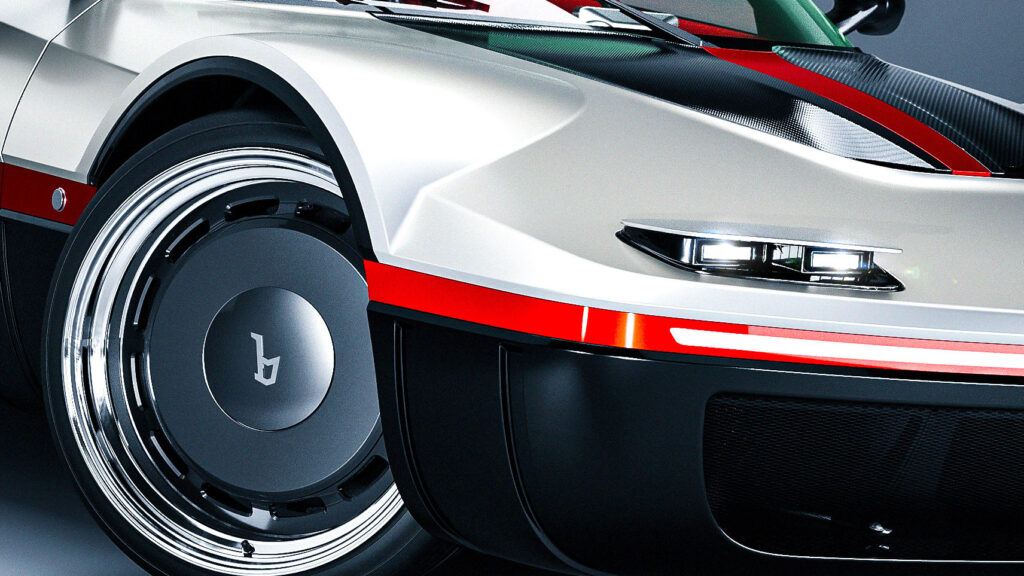
The Italian atelier Bertone has unveiled the Runabout, the production version of its 1969 concept car. The car will be released in a limited series of 25 units, with a starting price of 390,000 euros.
Revival of a Classic
In the market of modern supercars and racing specials, true cars with a retro soul are rare. Bertone is targeting precisely this niche with the new Runabout, which revives the 1969 concept using modern technology. Instead of drawing inspiration from obvious icons like the Lamborghini Miura, the company turned to the less known but iconic Autobianchi A112 Runabout, a concept that later influenced the design of the Fiat X1/9.
This car is aimed at collectors who don’t bat an eye at cars with seven-figure price tags.
Exclusivity and Price
The production version of the Runabout premiered at the Retromobile exhibition in Paris. Production is limited to just 25 cars. The base price of 390,000 euros (approximately $460,000) does not include taxes, options, delivery, and personalization. Considering all additional costs, the final sum is unlikely to be less than half a million dollars.
Design: Bertone’s Neo-Retro
For such a sum, the buyer gets a lightweight sports car with a strong 70s style influence and analog mechanicals. The car’s length is 3,990 mm. The design is characterized by a clear wedge-shaped profile line, a low front end with classic pop-up headlights and a modern LED strip. The fenders rise independently from the vented hood, creating a sculptural look.
The wheels are in a retro style: 18 inches at the front and 19 at the rear, all forged. Short overhangs and clean surfaces give the Runabout a distinctive character.


Rear End and Body Options
The car’s rear end is very rich in details. A sculptural roll bar combines with a short rear panel featuring round taillights and an engine cover in a vintage style. The wide tires are only partially hidden by a minimalist bumper framed by a carbon diffuser. Four rectangular cutouts on top, two of which serve as exhaust pipes.
Buyers can choose between Targa configurations with removable roof panels or a fully open Barchetta, which has only a small windshield.
Interior: Nautical Motifs
According to Bertone, the Runabout’s interior pays homage to nautical design. The shape of the cockpit resembles a boat hull, and a compass sets the tone. The dashboard is styled like a minimalist deck. A pair of molded bucket seats, a thin two-spoke steering wheel, and exposed mechanical components, such as the manual gear lever, emphasize the car’s analog character.
A digital instrument cluster and physical climate controls are present, trimmed in a mix of hand-stitched leather and raw aluminum.
Technical Specifications
Under the stylish body lies a bonded aluminum chassis, borrowed from Lotus, with double wishbones, adjustable dampers, and anti-roll bars.
As in the Lotus Exige, the heart of the car is a mid-mounted, supercharged 3.5-liter V6 from Toyota. It produces 468 hp, which is significantly less than earlier forecasts but still far more than the 54 hp of the 1969 original.
Most importantly, the V6 is paired with a six-speed manual transmission with short gear ratios, sending power to the rear wheels.
Bertone claims a 0-100 km/h acceleration time of 4.1 seconds and a top speed of 270 km/h. However, perhaps the most important figure is the car’s weight — just 1,057 kg.
Future Plans
The Bertone Runabout will be publicly presented at Retromobile 2026 in Paris from January 29 to February 1. It will be displayed next to the original 1969 Autobianchi A112 Runabout concept, offering a rare opportunity for comparison, as well as alongside the equally limited Bertone GB110 model.
The emergence of the Runabout demonstrates the ongoing interest in high-quality, emotional car manufacturing, where design and driving feel take priority over absolute technical specifications. The limited run makes it not so much a means of transportation as a moving work of art intended for connoisseurs. The success of such a project could signal to other manufacturers the viability of the niche for neo-retro sports cars with an analog soul, even at astronomical sums.