


Fuel prices hit a four-year high
The situation on the fuel market continues to worsen. After a brief period of stabilization linked to hopes for an end to the conflict in Iran, prices have started rising again. The reason is the virtual deadlock in negotiations and the blocking of the Strait of Hormuz.
Surge in gasoline prices
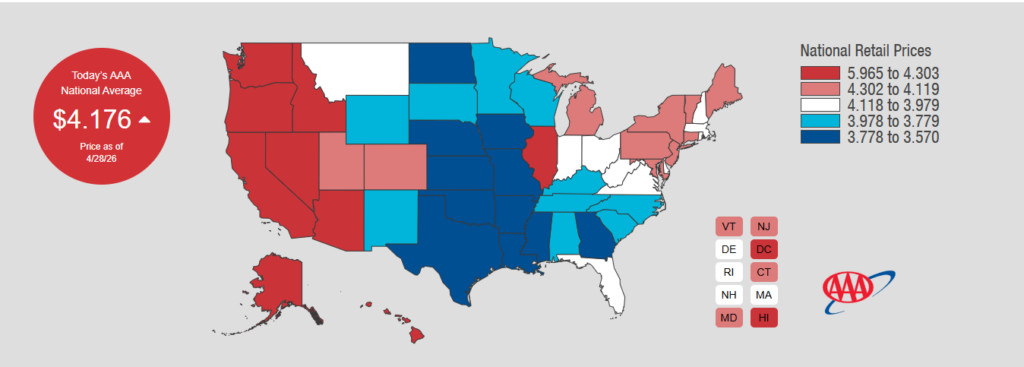
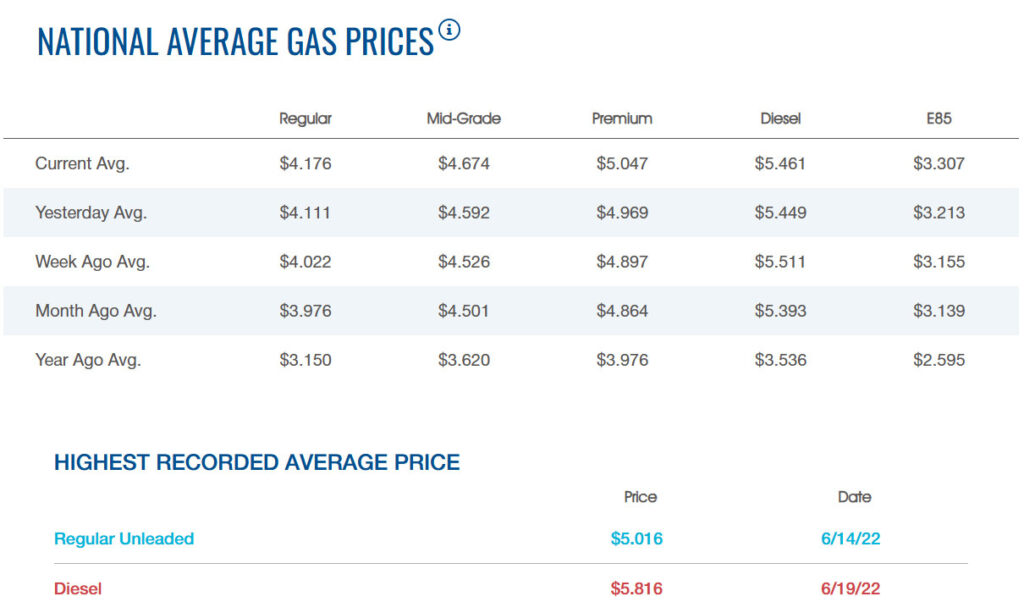
According to AAA, the average price of a gallon of gasoline in the US has jumped to $4.176, which is 6.5 cents more than yesterday. This is a significant increase in just 24 hours. Compared to last week, the price has risen by 15.4 cents, and compared to last month, by 20 cents. Even more striking is the annual figure: a year ago, gasoline cost an average of $3.150 per gallon. Thus, drivers today are paying $1.026 more, representing a 33% increase. As reported by ABC News, the average of $4.176 per gallon is the highest in four years.
Diesel fuel approaching historical record
Although gasoline prices have risen significantly, they are still outpaced by diesel fuel. The average cost of diesel is now $5.461 per gallon, which is $1.925 more than a year ago. The situation is so critical that the price of diesel is approaching its all-time high of $5.816, recorded on June 19, 2022.

Regional differences
As always, prices vary significantly by region. In California, drivers pay an average of $5.965 per gallon of gasoline, while diesel costs $7.480. This sharply contrasts with Oklahoma, where gasoline can be purchased for $3.634 per gallon, and diesel for $4.731. Both prices are well below the state’s historical highs of $4.666 and $5.303, respectively.
Outlook for resolution
When the situation will improve remains unclear. President Trump stated that “Iran just told us that they are in a ‘state of collapse'” and that they want the United States to open the Strait of Hormuz as quickly as possible while they “deal with their leadership situation.” Of course, it is unclear if this is true, and what it means in practice.
The current crisis in the fuel market is a direct consequence of geopolitical tensions surrounding Iran and the blocking of a key maritime route — the Strait of Hormuz, through which about 20% of the world’s oil passes. Even if claims about the “state of collapse” in Iran turn out to be true, the process of restoring supply and stabilizing prices could take weeks or even months. It is worth noting that such a rapid rise in prices puts additional pressure on the economy, especially on the transport sector and logistics, which will inevitably lead to higher prices for essential goods for consumers. The situation remains extremely volatile, and any diplomatic or military actions in the region could trigger new price shocks.