 by
by Electric vehicle technologies have opened new horizons for tuners, allowing serious performance to be implemented into cars that were not originally intended for it.
Innocent on the Outside, but Powerful Within
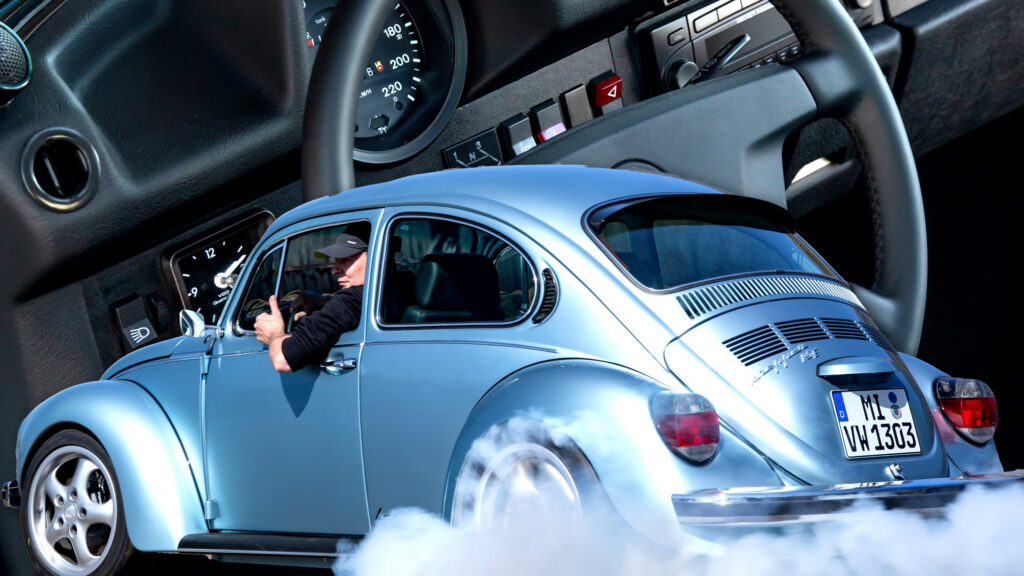
A vivid example is this classic Volkswagen Beetle. On the outside, it looks like an ordinary car, but under the hood (or rather, in its construction) hides power capable of making even a modern supercar nervously smile.
The car was built by the German workshop Knepper Bugs & More. This Beetle was found when it was almost rotted away in a junkyard in California. The masters bought it, brought it to Germany, and began a large-scale restoration, completely replacing the original powertrain with a modern electric one.
The Heart of a Supercar in the Body of a Legend
Now the car is propelled by a motor identical to the one installed on the rear axle of a Tesla Model S. However, it was modified to operate at higher voltage, allowing it to produce over 600 horsepower and 700 Nm of torque. This is power that exceeds the figures of many modern sports hatchbacks.
The torque is transmitted to the wheels via driveshafts from a Porsche 930, and the energy is provided by 17 battery modules from a Porsche Taycan. This is a true Frankenstein, created from high-tech components of premium electric cars, squeezed into the body of a car that once barely developed 50 horsepower.
The exact weight after the conversion is not disclosed, but it is obvious that the Beetle has turned into a real weapon on the road.

According to its creators, acceleration from 0 to 100 km/h takes only 2.9 seconds. This is a figure that looks worthy even in the world of supercars. For comparison, the new Lamborghini Temerario with a V8 twin-turbo hybrid setup does it in 2.7 seconds, and the Porsche 911 GT3 in 3.4 seconds. The latter would quickly be left behind in the rearview mirrors of this Beetle.
On a full battery charge, the car can travel about 250 kilometers. However, if driven aggressively, in line with its new capabilities, the range is reduced to approximately 100 kilometers.
Upgrades for Power Control
For the car to handle the colossal performance, a significant part of the suspension and braking system was borrowed from the Porsche 944. Components from renowned manufacturers KW and Bilstein were also used, providing the Beetle with the necessary stability and handling.
Exterior and Interior
The car’s body has also undergone serious changes. It is painted in a pleasant shade of Marathon Blue, fitted with classic Porsche wheels, and the ride height is lowered for a more aggressive and sporty stance on the road.
A small carbon fiber spoiler is almost the only exterior detail hinting at the incredible power of this machine, comparable to a Lamborghini Huracan.
The interior, on the contrary, has remained impressively simple and true to the original. The original dashboard and gauges have been preserved and restored. Only Recaro sports seats from a BMW 2002 have been installed. The old gear lever has been replaced by a small touchscreen for selecting the driving mode.
To demonstrate the reliability and readiness of the car for long journeys, the Knepper team this year undertook an approximately 8,000-kilometer trip in it. The route passed through Belgium, France, Spain, Portugal, Luxembourg, and even through Gibraltar to North Africa.
Projects like this clearly demonstrate how the era of electromobility is changing the very philosophy of automotive restoration and tuning. There is no longer a need to search for rare internal combustion engines—the availability of powerful and compact electric units opens the way for the revival of practically any classic. This gives cars a second life, but now with completely new, often revolutionary, characteristics. The success of such conversions, like the Knepper Beetle, could become an impetus for a new wave of creative and high-tech projects, where respect for history is combined with a bold look into the future.