


A Modest Find at the Auto Show
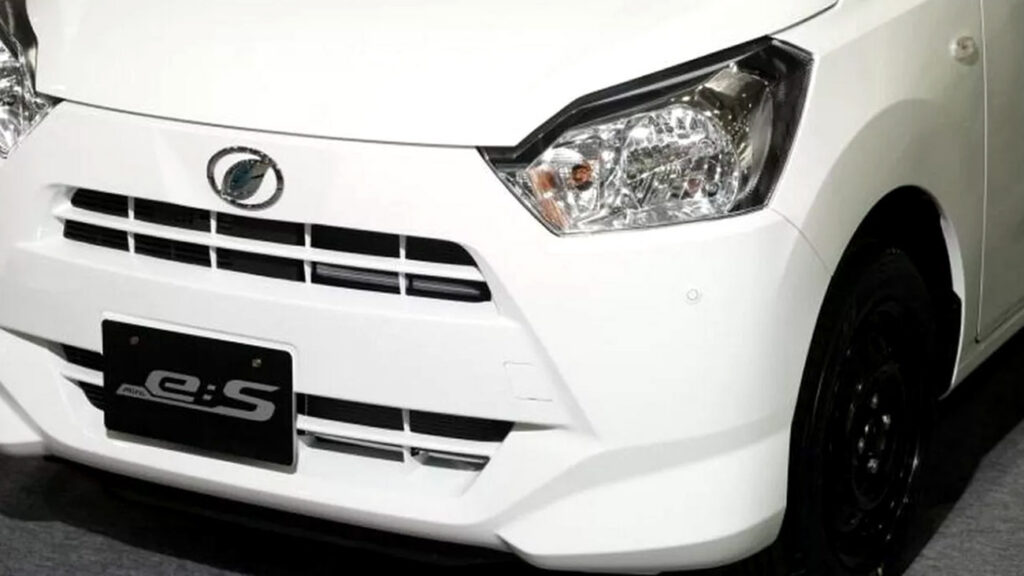
This year’s Tokyo Auto Salon brought a wave of new releases, but among the bright premieres, an interesting compact car was almost lost. In collaboration with D-Sport Racing, Daihatsu presented a modified Mira e:S, which combines an unassuming exterior with track-ready preparation, including a turbo engine, manual transmission, limited-slip differential, and a factory-installed roll cage safety system.
Daihatsu revives a tiny Japanese legend with an electric twist
The Philosophy of Minimalism
Unlike the usual aggressive body kits, this version of the Mira e:S chose the opposite path. It has no aerodynamic body kits, alloy wheels, or Gazoo Racing emblems. Instead, the car is based on the base model, with modest halogen headlights and black 14-inch steel wheels, creating the impression of an inconspicuous road user.
Safety and Driving Pleasure
The interior is also quite simple but hides two surprises. First, this kei car is equipped with a standard six-point roll cage, emphasizing its track orientation without sacrificing the ability to carry four passengers. Second, it’s the five-speed manual transmission, which replaces the uninspiring CVT of the production model with something much more exciting.
Heart from the Copen
Under the hood lies the familiar 660cc turbocharged three-cylinder engine from the Daihatsu Copen. It produces 64 hp (48 kW) and 92 Nm of torque. While these figures may not be impressive, the Mira e:S is truly light, weighing only 650–740 kg. This power-to-weight ratio makes driving significantly more engaging.
There is only one such example, and it is probably the smallest GR Supra ever built
As a finishing touch, D-Sport Racing added a limited-slip differential and ventilated disc brakes on the front axle.
From Track to Public Roads
The best part of this story is that the special Mira e:S is not a one-off. The model was developed using data from SPK and D-Sport’s participation in 10-hour endurance races. In fact, a full-fledged racing version with adjustable suspension, different wheels, upgraded brake pads, a boost pressure gauge, and a racing livery was presented right next to it at the Tokyo Auto Salon.
Daihatsu reports that this special version of the Mira e:S is planned for sale through SPK as a full-fledged road car. While the price has not yet been announced, the base model costs only ¥992,200.
Even considering the additional cost for the turbo engine, manual transmission, and safety equipment, the car is expected to remain in the affordable segment. This aligns with the original goal of creating this car—to bring the joy of driving to as many people as possible.
This project perfectly illustrates a trend in the automotive industry where even the most affordable and utilitarian models can become the basis for creating exciting, driver-oriented cars. The synergy between a mass manufacturer, a racing team, and competition experience highlights a path for the development of compact city cars, giving them a second wind without losing their practicality and affordability. Such initiatives expand the perception of what a small car can offer, combining daily-use efficiency with emotions typically associated with more niche models.