


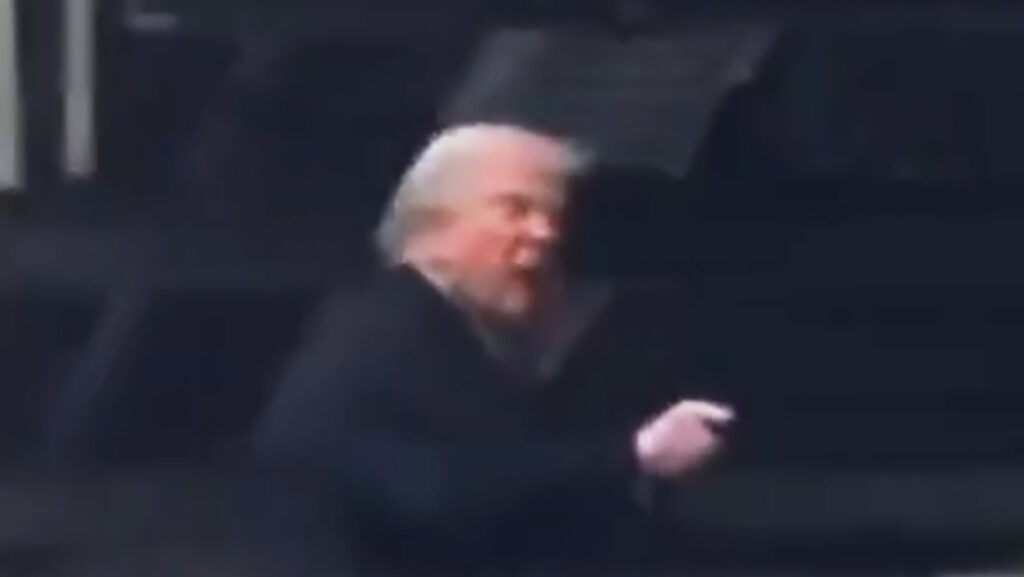
It’s not every day you see a sitting president making a provocative gesture during a plant visit, but Donald Trump’s tour of the Ford assembly plant in Dearborn, Michigan, drew attention for just that. In response to shouts from a protester, he appeared to utter an insult and made a certain hand gesture, a moment that didn’t take long to spread across the internet.
Circumstances of the Incident
In the widely circulated video, the president seems to say “go to…” towards someone off-camera, followed by a brief hand motion that many interpreted as an unmistakable gesture, before resuming the tour of the Ford F-150 production line.
Recent headlines about Trump have focused on US actions in Venezuela, his comments on Greenland’s future, and his response to the recent shooting in Minnesota. But the heated exchange at the Ford plant was tied to a different controversy – the renewed public discussion of his alleged connections to the Epstein case.
Flare-up at the Plant
The man who interrupted the tour accused Trump of being a “defender of pedophiles,” which seemingly provoked the president’s response. He was later identified as T.J. Sabula, a Ford employee and United Auto Workers union member, whom the company subsequently suspended.
Sabula, 40, stated he was unsure what this meant for his job long-term, especially after “embarrassing Trump in front of his friends.” But when asked if he regretted the confrontation, he was categorical: “As far as calling him out, absolutely no regrets.”
Am I crazy, or did Trump just flip off several protesters?
Ford Company’s Reaction
According to reports, Ford Executive Chairman Bill Ford described the incident as unfortunate and unpleasant during a brief talk with reporters. Nevertheless, he tried to downplay its significance, describing it as “six seconds out of an hour-long tour” that otherwise went smoothly. “I think he really enjoyed it, and we did too,” Ford added.
A company representative offered a more formal response, describing the day as overall successful. “We had a great event today and are proud of how our employees represented Ford. We saw the video you’re talking about. One of our key values is respect, and we do not condone anyone saying something inappropriate like that on our premises. When something like this happens, we have a process to deal with it, but we do not get into specific personnel matters.”
The Administration’s Position
In a statement to the media, White House Communications Director Steven Cheung defended the president’s actions: “A crazy person was wildly screaming profanity in a full rage fit, and the president gave an appropriate and unambiguous response.”
Whether “appropriate” is the right word depends on your point of view. But Trump is not the first US leader caught using that gesture. George W. Bush once famously gave the middle finger to a camera backstage during a TV interview, later calling it a “one-finger victory salute.”
Vice President Nelson Rockefeller made a similar gesture to a crowd of protesters in 1976, which became known as the “Rockefeller Salute.” More recently, Vice President J.D. Vance used the same gesture during a Republican fundraiser in Ohio to emphasize a point about political division and protest culture.
What Did the President Say About Ford?
Returning to the initial purpose of the visit, Trump’s tour of the Ford River Rouge plant served as public support for his “America First” economic strategy. The visit came at a time when Ford is scaling back its electric vehicle efforts, which some see as aligning with the president’s more traditional manufacturing focus.
Trump walked the F-150 assembly line with Bill Ford and CEO Jim Farley, praising what he called the “incredible quality” of the pickups. He also emphasized Ford’s role in keeping manufacturing within the US.
Speaking to reporters, Trump stated: “Ford really has been a leader, they’ve done a fantastic job. But all of them, General Motors is doing well too, Stellantis is doing well, we’re very happy with that. I just want them to build their product in the USA.”
When asked about the nearly completed USMCA trade deal, he responded with his characteristic ambivalence. “We may or may not have it, it doesn’t matter. I think they want it, I don’t really care.”
This incident in Dearborn is another example of how personal controversies and political gestures intertwine with official state visits. The reactions from various sides – from the employee’s suspension to the administration’s attempts to justify the behavior – show the deep polarization in society. At the same time, the economic context of the visit, with its emphasis on American manufacturing, may remain in the shadow of this brief but loud episode. Such situations often become a test for the corporate ethics and communication strategies of large companies caught between the need to adhere to internal rules and the pressure of the political context.