


Dodge Challenger second generation: when a legendary name doesn’t match the essence
Not every car that bears a famous name truly deserves it. Dodge in the late 1970s demonstrated this clearly. If you’re a fan of American muscle cars, you are probably well acquainted with the first generation of the Dodge Challenger and the third-generation model from the late 2000s, which Dodge produced for fifteen years, until 2023.
One version of the Challenger you may not be familiar with is the second-generation model. And the reason is that it was not a muscle car at all. In fact, it wasn’t even a true Dodge.
When Dodge decided to revive the Challenger name in 1978, four years after production of the original ceased, it completely abandoned the muscle car formula. Instead, buyers got a cheaper, less powerful, and significantly less interesting coupe based on the Mitsubishi Galant, which was sold as the Sapporo in some foreign markets.
Mitsubishi in Dodge clothing
Initially known as the Dodge Colt Challenger, this coupe was virtually identical to the Mitsubishi model sold in other countries, except for the new badges. Whereas the original Challenger used six- and eight-cylinder engines, this model was mostly sold with a 2.6-liter four-cylinder engine, although a smaller 1.6-liter version with 77 horsepower was also offered for a time.
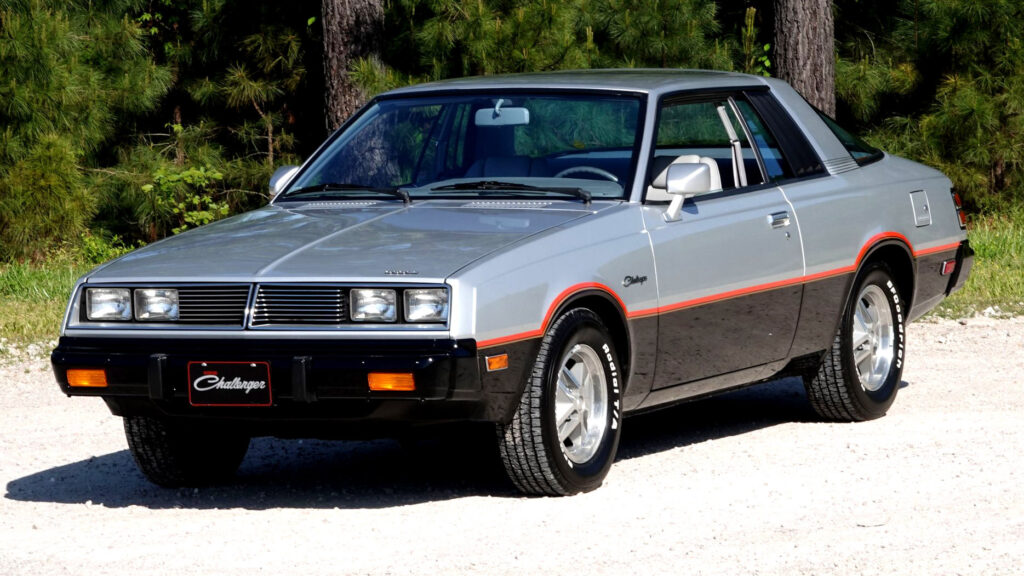
While most of these second-generation Challengers, produced between 1978 and 1983, have faded into obscurity, the Raleigh Classic Car Auctions has one example in Zebulon, North Carolina. This is a 1980 Challenger that has driven only 37,309 miles (60,043 km) since production. Furthermore, it is believed to have had only two owners and may be one of the best-preserved examples in the United States.
At least it looks good…
The exterior features a two-tone black and silver paint job with yellow and red stripes along the sides. The car still sits on its original 14-inch wheels and appears to have been well-maintained over the decades.
Just like the exterior, the interior of this two-door model is drastically different from other Challenger versions. It has gray upholstery throughout the cabin, which contrasts with red, white, and black plaid on the seats and door panels.
Although the design of this model has aged quite gracefully, it is not exactly an exciting car to drive. Indeed, the 2.6-liter naturally aspirated four-cylinder engine had a paltry 105 horsepower at the time of release, and some of those horses have inevitably been lost over the decades.
The second-generation Challenger may have traded muscle car glory for Japanese reliability, but its quirky charm has aged better than one might expect.
This car is an interesting example of how even legendary names can be used for completely different purposes. In the era of oil crises and tightening environmental regulations, American manufacturers often resorted to rebranding Japanese models to fill gaps in their lineups. Although such a Challenger has nothing in common with its powerful predecessors or successors, it stands as a testament to a complex transitional period in US automotive history. For collectors, it is valuable not for its performance, but rather as a rare and well-preserved artifact of that era, evoking nostalgia for a time when economy and practicality were more important than power.