 by
by The Heart of the T.50 Driving Experience
When Gordon Murray announced his intention to create a modern interpretation of the legendary McLaren F1, the automotive world became intrigued. With the T.50 model, the famous designer delivered on his promise, creating a supercar significantly more compact than most modern competitors. He deliberately eschewed turbocharging systems and hybrid technologies in favor of a roaring naturally aspirated V12.
Many videos already showcase the T.50 on race tracks. This is interesting but does not answer the more important question: what is this car like on a regular road? Harry Metcalfe decided to find out, spending five days with a pre-production prototype and driving it across Great Britain, including the winding roads of Wales.
The Cosworth V12 engine defines the T.50 driving experience. Harry Metcalfe spent five days with the T.50 on British roads. Clarkson says the GMA supercar doesn’t give him that “fizz” feeling.
An Outsider’s Opinion and an Unusual Layout
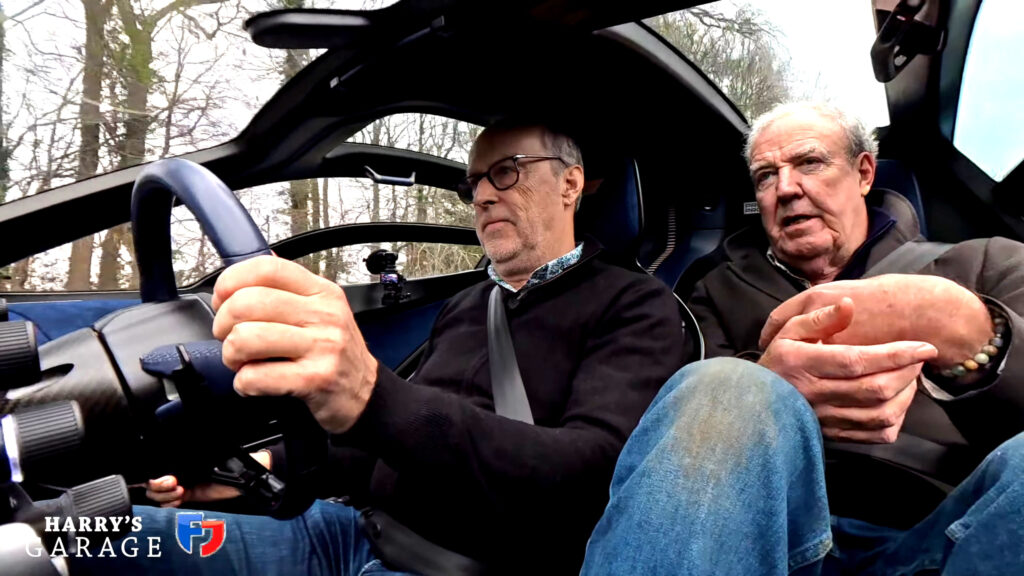
During his journey, Metcalfe stopped by his neighbor, a farmer, who turned out to be none other than Jeremy Clarkson, to get his opinion on the car. Clarkson didn’t get to sit behind the wheel himself, as the T.50’s seat must be individually fitted to the driver, and Metcalfe had already undergone this procedure before receiving the keys from Gordon Murray Automotive.
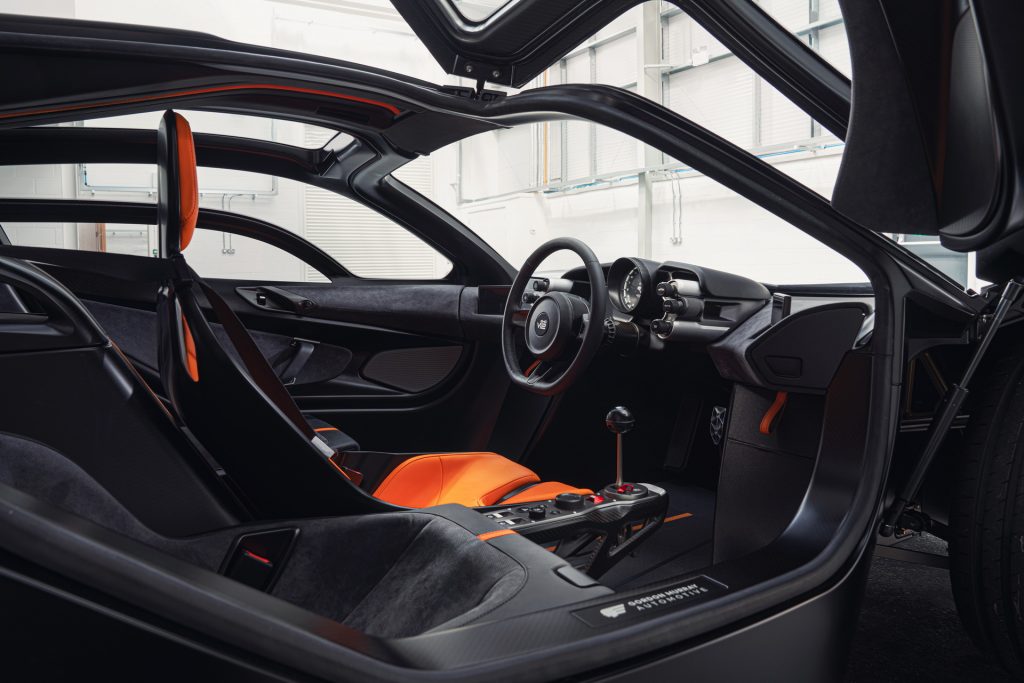
However, Clarkson got into the car as a passenger, which gave him the opportunity to take a closer look at the unusual three-seat cabin layout. As one might expect, both Clarkson and Metcalfe praised the 4.0-liter Cosworth V12, with the former Top Gear host calling it “extraordinary.” The downside of the engine is its incredibly high noise level, and due to the seating peculiarities, it’s not very convenient for the driver and passenger to communicate.
Technical Specifications and Driving Features
The naturally aspirated V12 develops 654 hp at a frantic 11,500 rpm and 467 Nm of torque at 9,000 rpm. It is paired with a six-speed manual gearbox that sends all power to the rear wheels. These figures ensure serious performance: the T.50 can accelerate to 60 mph (96 km/h) in less than 3.0 seconds and reach a top speed of 364 km/h.
Besides its “old-school” engine, the T.50 also differs from modern sports cars in another noticeable way. At speeds above 10 mph (16 km/h), it does not use power steering. This means the car easily “catches” ruts on the road, and throughout the video, one can notice how the steering wheel constantly moves in Metcalfe’s hands. Power steering only engages at speeds around 9 mph, providing sufficient ease of maneuvering at low speeds.
Impressions and Subjective Feelings
Unsurprisingly, Metcalfe is a big fan of the T.50, although he admits the car feels more extreme than he initially expected. Interestingly, Clarkson confesses that this car doesn’t give him that “fizz” feeling James May once spoke about in the old Top Gear days. However, Metcalfe quickly notes that Clarkson’s opinion might have changed if he had gotten behind the wheel himself.
This experiment of living with a supercar on regular roads highlights the gap between technical perfection and emotional perception. The T.50 is undoubtedly an engineering masterpiece and a tribute to the classic values of high revs and mechanical purity. However, its extreme specialization and specificity make it a car for true connoisseurs, willing to put up with its demanding nature for the sake of a unique experience unavailable anywhere else. While some seek the perfect driving tool, others might miss precisely that irrational pleasure that breeds a true attachment to the machine.