


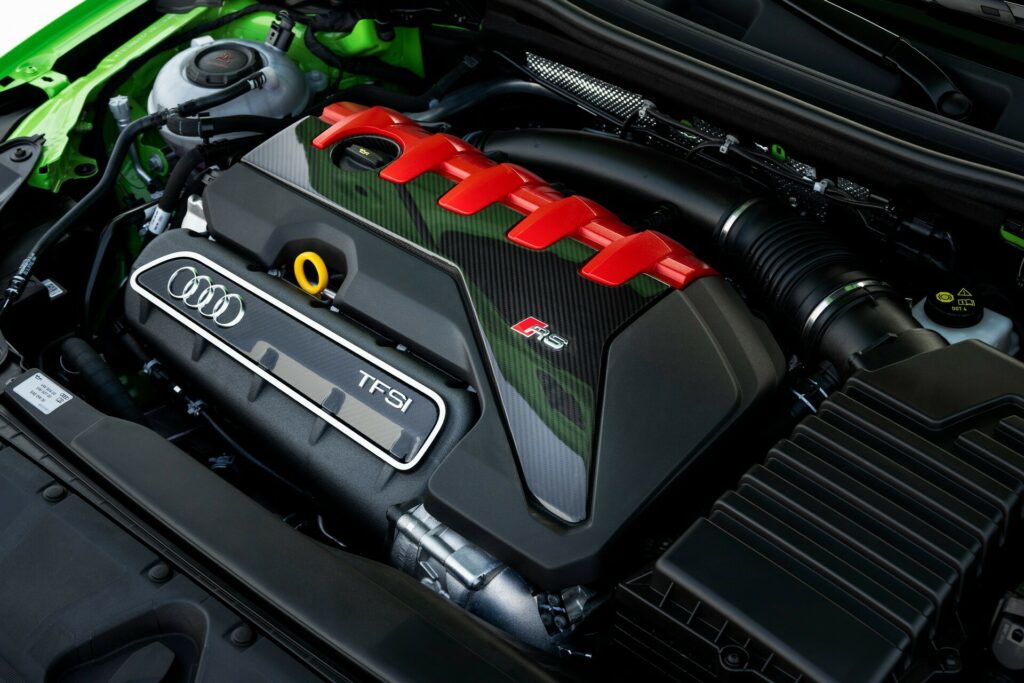
Audi seeks a way to save the legendary five-cylinder RS3 engine
In times when environmental regulations are becoming increasingly stringent, even the most iconic engines are under threat. It seemed that Audi was already preparing to say goodbye to its cult 2.5-liter turbocharged five-cylinder engine, but new data suggests the automaker may be able to preserve this unit through hybridization.
Currently, the EA855 engine does not comply with the Euro 7 standards coming into effect in November. To bring it up to standard, Audi will need new NOx sensors, a particulate filter, more efficient catalytic converters, and updated injection mapping. These changes may be hard to justify since the engine is currently used only in the Audi RS3 and the Cupra Formentor VZ5.
Hybridization as a rescue
Audi Sport boss Rolf Michl, responding to Autocar’s questions about possible ways to preserve the engine, noted that the company is considering all options. Converting the five-cylinder engine into a hybrid is one of the potential solutions.
“We are open to all possibilities. Deliberations on how to do this will continue on our part. I can say that we are still looking at various technological possibilities,” Michl confirmed. “Ultimately, the most important thing is the most emotional driving experience in the compact segment. We are absolutely aware of the DNA of the five-cylinder engine and are open to all possibilities.”
The Lamborghini example
Lamborghini has already demonstrated that hybridization can extend the life of a large-displacement engine, keeping its 6.5-liter naturally aspirated V12 in production. From a technical standpoint, applying a similar approach to the 2.5-liter five-cylinder engine seems entirely feasible. The more difficult question is whether the investment is justified, especially given the limited production volume of this engine.
Regardless of what happens to the 2.5-liter turbo engine, it will remain on sale in the U.S. in its current form longer than in Europe. Production of the current RS3 in Hungary will continue until mid-next year for markets such as the U.S.
Thus, while the future of the five-cylinder engine in Europe looks uncertain due to strict environmental regulations, Audi is actively seeking ways to preserve it. Hybridization, which has already saved Lamborghini’s V12 engine, could be the key to extending the life of this unique unit. However, the final decision will depend on economic feasibility and the company’s strategic priorities. For fans of the brand, this means hope for preserving the characteristic sound and power of the RS3 is not yet lost, although the likelihood of a hybrid version appearing is increasing.