


Toyota GR Yaris Ad Pulled from Air in Australia
Australian regulators have once again intervened in a Toyota advertising campaign, this time concerning a television commercial for the hot hatch GR Yaris. The ad was deemed to violate vehicle advertising standards, leading to its removal from television broadcasts. This situation reignites the ongoing tension between automakers and Australian compliance norms.
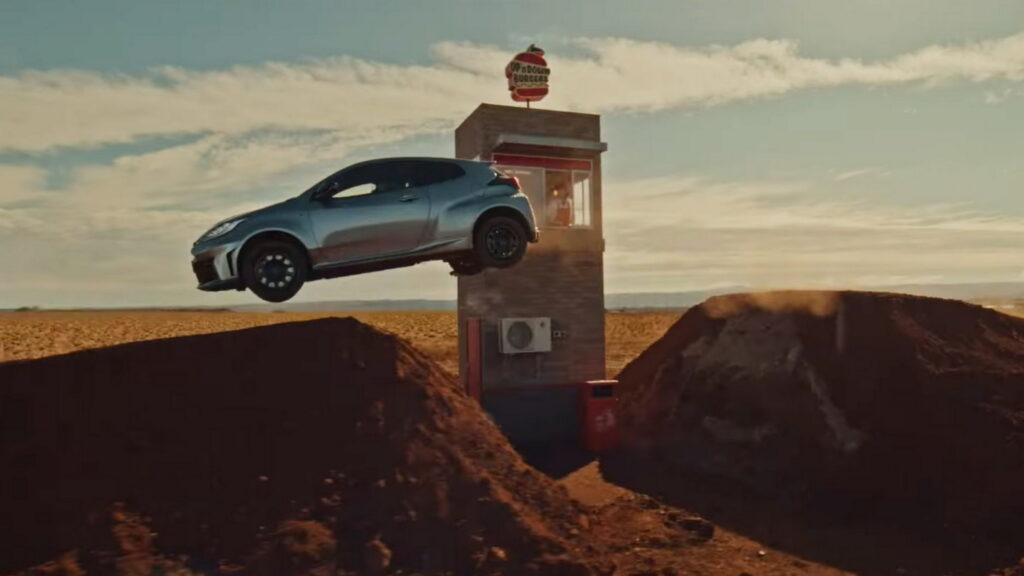
The ad features the car in a remote location. A driver in a helmet and sportswear drives up to a fictional fast-food establishment called ‘Up’n Down Burgers,’ where they order a burger, fries, and a milkshake.
While the order is being prepared, the GR Yaris is shown driving actively on a gravel road. At the end, the driver collects the package from an employee while performing an impressive jump with the car.
After the jump, the car ends up near a port, where the wet road surface allows for more sliding to be demonstrated. The GR-Four all-wheel-drive system shows its capabilities, followed by a brief two-wheel stunt, and the GR Yaris concludes its performance with a side brake slide next to GR86 and GR Corolla models.
What Did Regulators Deem Dangerous?
It was this sequence of actions that caught the attention of Australian regulatory bodies. Following a complaint about dangerous driving behavior, the ad was found to violate the Federal Chamber of Automotive Industries Code. The ruling stated that if similar driving were to occur on public roads, it would almost certainly violate the laws of any Australian state or territory.
Toyota Australia acknowledges the decision made by Ad Standards. The current GR Yaris advertisement has been discontinued while we make the necessary adjustments.
In its defense, Toyota pointed to the genuine sporting heritage of the GR model range. The company stated that the ad clearly mimicked “fantastical and unrealistic” rally driving performed by professionals on closed tracks, in vehicles sharing characteristics with Gazoo Racing competition models.
The manufacturer added that the driving shown was not intended to promote irresponsibility in the real world, but rather to demonstrate the car’s capabilities under the control of an experienced driver in controlled conditions. Toyota argued that the GR Yaris was shown doing precisely what it was built for, but in a stylized, fictional context.
Nevertheless, regulators ordered the media agency to cease broadcasting the spot. The ad has now been pulled from television, but it remains available on YouTube, where the fantastical burger run continues uninterrupted.
Not the First Incident for Toyota in Australia
This situation has a familiar ring, as in 2021 another GR Yaris ad for the Australian market was also banned. That version showed the car’s wheels spinning slightly as it exited a garage. This moment, which one might miss by blinking, still led to the ad’s removal for promoting dangerous driving.
For manufacturers, repeated violations highlight how strict the standards in Australia have become. Advertising powerful cars without showcasing their capabilities has turned into an increasingly difficult balancing act.
This phenomenon is not limited to Australia. In 2023, the UK’s Advertising Standards Authority banned a Toyota Hilux ad for, in the regulator’s view, promoting off-road driving without considering environmental impact. Again, the car was doing what it was built for, but clearly not what regulators want to see on screens.


This GR Yaris case clearly illustrates a global trend towards tighter control over content that could be perceived as encouraging dangerous behavior. On one hand, manufacturers try to effectively present the dynamic characteristics of their products; on the other, regulators are increasingly focused on the potential impact of such imagery on a mass audience. The dispute between “artistic freedom” and “social responsibility” in marketing remains one of the most debated topics in the automotive industry, especially concerning powerful and specialized models. The question of where exactly the line lies between demonstrating capabilities and setting an undesirable example often remains open and depends on the cultural and legal context of a specific country.