 by
by Artificial intelligence is fundamentally changing the approach to automotive design, significantly reducing development time and simplifying previously complex processes. To test the limits of the technology, a professional designer set himself a task: to create a full-fledged concept car in just one day, starting from a few hand-drawn sketches and ending with high-quality photorealistic images, entirely generated by artificial intelligence.
The Designer and His Experiment
The author of this experiment is Antonin Cohen, a French automotive designer currently working at Ford Europe in Germany. He previously contributed to design development for Kia. Cohen admitted that he was initially not a supporter of artificial intelligence but changed his mind when he explored the capabilities of these tools more deeply.
The technology allows for generating impressively realistic images from different angles and quickly exploring different colors, materials, and environments. It is a faster way of communication and evaluating early concepts, without diving into the labor-intensive process of manual modeling.
Creating the Digital Lexus
Cohen used new technologies for a personal project developed in his free time — a futuristic electric vehicle under the Lexus brand. He started with two sketches showing the front and rear of a low three-door hatchback. Then, artificial intelligence, guided by his creative prompts, generated a full set of visualizations.
The car has the shape of a compact three-door hatchback with a streamlined, aerodynamic silhouette. A short hood, combined with a steeply raked windshield in supercar style and low-positioned LED headlights, gives the front a robust, sporty look.
The side profile enhances this impression thanks to pronounced wheel arches and sculpted air intakes that hint at high dynamic capabilities. The rear features a glass hatch, thin LED taillights, and an aggressive carbon fiber diffuser.
Cohen noted that he always tries to give his designs “an expressive face,” describing the concept’s look as “a bit robotic.” He imagined the C-pillars as arms holding the volume together, and the rear as “practical, straight, and sturdy.”
Details That Create the Illusion
Even for professionals, it is difficult to distinguish images created by artificial intelligence from real photographs. The reflections and texture of high-quality materials are present, and the framing meets the expectations of a professional photographer’s work.
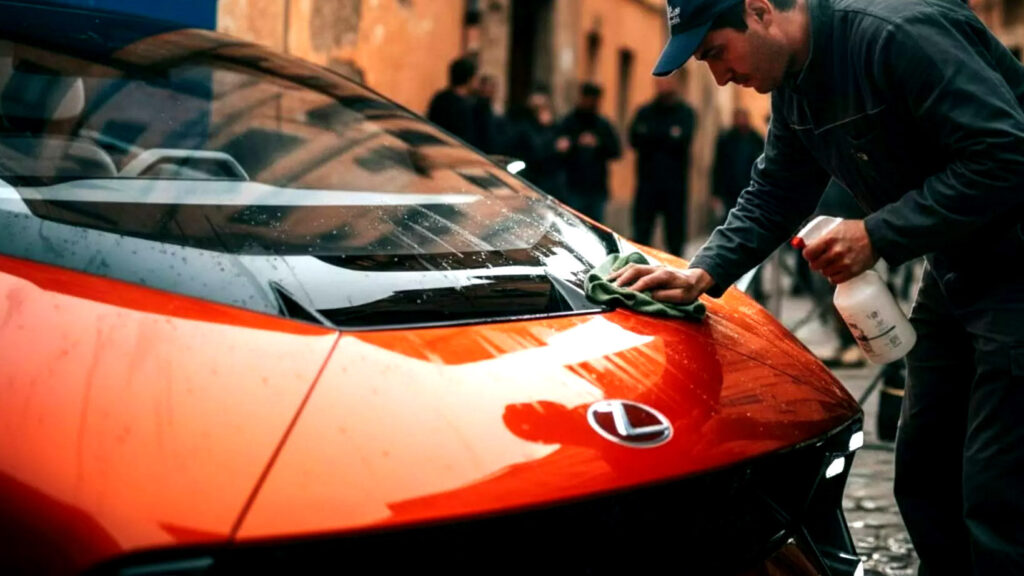
Cohen also generated “behind-the-scenes” images showing AI-created people preparing the car for an imaginary press shoot. The concept looks particularly impressive in a deep orange shade combined with a contrasting black roof, pillars, accents, and wheels.
Some images even reveal the interior, which features a wide digital instrument panel and an angular center console. One version combines white, leather-like materials with minimalist trim, while another opts for a more textured look, combining blue upholstery with wooden accents.

The Real Benefit for Designers
Although the Lexus concept is purely digital, the process of its creation highlights how artificial intelligence tools can support, not replace, a designer’s vision. When used wisely, they allow ideas to take shape faster and in more detail, facilitating the presentation or refinement of early concepts.
Cohen explained it this way: “Artificial intelligence allows you to focus exclusively on the creative side, instead of spending time on visualization. I love illustration — I used to make sketches that took three days — but sometimes you just don’t have that time.”
He also gave advice to young designers: “No sketch is ever chosen for the quality of reflections or the number of hours spent drawing wheels. What really matters are the first few lines, regardless of the technique you use.”
This project clearly demonstrates how technologies are becoming an integral part of the creative process, expanding the capabilities of professionals rather than limiting them. The speed of generating ideas and their visualization opens new horizons for prototyping and allows experimenting with forms and concepts that were previously too resource-intensive. Such tools can be especially valuable in the early stages when it is necessary to quickly evaluate dozens of options before choosing a direction for deep detailing. This changes not only the designer’s workflow but could also potentially influence how automakers make decisions about future models.