


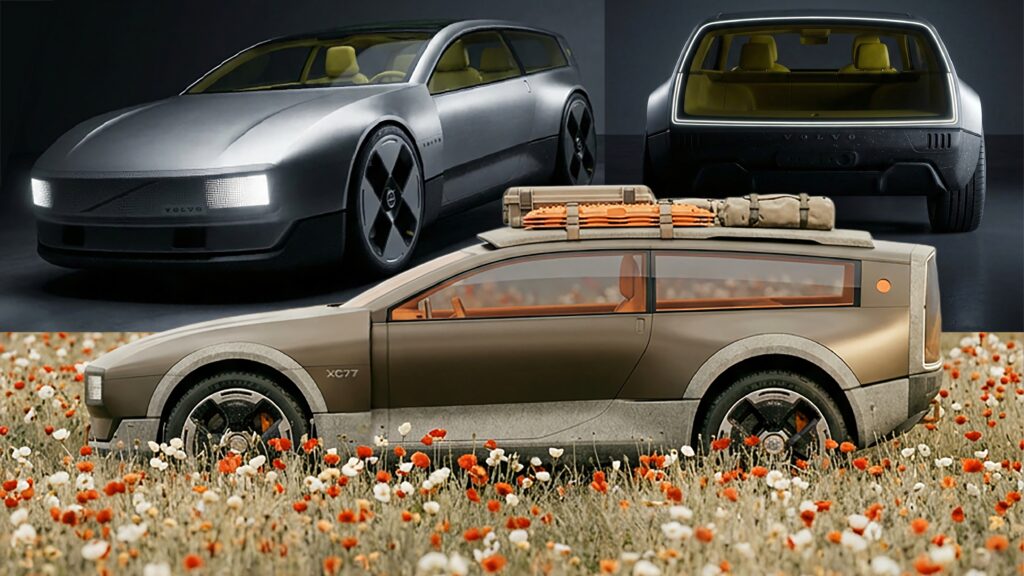
Return to the roots: V77 and XC77 concepts
Modern Volvo’s lineup largely consists of SUVs, yet the brand built its reputation on wagons, and there is reason to believe it hasn’t completely abandoned them. At least one former company designer shares this opinion. He decided to revive the old formula, creating a pair of digital concepts — the V77 and XC77, each combining minimalism and sustainability.
The author of these concepts is Julien Fesquet, a professional designer from Los Angeles who currently works at Slate Auto. His resume includes work at companies such as Volvo, Honda, Jaguar Land Rover, BMW, and Ferrari.
Design inspired by Bauhaus
The V77 and XC77 are a personal project based on the principles of Bauhaus and the work of Dieter Rams, an industrial designer whose ideas later influenced the appearance of Apple products. Both concepts feature a three-door shooting brake body with a low nose and an aerodynamic roofline. Staying true to Volvo’s strategy, the V77 is built for the road, while the XC77 adds crossover traits and increased ground clearance.
«Volvo is a brand with iconic wagons, very minimalist functional shapes in the past. They still have good cars, but they are more focused on traditional automotive design. I thought it would be interesting to challenge modern Volvo codes and imagine what a car would look like if it remained more minimalist, functional, and industrial. Something modern, refined, yet angular, without forgetting the need for aerodynamic efficiency. This led me to this shooting brake silhouette with a low nose, smooth roof, and low ground clearance.»
Clean lines and sustainable materials
Beyond the compact dimensions and truly beautiful proportions, the concepts stand out for their clean surfaces and restraint. Low-mounted headlights smoothly transition into a closed radiator grille via a digital gradient, and the Volvo emblem is reduced to a single horizontal line.
The profile of the cars features large alloy wheels, supercar-style cutouts on the front fenders, a flat beltline, and a two-tone color scheme with a darker coating on the lower body. The rear is even more striking: a glass tailgate surrounded by ultra-thin LEDs. The designer also paid attention to color, materials, and finish (CMF) strategy, proposing the use of recycled materials and an unpainted body for the V77.
Inside, we find two rows of seats and a fairly large trunk. The V77 has a cream-yellow interior inspired by the Volvo 850 T-5R, while the XC77 gets an orange cabin that complements its earthy brown exterior panels.
Electric future and real prospects
Fesquet did not specify any technical characteristics, but the absence of ventilation openings and exhaust pipes suggests the digital concepts were envisioned with a fully electric powertrain.
Volvo recently discontinued the outdated V60 and V90 models, as well as their off-road versions XC60 and XC90. Nevertheless, wagon enthusiasts have not completely lost hope. Chief Technology Officer Anders Bell stated that the new SPA3 architecture, which debuted under the hood of the EX60 crossover, could support various body types, including low models. Volvo has not yet confirmed the release of any wagon, so the question comes down to whether there will be sufficient demand to justify the costs. For now, all that remains is to wait.
These concepts demonstrate that even in times of total SUV dominance, the idea of an elegant and functional wagon remains relevant. They serve as a kind of reminder that minimalist design and sustainability can harmoniously combine, creating not only a practical but also a visually appealing car. Perhaps projects like these will push automakers to rethink classic forms in the context of the electric era.