


What is the Ferrari CZ26
The SF90 Stradale cannot be called outright ugly, but it was rarely counted among Maranello’s finest works. Its successor, which drew considerable criticism, also turned out not to be particularly successful. It seems Ferrari saves its most interesting design ideas for clients who order one-off cars, because the new project from the Special Projects department looks better than both production models.
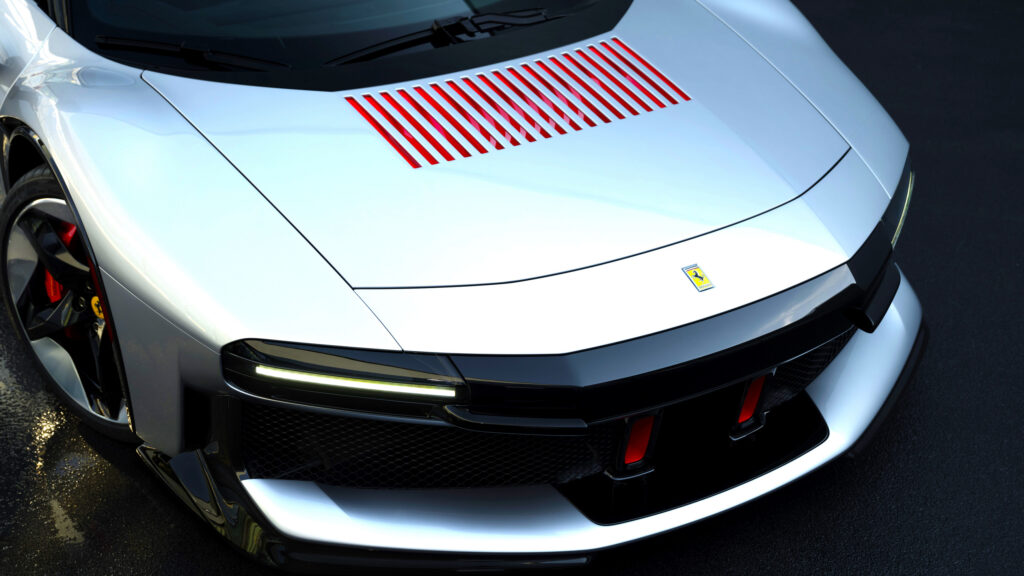
This car was created for an American client. The name CZ26 means it is already the 26th exclusive Special Projects project. Compared with the original SF90, the nose has become taller and more massive, the surfaces more geometric, and the former headlights, which slightly resembled McLaren’s, are gone. Instead, ultra-thin LED elements integrated into the grille across the full width of the body have appeared in the front end. Thanks to this, the car looks significantly more modern.
The rear has become cleaner
The rear has also been tidied up. Thin lights replaced the bulky square blocks of the hybrid SF90, while the central twin exhaust outlets remain. However, the former V-shaped bumper is gone, so the lower body section and diffuser now extend horizontally across the entire tail. It looks neater, wider, and noticeably better.
As a result, there is a slight association with the Polestar 6. But what is most striking is that the CZ26 could easily be imagined as a futuristic concept car from Kia’s line of electric models. Ferrari says inspiration came partly from Italian industrial design of the 1970s, although there is no retro feel to this car at all.
Technical package unchanged
Beneath the carbon-fiber body lies the same technical foundation as the SF90, and there is no Kia electric drivetrain inside. The four-liter twin-turbo V8 and three electric motors together produce 986 horsepower (1000 PS). Ferrari claims a 0-100 km/h time of 2.5 seconds and a top speed of 328 km/h.
Aerodynamics and interior
The interior has hardly changed — the updates mainly involve new technical fabric and glossy carbon fiber. But the CZ26 is not just an expensive body reskin. Engineers reworked the cooling system, underbody, vortex generators, front air curtains, rear spoiler, and diffuser so that the new shapes work with proper aerodynamics.
How much does it cost
Ferrari traditionally does not disclose the amount paid by the American owner. Such special projects usually take about two years, and the client participates in development at all stages. So one should be prepared for a seven-figure sum even before the keys and champagne are handed over. Whatever it cost, many SF90 owners are probably now asking why their cars did not look like this from the very beginning.
What this means for the model lineup
The appearance of the CZ26 shows that Ferrari fully understands: the production SF90 does not look expressive enough, but the technical platform is capable of much more. It is also a reminder that the boldest solutions from the Italian brand often remain within exclusive commissions and never reach the assembly line. Perhaps some of the CZ26’s stylistic cues — thin lighting, horizontal rear lines, and more geometric forms — will be used in future production models to refresh the now dated-looking design.