 by
by A New Era for the Legendary Pickup
The latest generation of the Toyota Hilux has begun a new era. For the first time in its history, this model offers a fully electric version alongside conventional gasoline, diesel, and mild hybrid options. In Australia, the zero-emission pickup is already available for order, occupying the top of the local Hilux model range as the most expensive model.
Pricing Policy
The base Hilux BEV SR variant with a double cab and chassis starts at a significant sum of 74,990 Australian dollars. This is $20,000 more expensive than a comparable diesel version with a manual transmission. The electric SR pickup with a double cab already costs $76,490, which is still $17,000 higher than its mild hybrid diesel counterpart with an automatic transmission.
The SR5 trim is by default the pinnacle of the electric Hilux assortment, as the Rogue and Rugged X versions do not offer electrification at all. Priced at $82,990, it is now the most expensive Hilux that can be bought in Australia.
The price of the electric SR5 is $19,000 higher than the diesel SR5, and also $11,000 higher than the former top-of-the-line Rugged X model with a mild hybrid diesel.
Even more indicative is that it reaches the starting price level of the new Ford Ranger Super Duty, which says a lot about how Toyota is positioning its first electric pickup.
Technical Specifications
But what does the buyer actually get for their money? The Hilux BEV is equipped with a powertrain consisting of two motors, delivering a combined 193 hp and 468 Nm of torque. It has all-wheel drive and six driving modes via the Multi-Terrain Select system, so its off-road capabilities are not limited.
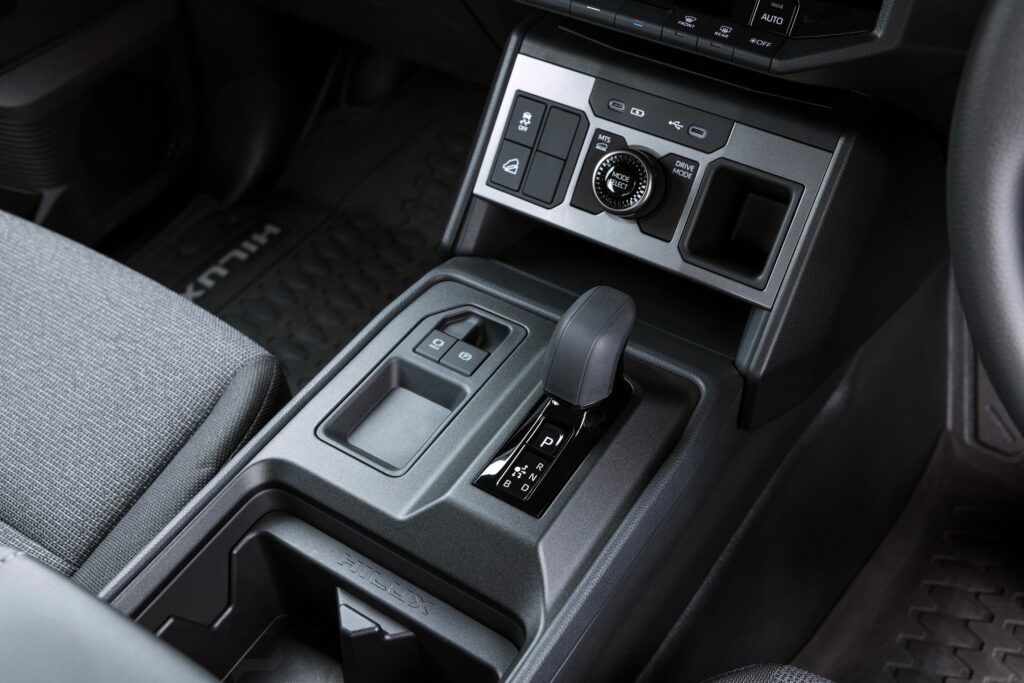
Energy is provided by a 59.2 kWh battery, which, according to claims, is sufficient for a range of 245–315 km on the NEDC cycle, depending on the configuration. This is hardly ideal for long trips across the vast Australian outback, although charging from 10% to 80% takes about 30 minutes. There is also a practical detail: a 1500W power inverter in the center console allows the pickup to be used as a mobile power source when needed.
Under the ladder-type frame, a special De Dion rear suspension with leaf springs is installed, along with additional reinforcements to compensate for the battery weight. The maximum towing capacity is limited to 2000 kg, which is significantly less than the 3500 kg of the diesel version.
Design and Equipment
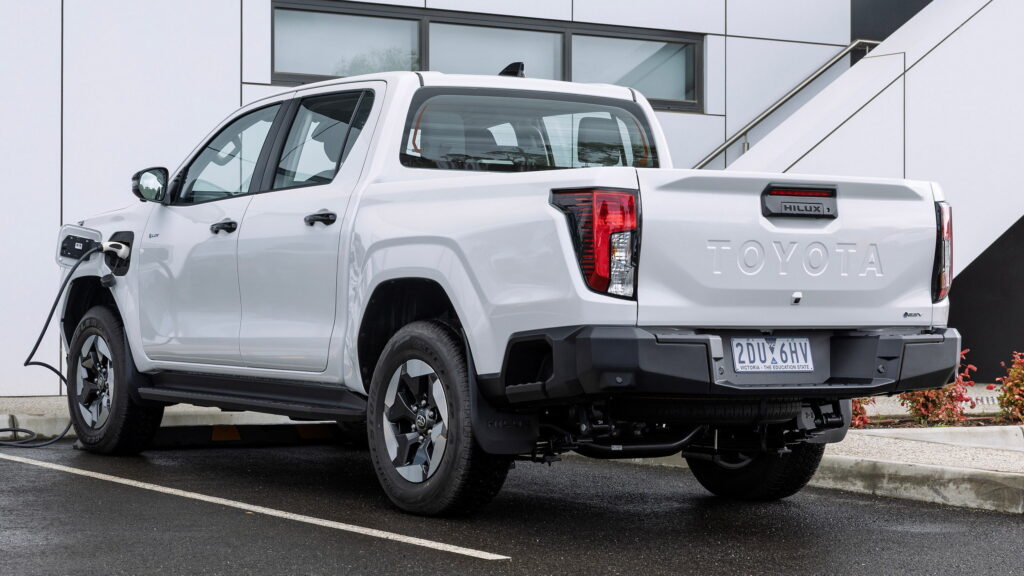
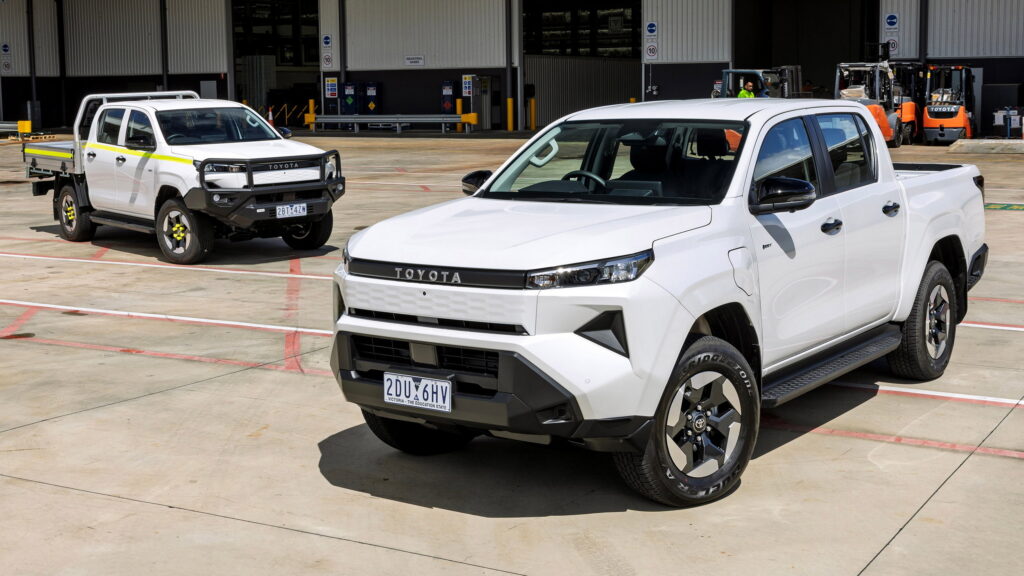
Visually, the Hilux BEV differs with a closed-off grille and a set of distinctive 17-inch alloy wheels, shaped to improve aerodynamics. The color choice is limited: Glacier White, Frosted White, and Ash Slate, emphasizing its orientation towards the commercial sector, although private buyers can also order it.
As for equipment, the SR trim is well-equipped. LED headlights, body-colored bumpers, side steps, fabric upholstery, and all-weather floor mats are standard. Also standard are dual-zone climate control, a pair of 12.3-inch displays with navigation, eight airbags, and the full suite of Toyota Safety Sense driver assistance systems.
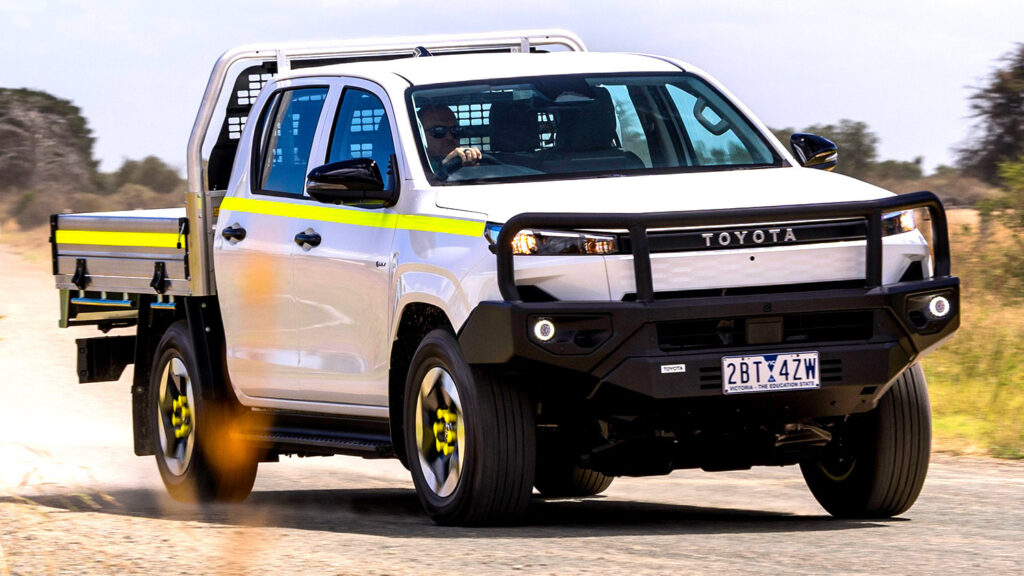
The SR5 trim adds headlights with automatic leveling, LED daytime running lights and taillights, folding and heated mirrors, tinted windows, leather upholstery, heated front seats and steering wheel, an eight-speaker audio system, wireless charging, and more. Thanks to the shared design, the BEV version is compatible with most additional accessories already available for the diesel model, including the pictured bull bar.
Modest Sales Targets
Given its price and rather unimpressive range, it’s no surprise that Toyota is managing expectations, planning to sell only 500 units in Australia during the first year. Most of them will likely go straight into the fleets of mining and construction companies, where absolute range matters less than predictable daily use. To confirm this, the company states that the HiLux BEV has already undergone intensive testing in remote outback conditions, closely collaborating with mining operators.
Australia will not be the only market. The electric HiLux will also head to Europe, Japan, South Africa, and several Southeast Asian countries.
For now, Thailand is the first place where buyers can actually place an order, which is logical as it is the production hub for the pickup. There, the Hilux Travo-e starts at a price of 1,491,000 baht, slightly below expectations but still 165,000 baht higher than the comparable diesel Hilux Travo 4TREX with an automatic transmission.
The arrival of the electric Hilux is an important step for Toyota in the commercial vehicle market, especially in regions where this model is an icon. However, the high starting prices and limited range raise questions about its mass appeal outside the corporate sector. The success of this model may largely depend on the development of fast-charging infrastructure and whether future generations of electric pickups can offer greater range at a more competitive price. For now, it looks like a niche product aimed at specific business needs rather than a broad audience of private owners.