


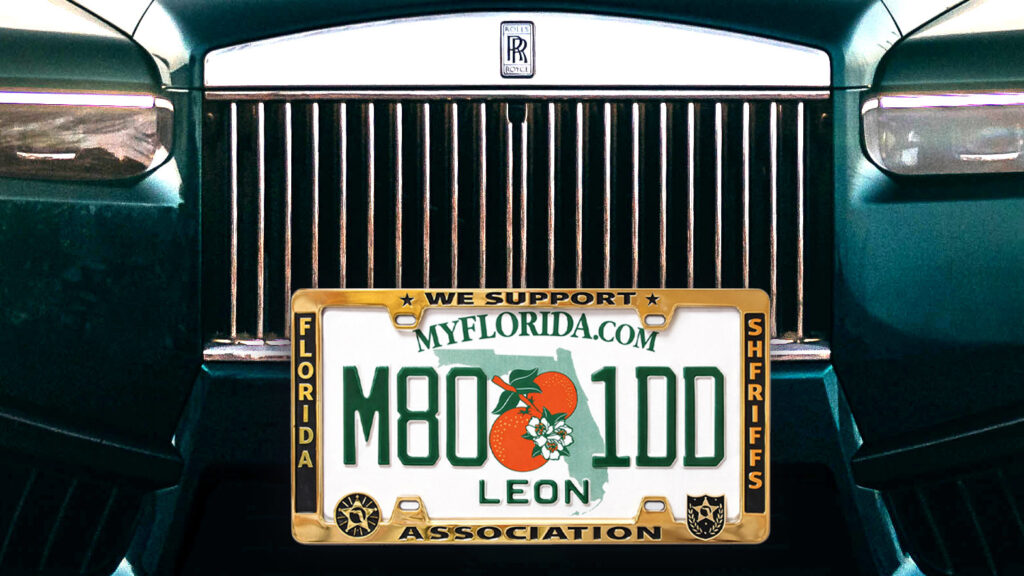
In Florida, drivers are facing criminal charges due to a new law prohibiting the obscuring of license plates. Lawyers argue that the law’s wording is vague, and its enforcement varies significantly from county to county. A federal lawsuit has now been filed aiming to block this law and void already issued fines.
Controversial Legislation
Last year, a law took effect in Florida prohibiting the use of license plate frames if they cover “any detail or feature” of the license plate itself. This move quickly raised more questions than it answered. The legislative initiative became problematic almost immediately, as it seemed to render nearly all frames illegal. Furthermore, selling such frames could become an even more serious offense. Now, after a series of fines and significant confusion, a federal lawsuit has been filed regarding this entire situation.
The law took effect in October of last year with relatively minor penalties for violators. However, in rare cases, a violation can be classified as criminal, with a maximum penalty of 60 days in jail and a $500 fine. According to reports, the law is being challenged after several drivers were held accountable, even if their license plates were only partially covered by frames or decorative overlays.
Vague Wording
Lawyers from the firm “Ticket Toro” argue that the problem lies not only in the punishment but also in the wording.
“The law is written so vaguely that it contains no definitions,” stated attorney Anna Quesada. – “It does not define what constitutes obscuring a license plate or to what extent interference becomes criminal behavior.”
Her firm examined public records across Florida and found that enforcement differs significantly depending on the locality.
In some counties, officers reportedly completely ignore frames, while in others, drivers have been fined or even arrested for covering small details such as the motto “Sunshine State.” It was revealed last year that one sheriff’s association was selling its own license plate frame and claimed it did not directly violate the law.
Official Clarifications and Contradictions
The confusion was compounded by clarifications issued by the Florida Department of Highway Safety and Motor Vehicles to law enforcement agencies approximately three months after the law took effect. According to the memorandum, license plate frames are permitted if they do not cover the license plate or the registration sticker. These clarifications appear to contradict how the law has been applied in some parts of the state.
The law firm “Ticket Toro” has filed a federal lawsuit demanding the enforcement of the statute be halted, declaring it unconstitutional, and voiding fines or arrests related to this rule. Until a judge rules on the case, the safest step for Florida drivers may be the simplest one.
Drivers are advised to ensure every part of their license plate is fully visible and to think twice before leaving a dealer-installed frame on their vehicle. The question of whether dealers who sell cars with already installed frames will be prosecuted remains unanswered by the state.
This situation vividly illustrates how poorly conceived legislation can lead to widespread legal uncertainty and unequal application of rules. The problem lies not only in the prohibition itself but in the absolute lack of clear criteria, granting law enforcement extremely broad powers of interpretation. Such cases often become a test of the effectiveness of the state mechanism, where the judiciary is forced to intervene to correct legislative flaws created by the executive branch. The court’s final decision may set an important precedent regarding the requirements for precision in wording in similar administrative and criminal regulations.