


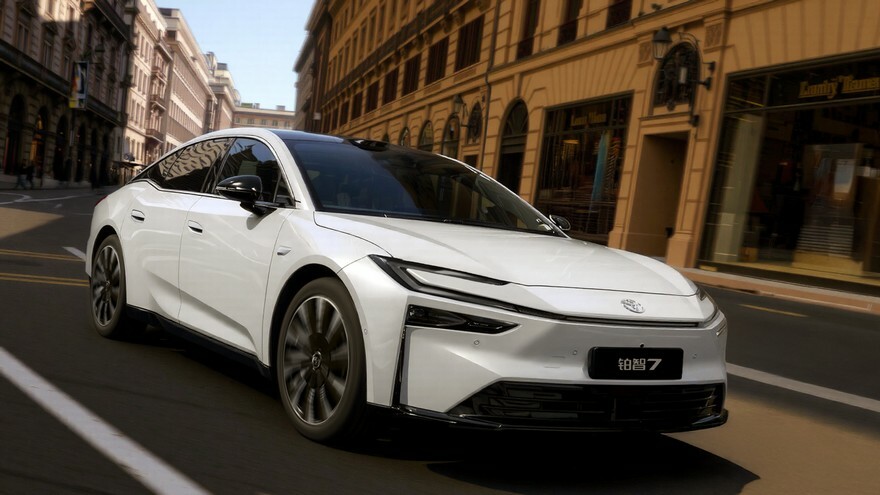
Official Sales Launch of Toyota bZ7 Electric Sedan in China
Toyota has officially started pre-orders for the new all-electric bZ7 sedan in the Chinese market. The car is offered in two trim levels: 600 Pro and 710 Ultra LiDAR, with prices ranging from 179,800 to 239,800 yuan. Converted, this is approximately $26,000 to $34,800 USD. Such an aggressive pricing policy immediately makes the model a serious player in the highly competitive Chinese electric vehicle market.
Design and Dimensions of the New Sedan
The launch of this model is not just about affordability. It symbolizes a clear shift in Toyota’s approach to electric vehicles in the region. The bZ7 features a sleek fastback design, modern but not overly extravagant. With a length of just over 5.1 meters, a width of 1965 mm, a height of 1506 mm, and a wheelbase of 3020 mm, the car has the proportions of a full-fledged executive sedan. Such dimensions place it alongside competitors like the Tesla Model S, BYD Han L, and BMW i5.
Technological Equipment and Integration with Chinese Ecosystems
The interior is designed in a clean, technology-oriented style. A massive 15.6-inch central display is positioned in the center of the dashboard, complemented by a compact driver’s display and a heads-up display. The system runs on Huawei HarmonyOS Cockpit 5.0, which is a significant step for Toyota.
Legacy automakers have long struggled to get on top of Chinese-centric ecosystems which buyers love. The adoption of HarmonyOS Cockpit not only offers sharp graphics, quick response times, and voice control features, but it will also be able to natively integrate with China’s own ecosystem of connected apps and services.
Integration with Xiaomi’s smart ecosystem means the car is designed to interact with compatible devices from this brand’s smart home. Drivers can control certain smart home functions directly from the car’s interface, as well as synchronize personal settings between devices. This makes the car part of a broader digital lifestyle, not just a means of transportation.
Driver Assistance System and Comfort
Advanced driver assistance systems are provided by the Momenta R6 system, which uses a combination of sensors and a roof-mounted LiDAR. Features include navigation-assisted driving and automatic parking functions. The more expensive trims are also heavily focused on comfort: zero-gravity effect seats, massage and ventilation functions, a premium audio system, rear seat tables, and even a built-in refrigerator oriented towards rear passengers.
Powertrain and Range
The bZ7’s powertrain is the Huawei DriveONE electric system combined with lithium iron phosphate battery packs. Depending on the trim, Toyota claims a range of approximately 600 to 710 km according to the CLTC standard. This places the model on par with key local competitors. The range is combined with an electric motor producing 207 kW (277 hp).
This range also brings it close to the territory of the all-wheel-drive dual-motor Tesla Model S, at least on paper. The Tesla car, of course, is in a completely different league when it comes to absolute performance, boasting approximately 670 hp. It is also in a completely different price range, starting at 842,900 yuan, or about $122,000. This is roughly 4.6 times more expensive than the base bZ7 and about 3.5 times more expensive than the top version of the Japanese sedan.
The launch of the Toyota bZ7 in China demonstrates how crucial adaptation to local technological standards and ecosystems has become for global automakers. Collaboration with Huawei and Xiaomi is not just a marketing move but a strategic necessity to compete in the world’s largest electric vehicle market. The price, technology, and dimensions make the bZ7 a direct competitor not only to Chinese manufacturers but also to premium European and American brands, forcing the latter to reconsider their positions in the segment. The success of this model could set the tone for future developments by Toyota and other traditional automakers seeking to establish themselves in the electric era.