


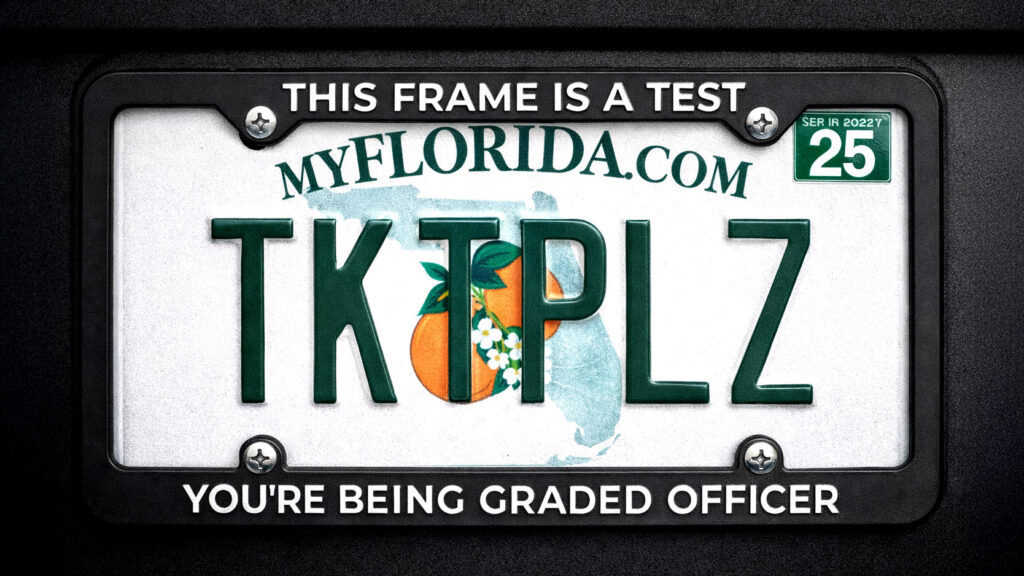
Confusion Over License Plate Frames in Florida
Florida residents have faced a wave of confusion due to differing interpretations of the law regarding license plate frames. A new law, which qualifies obstructing the reading of a license plate as a second-degree misdemeanor, initially seemed to prohibit practically any overlays, including decorative frames.
After mass uncertainty among law enforcement and drivers, some clarifications have emerged, yet the risk of receiving a fine for frame owners is still not reduced to zero.
What Does the Law Say?
Bill HB 253, which appeared to make almost all frames illegal, states:
“A person is prohibited from applying or attaching any covering or other material to a license plate or around it, if it interferes with the legibility, angular visibility, or detection of any detail on the license plate or hinders the ability to record any detail on the license plate.”
Reaction from Law Enforcement and the DMV
When journalists contacted Florida law enforcement for clarification, no official response was received. However, just days ago, the Florida Sheriffs Association (FSA) began selling its own license plate frames, claiming they do not violate the law.
Commentators pointed out the contradiction in this, and the FSA even acknowledged that a driver could still receive a fine, depending on the discretion of a particular officer. The sales page even advised buyers to measure their license plate in advance for safety.
The Florida Department of Motor Vehicles (DMV) is trying to clarify the situation. According to them, the law does not prohibit the use of a frame if it does not cover “the license plate’s alphanumeric identifier” and “the registration decal located in the upper right corner of the plate.” However, the DMV further advises officers to consult their agencies for additional guidance, which again leaves room for interpretation.
Visual Guidelines and Residual Risks
The Seminole County Sheriff also spoke out on social media, providing visual examples. According to the clarifications, frames may be perfectly acceptable even if they partially cover the top and bottom of the plate, provided that law enforcement can see which state the plate is from and the registration decal remains visible.
However, a question remains: will these clarifications be effective when a driver is stopped by an officer who is not aware of the latest directives? Stories about such stops are likely yet to come.
The situation in Florida clearly demonstrates how, even with a law in place, its practical application can vary significantly due to the lack of clear, unambiguous standards. This creates room for arbitrariness and puts drivers in a position of uncertainty, where an accessory they view as legal can become a cause for conflict with the law. Such cases often arise when legislators attempt to regulate technical details without considering all everyday nuances, and law enforcement agencies are given overly broad powers of interpretation. As a result, the safety and confidence of drivers on the road can suffer due to bureaucratic imperfection.