 by
by Updated Ford Explorer for the Chinese Market
Ford is preparing an updated version of the Explorer SUV for the Chinese market. The model has received noticeable changes to the front-end design and a number of other updates, while the powertrain remains the same.
Ford’s Chinese lineup differs from the American one and includes models such as the Bronco Basecamp, Mondeo, and Edge L. The Chinese version of the Explorer has traditionally looked more interesting than its American “sister,” and this trend continues with the new facelift, information about which was published by China’s Ministry of Industry and Information Technology.
New Exterior
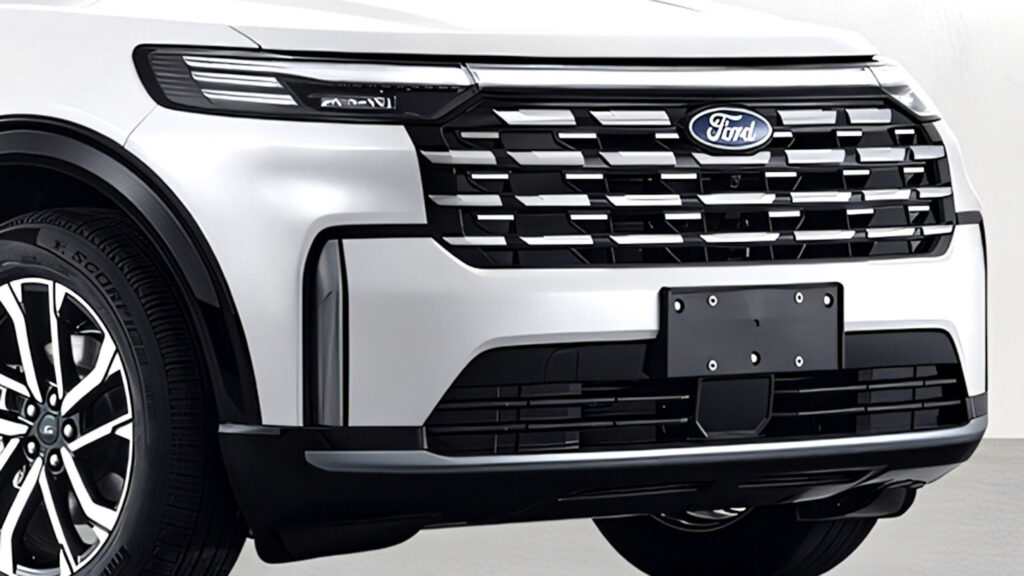
The updated crossover is easily recognizable by its completely new front end. It features narrow headlights with horizontal graphics, connected by an LED light bar. Below is a flatter and wider radiator grille with a new pattern.
The new front bumper has sharper lines and an H-shaped design, unlike the soft curves of its predecessor. Designers also added new vertical air intakes, which visually connect with the grille thanks to black accents.
Side and Rear Changes
The side body panels have remained virtually unchanged, but Ford will likely offer several new wheel designs. A contrasting black roof will also be available on some versions.
The rear has been minimally updated: the model received a new rear bumper with vertical accents. Furthermore, the Explorer now has a hidden exhaust system – the tailpipes are tucked under the body.
Technical Specifications
The ministry’s documents indicate that the Explorer will be equipped with a 2.3-liter engine producing 286 horsepower. This points to the use of the familiar 4-cylinder EcoBoost engine, whose torque is 445 Nm, with a top speed limited to 200 km/h. As before, the engine will be paired with a 10-speed automatic transmission.
The full presentation and start of sales of the updated Ford Explorer in China are expected in the first quarter of next year.
Context and Market Features
The Chinese automotive market continues to demonstrate its uniqueness, forcing global manufacturers to create special versions or even separate models for local consumers. The emphasis on technology and LED graphics in the design of the new Explorer clearly aligns with current trends in China, where digital interfaces and external presentation often take priority over classic engineering solutions. The retention of the familiar powertrain may indicate that the main focus of the update was precisely the design refresh and, possibly, the interior, to maintain the model’s competitiveness among numerous local and international brands in the SUV segment. The success of this updated model could influence Ford’s further decisions regarding the global strategy for the Explorer.