


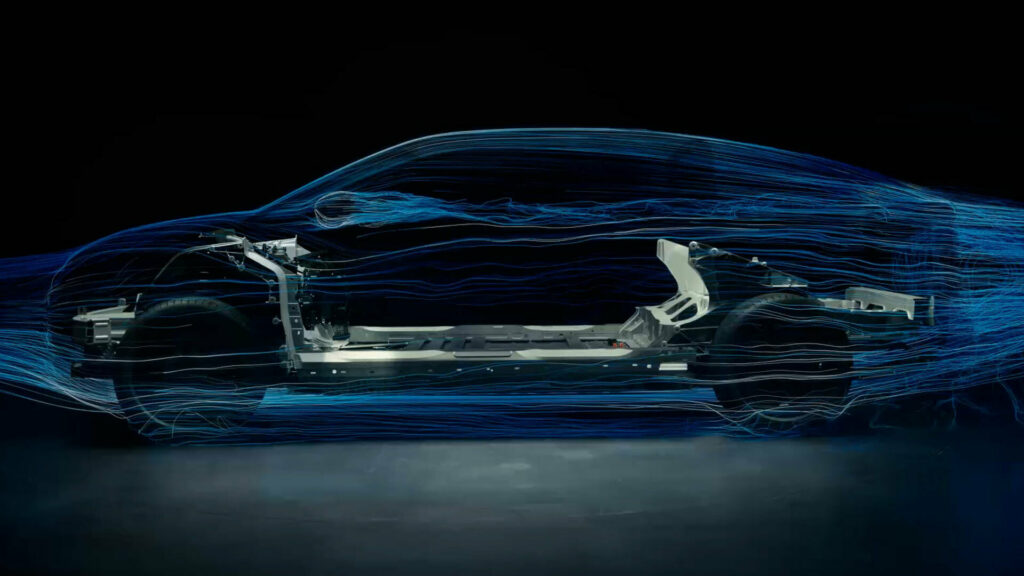
Ford has released a new video teaser dedicated to its mid-size electric pickup, expected to launch next year. The vehicle promises to be aerodynamic and energy-efficient, and will also feature LFP batteries and a new 48-volt low-voltage system.
New Platform and Pickup Details
Despite the mixed success of the F-150 Lightning, Ford continues to invest billions in electric vehicles. A portion of these efforts is becoming visible through the disclosure of details about the new generation of EVs on a universal EV platform. The first vehicle on this platform in 2027 will be the mid-size electric pickup, which is the subject of a 14-minute video.
The video contains several interesting points. For example, it is stated that the aerodynamic efficiency of this model will be more than 15% better than any other pickup on the market today, which is expected to provide greater range and lower cost for customers. The footage shows a rounded front end and a curved roof that allow air to “jump” over the body. The model also received side mirrors that are 20% smaller, which, according to calculations, adds approximately 1.5 miles of range.
Aerodynamic efficiency is more than 15% better than any other pickup on the market today and will ultimately lead to greater range and lower cost for our customers.


Innovations in Design and Batteries
The pickup’s design will include large aluminum single-piece castings, which, according to Ford, provide a 27% weight advantage compared to competitors. Furthermore, the model will have only two structural components versus 146 in the Ford Maverick.
Special attention is paid to the batteries. The pickup will get an available lithium-iron-phosphate (LFP) battery and an updated regenerative braking system, estimated to save $100 in battery cost. Ford emphasizes that many manufacturers combat “range anxiety” simply by increasing battery size, which makes vehicles heavier and significantly more expensive, as batteries constitute about 40% of the total EV cost and 25% of its weight.
Efficiency Philosophy: Every Millimeter Matters
In contrast, Ford’s strategy is to create an affordable pickup with a small but efficient battery. Engineers meticulously tracked weight, aerodynamic drag, and rolling resistance. During development, a “reward” system was even used to evaluate trade-offs between different goals.
Adding even 1 mm to the roof height would mean an additional $1.30 in battery cost or 0.055 miles of range.
This approach was consistent. For instance, the aerodynamics and interior teams clearly saw how every millimeter impacted cost and efficiency. Such detailed work allowed for the creation of a balanced product.

Energy Consumption Efficiency and New Systems
The work on efficiency also touched on energy consumption. Ford noted that energy conversion in the electric platform can lead to significant losses, for example, during charging or converting energy from the 400-volt battery for low-voltage devices. To solve this problem, the pickup received a proprietary-developed “fully electric charging ecosystem” with custom software, which is expected to improve efficiency, reduce charging time, and maximize battery life.
Furthermore, the model will have bi-directional power transfer (bidirectional charging) capability and will be the first in the company’s lineup with a 48-volt low-voltage system. Engineers also significantly simplified the wiring: the wire harness in the new model is 4,000 feet (1,219 meters) shorter and 22 pounds (10 kg) lighter than in Ford’s first generation of electric vehicles.
Ford’s presentation demonstrates a radically new approach to developing an affordable electric vehicle, where the priority is not battery size, but the total optimization of every system. The focus on aerodynamics, weight, and proprietary charging technologies could be the key to overcoming the main obstacles on the path to mass EV adoption – price and “range anxiety.” The success of this strategy will determine whether Ford can create a competitive product in an increasingly tough segment, especially considering other manufacturers’ plans to release their own affordable electric pickups.