
 by
by Automaker Ford has announced significant changes to its production plans, which are directly linked to the political context and market conditions. The company is not only working on an affordable electric pickup but is also returning to the production of gasoline models.
Key Decisions by Ford Company
Political Context and Management Statements
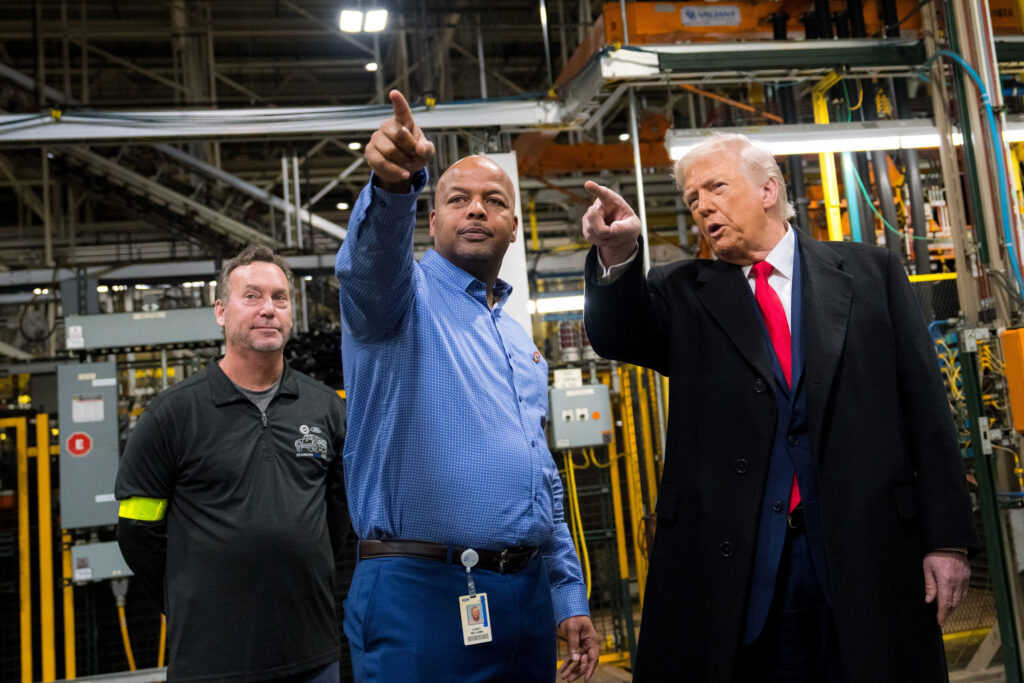
According to CEO Jim Farley, the new affordable gasoline pickup has officially entered the company’s long-term product development plan. He made this announcement during former US President Donald Trump’s visit to the Ford Dearborn Truck Plant in Michigan. This event occurred several weeks after Ford announced in December the renaming of the Tennessee Electric Vehicle Center and plans to start production of new affordable gasoline trucks from 2029.
We are adding an internal combustion engine vehicle — an affordable gasoline pickup — in Tennessee, as the President noted. These are the policies aimed at Ford. We will actually expand one of our existing plants and produce a different type of truck there.
When a journalist asked if these policies relate to Trump’s controversial tariffs, Farley replied: “Yes, and the Environmental Protection Agency (EPA).” Trump, in turn, attributed this decision to “his tariffs and relief from the most ridiculous standards.”

Change of Plans and Market Reality
According to Road & Track, the new gasoline pickup will replace the full-size electric pickup previously planned for production at the Blue Oval City facilities in Stanton, Tennessee. While news of an affordable new pickup is good for consumers, the situation may change. The vehicle will only appear in four years, and new federal elections will have taken place by then. If Republicans lose power, Democrats could reinstate pre-Trump era policies, potentially forcing automakers to ramp up electric vehicle investments and production again.
Financial Consequences and New Strategy
After the plant visit, Executive Chairman Bill Ford spoke at the Detroit auto show and acknowledged the losses the company incurred due to revising its electric vehicle strategy. After writing off nearly $20 billion due to scaling back electric commitments, the company faced a harsh reality.
No one likes to make such write-offs. But I believe it was an acknowledgment of market reality: our expectations, like those of the entire industry, for a rapid rise of electric vehicles simply were not materializing.
Farley, speaking at the same event, made it clear that Ford is not abandoning electrification entirely. The emphasis, in his opinion, is now shifting to more affordable electric vehicles and hybrid models, including gas-electric powertrain vehicles. One example is the future second-generation F-150 Lightning, which will not be purely electric. Instead, it will receive a range-extender system, signifying a departure from the fully electric approach of its predecessor.
This pivot by Ford reflects a complex transitional period in the global automotive industry, where long-term technological bets are intertwined with short-term political cycles and demand fluctuations. The decision to invest in traditional technologies alongside developing new electric platforms can be seen as an attempt to maintain balance and minimize risks in an extremely uncertain environment. The success of this strategy will depend not only on the outcomes of future elections but also on whether the company can effectively allocate resources between two technologically different directions without losing competitive positions in either.