 by
by Ford has announced significant changes to its electric vehicle strategy. The key decisions are:
Financial Implications and Plan Changes
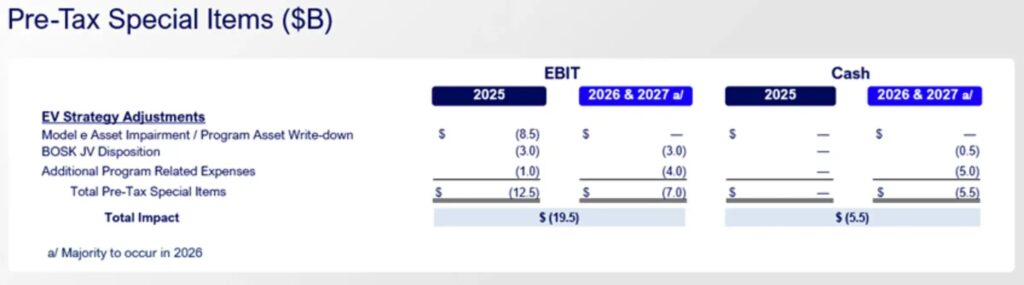
These decisions are part of the rationalization of assets and product lines related to electric vehicles in the US. They will have significant financial implications: the company plans to record special charges of approximately $19.5 billion in its results.
Ford explains this move as due to the erosion of the business case for large electric models because of lower-than-expected demand, high costs, and regulatory changes. This is why F-150 Lightning production is being halted, but in the future, this model is expected to return to the market as a range-extended pickup.
In addition to the pickup, plans for an electric commercial van for Europe, as well as an electric van for North America, have been canceled. It will be replaced in 2029 by an affordable commercial van with gasoline and hybrid powertrains, which will begin production at the Ohio plant.
Previously, Ford had already abandoned the development of large three-row electric SUVs. However, the company remains committed to the idea of creating small, affordable electric vehicles on the Universal EV Platform. The first such model, costing around $30,000, is expected to appear in 2027.
New Emphasis on Hybrids and Technologies
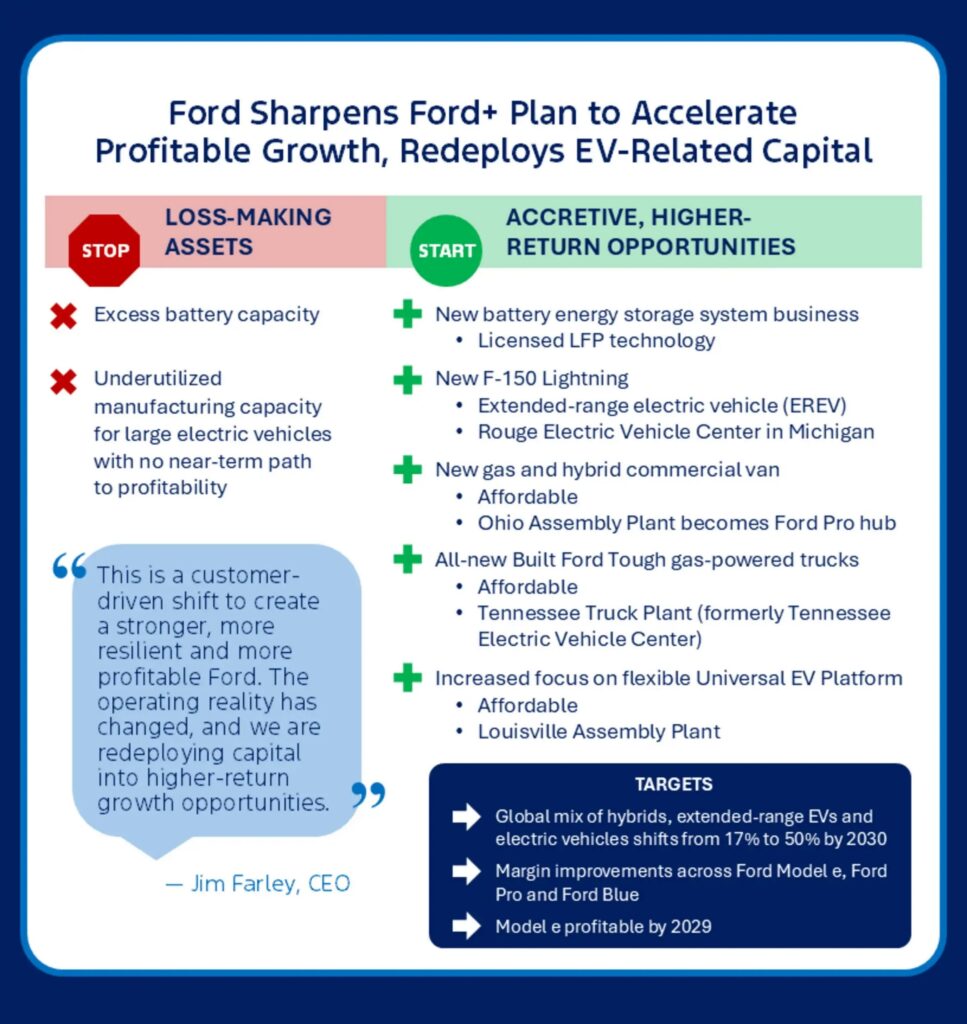
Announcing the slowdown in the development of fully electric models (BEVs), Ford confirmed its intention to significantly expand its lineup of hybrids and range-extended electric vehicles. The company expects that by 2030, the share of these three types of powertrains will account for approximately 50% of global sales volume, compared to 17% this year.

To meet future demand, Ford plans to produce a variety of hybrids: from economical to powerful, as well as models with a power export function, which has become popular among customers.
Regarding range-extender technology, the second generation F-150 Lightning will not be the only one. Ford hints at the appearance of similar versions for its larger SUVs, such as the Expedition and Navigator. By the end of the decade, nearly every Ford model will have a hybrid or “multi-energy” powertrain option.
Repurposing Production
In connection with the strategy change, Ford is renaming the Tennessee Electric Vehicle Center to the Tennessee Truck Plant. Instead of the next-generation F-150 Lightning, new, affordable internal combustion engine pickups will begin production there from 2029. This is a significant change from the initial plans for this plant.

New Battery Energy Storage Systems Business
Despite stepping back from mass-market EVs, Ford announces the launch of a new Battery Energy Storage Systems (BESS) business. It will be engaged in the sale and servicing of systems to support power grids and meet the growing demand from data centers.
This pivot is partly explained by the availability of excess battery manufacturing capacity. The plant in Glendale, Kentucky, will be repurposed to produce advanced energy storage systems with a capacity of over 5 MWh. It will produce LFP prismatic cells, energy storage system modules, and DC container systems.
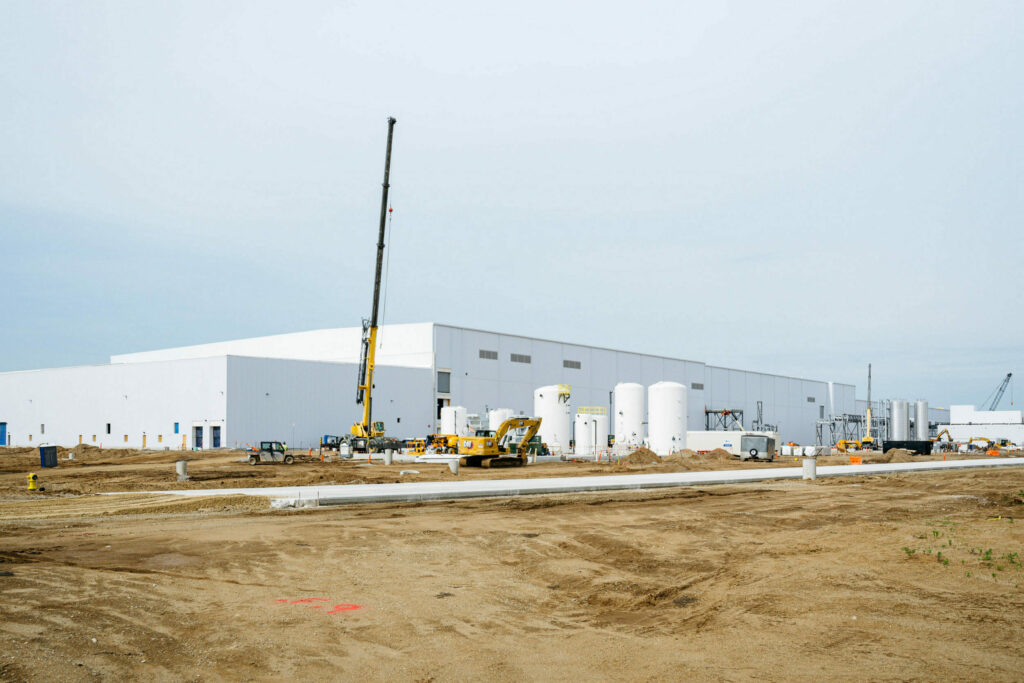
Furthermore, the BlueOval Battery Park in Marshall, Michigan, in addition to producing LFP cells for future small EVs, will engage in the production of energy storage systems for home use.
Ford CEO Jim Farley commented on these changes:
This is a customer-driven change to create a stronger, more resilient, and more profitable Ford. The operating reality has changed, and we are reallocating capital to higher-return growth opportunities: Ford Pro, our market-leading pickups and vans, hybrids, and high-margin opportunities like our new battery energy storage systems business.
These decisions reflect the complex dynamics of the global automotive market, where excessive optimism about a rapid transition to electric vehicles is colliding with economic realities and slowing demand. Focusing on hybrids and range-extender technologies may be an interim solution that better aligns with current consumer needs and infrastructure limitations. The parallel development of the energy storage systems business indicates the company’s desire to monetize its technological developments in the battery field, finding new, perhaps more stable applications for them outside the automotive sector. In a manner of speaking, Ford is not abandoning electrification entirely, but is radically changing its forms and priorities, betting on more flexible and diverse future technologies.