


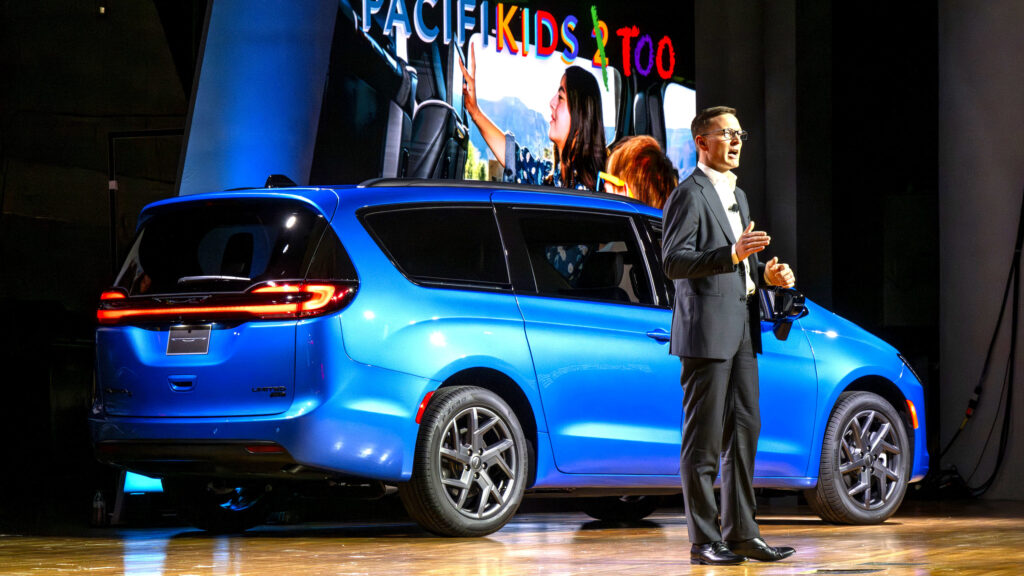
Updated Chrysler Pacifica and Hopes for a Minivan Revival
Chrysler recently introduced an updated version of its Pacifica minivan. Although the model cannot be called revolutionary, the brand’s leadership is confident that it opens a new chapter. The new CEO, Matt McAllyer, who replaced Chris Feuell, believes the Pacifica will be a catalyst for reviving demand for minivans. He does not disclose specific plans for future Chrysler models but promises to provide more details as early as next month.
This confidence looks somewhat ambiguous against the backdrop of the current situation. Chrysler’s entire model lineup now consists solely of minivans, which naturally raises questions about the brand’s future. These doubts are reinforced by sales statistics: in the first quarter, Chrysler sold 25,423 Pacifica and Voyager vehicles, which is 28% less than in the same period last year.
Management’s Optimism and Market Reality
In an interview with CNBC, McAllyer maintained an optimistic tone. He stated that the minivan market will grow, and Chrysler has the opportunity to improve its results year after year. It is worth noting that although sales increased in 2025 compared to 2024, they still did not reach the 2023 figures. In fact, 2024 was Chrysler’s least successful year in the past decade, so growth from this low base does not seem like an extraordinary achievement.
We are absolutely confident that the minivan market will grow, and we believe there is an opportunity for Chrysler to continue annual growth.
More impressive is that Chrysler was able to show any improvement, even minimal, with practically only minivans in its lineup. McAllyer believes this momentum will continue because these vehicles make life easier.
Practical Advantages of Minivans over SUVs
Undoubtedly, for most users, minivans are a more practical choice than SUVs. The Chrysler CEO gave specific life examples: one of his acquaintances, a race car driver, transports a kart with a power unit inside the cabin without needing a trailer, while another conveniently transports kitesurfing equipment inside the vehicle, not on the roof.
At the end of the day, these things make life easier, and you don’t always need to impress everyone.
Try to repeat this in most three-row SUVs, and you will understand why minivans are often better. In addition to versatility, they also have advantages in fuel consumption, ease of handling, and, importantly, in price. According to Edmunds, the average price of a minivan is $48,269, which is significantly lower than the average price of a large SUV at $77,215.
The Brand’s Future and Market Prospects
However, the problem lies in scale. Minivans remain a niche segment, whose market share has only grown from 1.7% in 2017 to 2.4% in 2025. Such growth can hardly be the foundation for the development of an entire brand, putting Chrysler in a difficult position. Matt McAllyer was cautious and did not reveal specific plans, only noting that the company has “a lot in the works.” More detailed information is promised to be revealed on Investor Day, May 21.
Positioning the updated Pacifica as both a luxury and adventure vehicle indicates an attempt to expand the target audience. Figuratively speaking, they are trying to transform the minivan from a purely family “workhorse” into a more stylish and versatile means of transport. The success of this strategy will depend not only on the appeal of the Pacifica itself but also on Chrysler’s ability as a whole to offer market innovations that dispel doubts about the brand’s overly narrow specialization. The future will show whether there is enough time and resources to implement these plans while minivans remain the company’s sole pillar.