 by
by Hypercar Premiere and First Modifications
Deliveries of the long-awaited Bugatti Tourbillon hypercar will begin no earlier than the end of this year. However, this did not stop one of the leaders in the custom wheel market, Vossen, from imagining how this car would look on new wheels. The question of whether the future 250 owners of the Tourbillon will turn to Vossen or other tuning studios remains open for now.
Design and Visual Effects
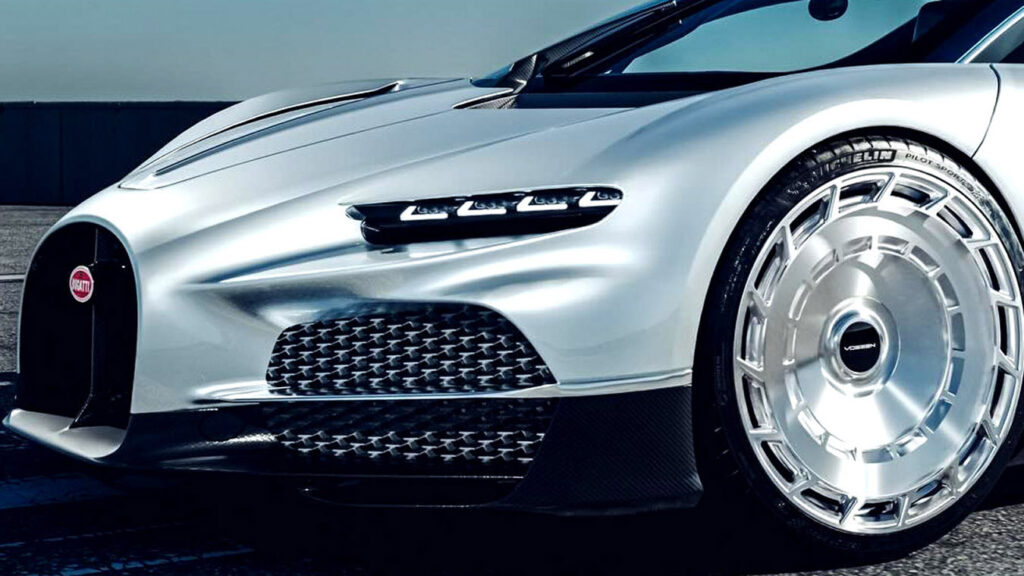
In the teaser images, the Bugatti Tourbillon is presented in a very stylish silver-blue paint job that perfectly highlights the car’s aerodynamic shapes. The body is adorned with elements of exposed carbon fiber, including side skirts, a front bumper insert, and a rear diffuser. Visually, this creates a cohesive and recognizable image, leaving no doubt about the Tourbillon’s powerful presence.
However, the wheel design raises some doubts. The front features Vossen LC3-11T model wheels. These are complex aerodynamic wheels that may improve airflow but visually appear somewhat alien against the car’s overall look. Their design is undoubtedly detailed, but the question of their real contribution to aerodynamics remains debatable.
Technical Heart and Production Plans
The rear wheels differ from the front ones. Designer Karan Adivi installed LC3-01T models with a polished shiny surface on the rear axle. The shape of these wheels is aggressive, but on such a premium and elegant car as a Bugatti, they may seem a bit odd.
What makes the Tourbillon worthy of such attention? First and foremost, it’s an entirely new powertrain. The famous 8.0-liter quad-turbo W16 from the Volkswagen Group has given way to a naturally aspirated 8.3-liter V16 developed by Cosworth, which alone produces 986 hp.
The hybrid system increases the total power to a colossal 1775 horsepower. According to Bugatti, the car accelerates from 0 to 100 km/h in 2 seconds, to 200 km/h in less than 5 seconds, and to 300 km/h in less than 10 seconds.
Production of the Tourbillon is limited to 250 units, with a starting price of around 3.8 million euros (approximately $4.5 million). This is significantly fewer than previous models—450 Bugatti Veyrons and 500 Bugatti Chirons were produced. However, this number likely does not account for future modifications and derivative versions, which traditionally appear in the brand’s lineup. Thus, the total production run may increase over time. The car’s formula has changed, but the brand’s overall strategy remains unchanged.
Limited production and exclusivity are the cornerstones of Bugatti’s business model, allowing it to maintain an insane pricing policy and hype around each new model. The transition to the new V16 powertrain, despite the break from the W16 legacy, demonstrates the brand’s commitment to technical innovation in a world transitioning to electric vehicles. At the same time, the exterior appearance and philosophy remain the same—it is always a unique artifact at the intersection of technology and art, where even a debate about wheel design only amplifies the overall attention.