


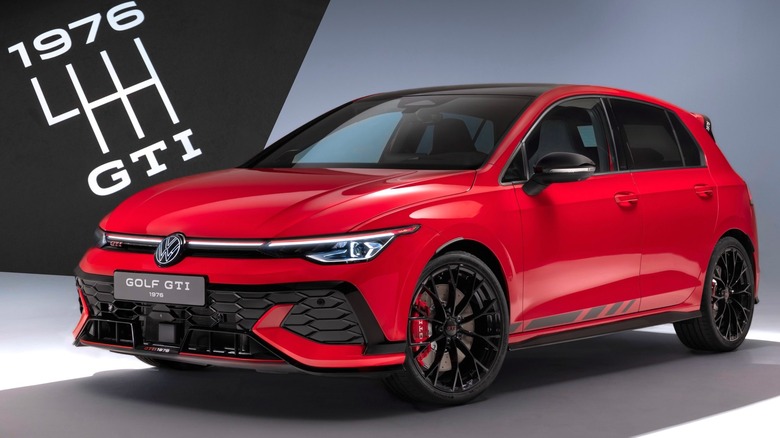
Limited series for GTI’s 50th anniversary
Volkswagen is wrapping up the year-long celebration of the Golf GTI’s 50th anniversary and fixing a notable gap: it is bringing back the manual transmission in the special Golf GTI 1976 edition. This is the fastest and most powerful manual Golf GTI in the model’s history.
The series will be limited to 1,976 cars — a reference to the year the GTI first went on sale in Germany. Under the hood, the special edition has a turbocharged 2.0-liter inline-four engine producing 321 hp (325 PS) from the Golf GTI Edition 50. For comparison, the regular European GTI has 261 hp (265 PS), the Clubsport has 296 hp (300 PS), and the American Golf GTI, with its single engine tune, makes do with 241 hp (245 PS).
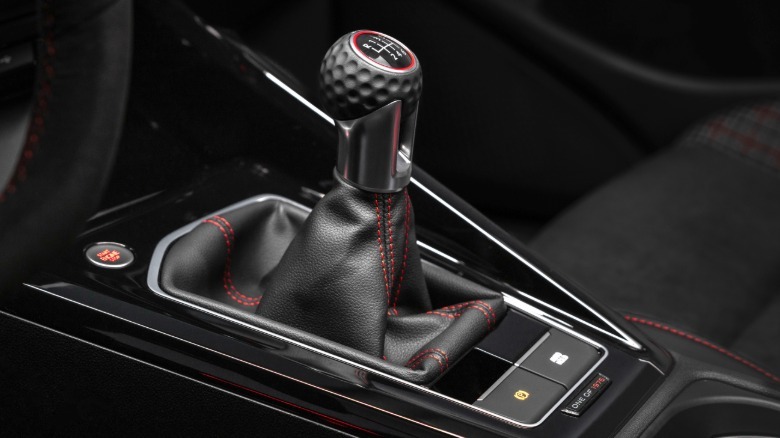
The key feature of the 1976 version is a six-speed manual gearbox instead of the seven-speed DSG automatic that the Edition 50 and other 2027 model year GTIs get. The car accelerates from 0 to 100 km/h in 5.8 seconds, and its top speed reaches 270 km/h. Against the backdrop of the real 1976 GTI, with its 9.2 seconds to 100 km/h and 182 km/h top speed, this looks almost like supercar pace.
A compromise between speed and feel
You will have to pay for tactility and driving enjoyment with a small loss of performance. The Clubsport with DSG only takes 5.6 seconds to reach 100 km/h, and the Edition 50 takes 5.3 seconds. Even the base 261-hp GTI can do it in 5.9 seconds, so the difference is small if you look at the seconds rather than the emotion of shifting gears manually.
Volkswagen stopped offering a manual for the Golf GTI and R after 2024 due to the approach of stricter Euro 7 regulations. That decision also affected availability in the US, even though those regulations do not apply in North America. Eventually the EU softened Euro 7 requirements under pressure from automakers, but Volkswagen had already made its decision. Throughout 2025 and 2026, neither the GTI nor the R was available with a manual gearbox in any market.
GTI Performance package
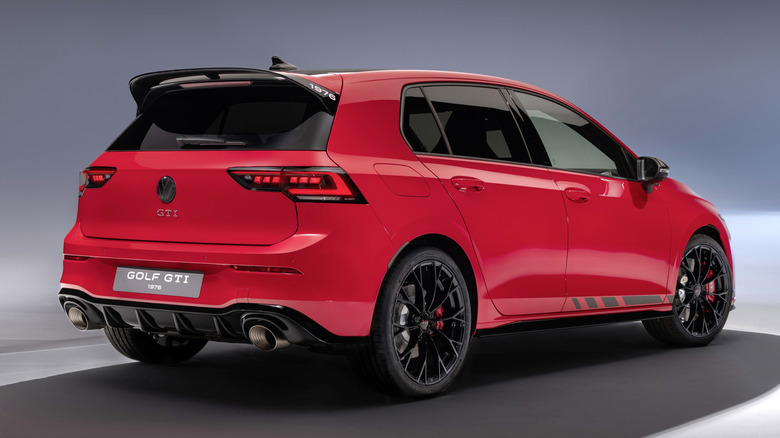
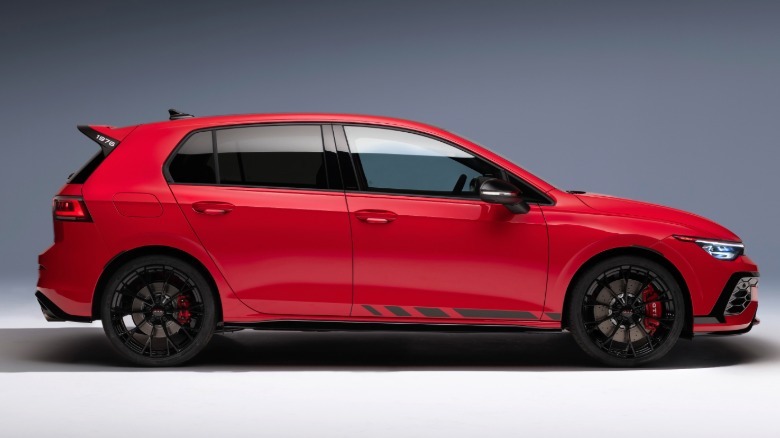
The new GTI 1976 does not just share an engine with the Edition 50. It also borrows much of its style. That means slightly more aggressive bumpers from the Clubsport instead of standard GTI parts, as well as a larger spoiler on the top of the tailgate. The 1976 version also gets a segmented stripe on the lower part of both doors, like the Clubsport, and can be ordered in white, black, or red.
But there are several details you can find only on the manual car. Among them is additional red pinstriping on the front splitter, which also gets GTI 1976 lettering. Similar graphics appear on the gloss-black mirror caps and on the spoiler, and the Volkswagen badges front and rear are darkened. The exhaust tips are now black rather than chrome.
Standard equipment includes 19-inch Queenstown alloy wheels, adaptive DCC dampers, and the Clubsport’s Special mode developed for the Nürburgring. That is where the Edition 50 earlier this year took the record for the fastest front-wheel-drive car from the Honda Civic Type R.
The optional GTI Performance package adds a lightweight exhaust system with titanium tips, as well as retuned suspension with stiffer mounting points that sits 5 mm lower than in the Clubsport. Perhaps the biggest bonus is the switch to 19-inch Warmenau forged wheels, which save as much as 3 kg of unsprung mass at each wheel.
The return of the golf-ball shift knob
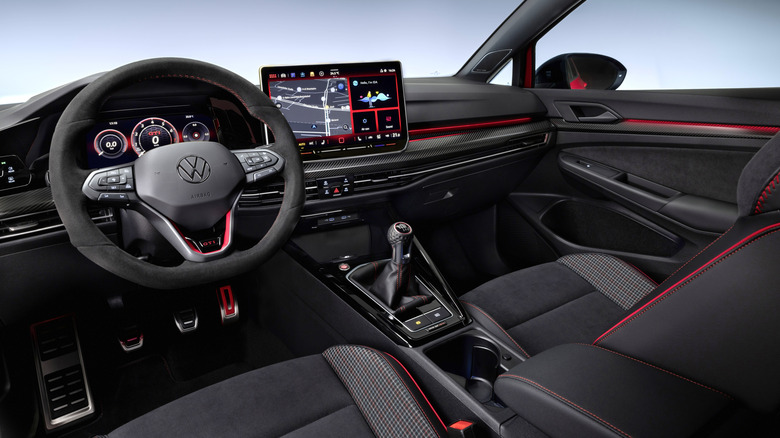
It becomes much easier to recognize the special edition when you open the door and get behind the wheel. The first thing that may draw attention is the original projection light in the doors, which projects the GTI 1976 graphic with the six-speed manual shift pattern onto the ground. Next you notice the matching door sill plates. The golf-ball-style gear knob — a memorable detail from the original 1976 GTI — also returns, and that is not the only difference.
Other new details include red seat belts, even a red accelerator pedal, and new seat fabric that combines a fine cell pattern with 1976 branding and large GTI letters. The dashboard gets prominent carbon-fiber inserts, and the steering wheel is wrapped in ArtVelours fabric.
European sales start in the first quarter of 2027. North America, which, remember, is not even subject to the European environmental rules that caused the manual to be dropped, will not join this celebration. For Volkswagen fans, that is unwelcome news.
“There are no plans to offer this special edition in the US,” a Volkswagen of America representative said.
Such a statement means that even despite the return of the manual in Europe, American buyers will not be able to order the GTI 1976. For them it will remain another special edition that they will see only in photos and videos.
What this means for buyers
The arrival of the Golf GTI 1976 shows that the manual gearbox in the modern GTI has turned from a mass-market choice into a niche collector’s product. Volkswagen is not making it available for all versions and is not bringing back a broad manual lineup — instead it is offering a limited run with a clear historical connection. For the buyer, this means a combination of the most powerful engine, unique styling, and a sense of retrospection, but without mass availability and without US availability.
This approach also highlights how strongly environmental regulations and production decisions affect which cars make it to market. Even after the softening of Euro 7, Volkswagen is in no hurry to bring the manual back everywhere. The 1976 special edition rather captures a certain moment in GTI history than opens a new mass-market chapter. For collectors and manual fans, it is an important event, but for the broad buyer it will remain a rare and expensive alternative.