


A Jubilee Look Back at the Past
Only a few automotive names can boast half a century of unabashed flirting with madness without ever fully succumbing to it. The Volkswagen GTI is one of them. To celebrate the 50th anniversary of the production version of the Golf GTI, the company has released a huge photo gallery of its most iconic concept cars from the series. No loud announcements, new concepts, or production models. Just a subtle reminder that at various points over the last twenty years, it could have built some of the most unrestrained production cars in history, but in the end, didn’t even come close.
The production Golf GTI turns 50 this year, and while it would be logical to focus on how it became a key player in the hot hatch segment, VW is once again showing cars that rightly ignored the more restrained GTI formula.
The Wildest Side of the GTI
In the foreground is the unrestrained Golf GTI W12-650, now painted red. First shown 19 years ago in white, it lost its rear seats to make way for a mid-mounted bi-turbo 6.0-liter W12 engine producing 641 hp (477 kW). The engine itself was borrowed from the Phaeton and closely related to the unit used in the Bentley Continental GT, although here it received two turbochargers and a much less noble purpose. Power was delivered exclusively to the rear wheels.
Volkswagen claimed a 0-100 km/h (0-62 mph) time of 3.7 seconds and a top speed of 325 km/h (202 mph). It borrowed brakes from the Lamborghini Gallardo and generally behaved like a Golf that had absolutely nothing left to prove. To make it all work, VW widened and lowered the body, added numerous air intakes for cooling, underbody aerodynamic elements, carbon fiber panels, and fitted 19-inch wheels that once seemed enormous. It was an incredible car, but unfortunately, not even close to production.
When the Golf Turned into a Supercar
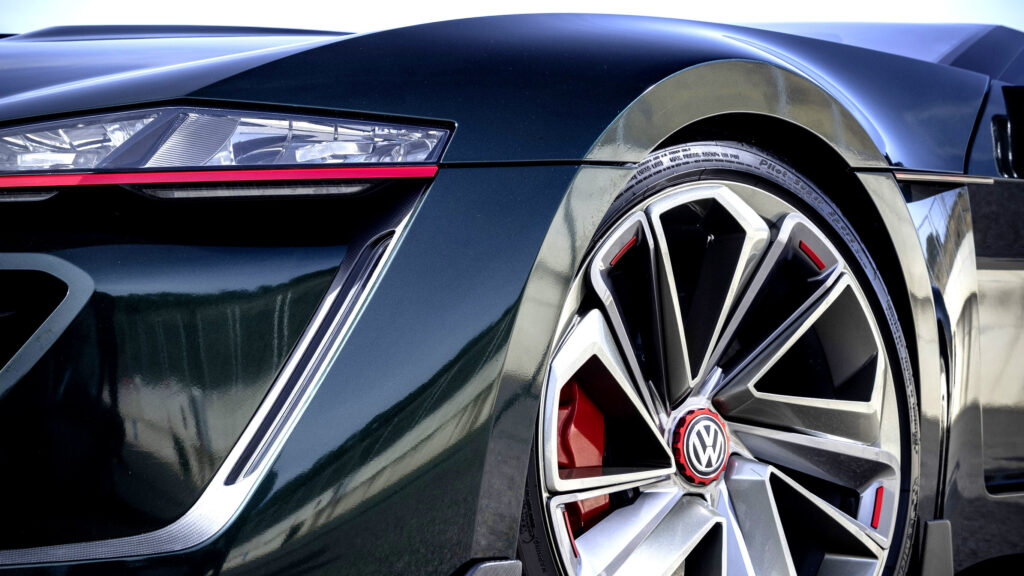
Next is the GTI Roadster Vision Gran Turismo, created for the sixth version of the video game before VW built a fully functional prototype. Its bi-turbo 3.0-liter VR6 produced 503 hp (375 kW) and 560 Nm of torque, paired with a DSG gearbox and 4Motion all-wheel drive. It accelerated to 100 km/h (62 mph) in 3.6 seconds with a top speed of 309 km/h (192 mph).
Based on the Mk7 platform, it lost its roof and rear seats, received completely new body panels, upward-opening doors, and the C-pillars were reinterpreted as a structural roll bar. Again: wild, dramatic, and, ultimately, one of a kind.
Despite the open layout, it wasn’t light. Due to all-wheel-drive components, larger brakes, and 20-inch center-lock wheels shod with 235/35 ZR20 tires at the front and 275/30 ZR20 at the rear, the Roadster weighed 1421 kg.
The Pinnacle GTI That Could Have Been Real
The most plausible of all was the Volkswagen Design Vision GTI, which received 500 hp (372 kW), 4Motion all-wheel drive, and a widened body close to production-ready. If any of these cars could have evolved into a limited-run ‘halo’ version of the GTI, this would have been it. But Volkswagen never pulled the trigger. And that’s the pattern.
For 50 years, the GTI has stuck to its core concept: front engine, front-wheel drive, daily usability, and driving pleasure. Even the modern Volkswagen Golf GTI Edition 50 retains this DNA with 325 hp (242 kW), a 0-60 mph time of 5.3 seconds, and a serious reputation at the Nürburgring. And let’s be realistic: cars like the W12 or the Roadster could only have existed as mini-series runs.
Despite all the painful teases VW has subjected us to over the last 20 years, the most we’ve gotten is a clever differential in the Golf R that can create a rear-wheel-drive feel. Volkswagen clearly knows how to build a rule-breaking GTI. It just keeps choosing not to.
VW Design Vision GTI Concept
This collection of concepts serves not only as a nostalgic trip but also as a visual contrast between bold engineering fantasies and the brand’s commercial caution. They demonstrate the technical potential and creativity of Volkswagen engineers who were not constrained by the limits of mass production and budgets. These fantasy cars remain important markers in GTI history, showing where the model’s development could have gone if pure emotion and engineering extravagance were the priorities, rather than global market strategies and environmental regulations. They will forever remain part of the GTI’s DNA—that part which constantly reminds us of unrealized possibilities and alternative paths one of the world’s most famous hatchbacks could have taken.