


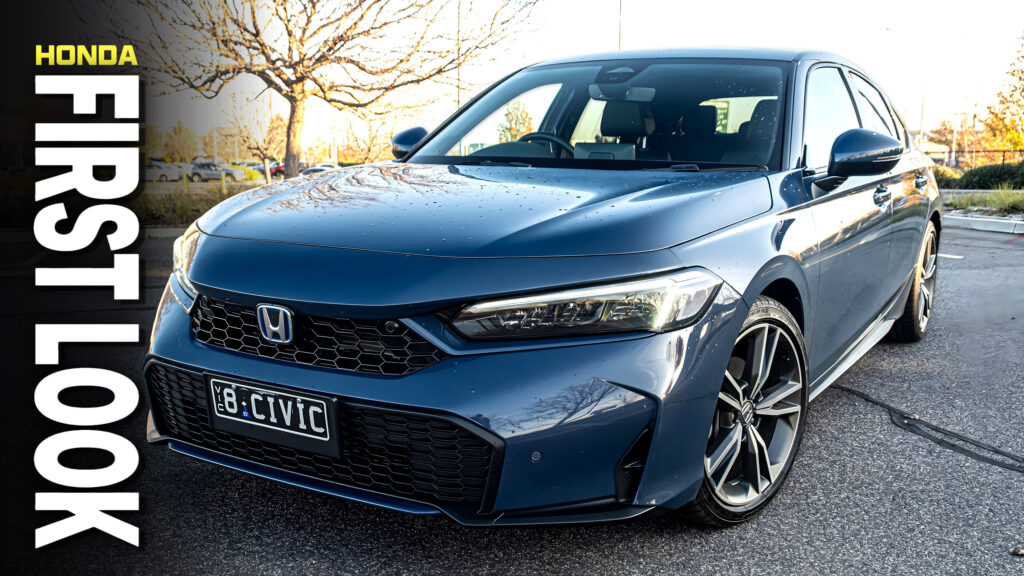
Before the eleventh-generation Honda Civic arrived in 2022, this model was a true cornerstone of the Australian affordable sedan market. However, it has now transformed into a niche product rarely seen on the roads.
This is largely because a few years ago Honda Australia decided to position the Civic as a more premium car. Apart from the flagship Type R version, the model is now available only in two well-equipped hybrid variants. Prices have risen, and sales have plummeted.
Review: Honda HR-V e:HEV X — Small in Size, But Big Where It Matters
I’ve long been curious to explore the new Civic: how it fits into the market compared to much cheaper competitors. In some aspects, it significantly outpaces others, but its price is hard to justify for many, if not most, buyers.
Key Facts
| Model: | 2026 Honda Civic e:HEV LX |
| Starting Price: | AU$55,900 (US$39,000) including on-road costs |
| Dimensions: | 179.5 x 70.9 x 55.7 in (4,560 x 1,802 x 1,415 mm) |
| Wheelbase: | 107.6 in (2,735 mm) |
| Curb Weight: | 1,497 kg (3,300 lbs) |
| Powertrain: | 2.0L four-cylinder engine / two electric motors |
| Power: | 181 hp (135 kW) / 315 Nm (232 lb-ft) |
| 0-100 km/h: | ~8 seconds |
| Transmission: | eCVT |
| Fuel Consumption: | 5.2 L/100 km (45.2 US mpg) |
| On Sale: | Now |
Priced Out of Its Segment
Back in 2020, the old Honda Civic cost from AU$22,590 (US$15,700) in Australia including on-road costs, making it a direct competitor to the popular Toyota Corolla. Now the Civic starts at AU$49,900 (US$34,800) for the base e:HEV L and AU$55,900 (US$39,000) for the e:HEV LX.
Photo credit: Brad Anderson / Carscoops
For comparison, in the US, prices for the current-generation Civic have remained relatively stable versus its predecessor — from $25,745, allowing the model to remain a legitimate competitor to the Corolla, which starts a few thousand dollars less.
Given the Australian price changes, it’s no surprise sales have fallen in recent years. Back in 2019, when the tenth generation was nearing the end of its life cycle, 10,531 units were sold. That’s significantly down from a peak of 14,672 sales in 2017. For comparison, in 2025 only 933 new models were sold, and in 2024 — 966 cars nationwide.
Although the overall market has shifted heavily toward SUVs and crossovers in recent years, the Toyota Corolla still sells reasonably well in Australia — 9,860 units last year.
Likely, part of the price jump is because the current Civic is equipped with a hybrid powertrain, while its predecessor only offered a conventional internal combustion engine. The system consists of a 2.0-liter naturally aspirated four-cylinder engine, a 1.05 kWh lithium-ion battery, and two electric motors. Power is sent to the front wheels via an e-CVT.
Familiar Honda Interior
Photo credit: Brad Anderson / Carscoops
The Civic e:HEV LX cabin will be familiar to anyone who has tested modern Honda models — it shares many details with other cars in the lineup.
The steering wheel is leather-wrapped, has plenty of physical buttons and switches, and feels great in hand. Behind it is a relatively small 10.2-inch digital instrument cluster which, despite being incredibly clear, offers almost no customization — a drawback.
On top of the dashboard sits a 9-inch infotainment screen with wireless Apple CarPlay and Android Auto. During the first few days of testing, Android Auto refused to open, regardless of connection method (wired or wireless). The only way to connect the phone was a full factory reset. After that, everything worked without issues.
The pleasant honeycomb mesh on the dashboard hides the air vents, which are adjusted via stylish levers. The transmission tunnel is covered in glossy plastic, but thankfully it’s not black piano lacquer, so it doesn’t collect fingerprints and scratches. The gear selector buttons weren’t to my taste — during U-turns, they feel less convenient than a traditional lever or even a steering column stalk.
Material and build quality in the Civic is impeccable, as expected for this price. It is definitely more premium than the much cheaper Corolla, although in my opinion, it’s not as luxurious as the top-spec Mazda3 Astina, which costs just over AU$47,000 (US$32,800).
At the same time, the Civic cabin loses some sparkle and starts to look a bit dated — though this applies to many competitors as well.
Photo credit: Brad Anderson / Carscoops
Aside from the overall impression, the Civic’s seating position is excellent, almost like in the Type R. The driver’s seat can be lowered very far, and the panoramic roof creates a sense of space often missing in small hatches that can feel tight and oppressive.
It’s worth noting that the Civic sold in Australia differs slightly from the US version. Here, only the hatchback is available, while in the US the model is offered exclusively as a sedan. Personally, I think the hatchback is the better choice: opening the trunk gives you a spacious cargo area that expands to 1,187 liters (41.9 cu ft) with the rear seats folded.
The downside of the hatchback is a slightly more sloped roofline than the sedan, so rear passengers over 6 feet (183 cm) tall may lack headroom.
Mini-Accord Vibes
Driving the Civic e:HEV LX feels like a carefree journey. For those who value a smooth, quiet, and refined driving experience, the hybrid powertrain works beautifully — at least most of the time.
Total output of 135 kW (181 hp) and 315 Nm (232 lb-ft) provides more than enough energy for daily driving. The e-CVT operates seamlessly, without jerks, because it’s essentially not a real CVT. Depending on conditions, the engine acts either as a generator for the electric motor or, via a clutch, directly drives the front wheels. The simulated gear shifts feel natural, much like in other Honda models, say the HR-V.
Overall efficiency is good, though we didn’t achieve Honda’s claimed 4.2 L/100 km (56 US mpg). Over more than 650 km (404 miles) of driving, mostly on highways, average consumption was 5.2 L/100 km (45.2 US mpg), slightly higher than the 4.9 L/100 km (48 US mpg) I got on a Honda Accord e:HEV a few years ago under similar conditions. Perhaps more city driving, where regenerative braking works, would improve economy.
Photo credit: Brad Anderson / Carscoops
Often, the 2.0-liter four-cylinder engine runs almost silently, as the car prefers to drive on electric power at low speeds. However, sometimes the engine unexpectedly revs up to about 2500 rpm, as if trying to charge the small battery. It’s not a big issue, but potential buyers should keep it in mind.
Although the standard Civic wasn’t designed as a pure driver’s car like the Type R, it shares a few traits with the latter. The steering is extremely precise and well-weighted, which sets it apart from the overly assisted systems of some other new hybrids and EVs.
Honda has also tuned the Civic’s suspension well. It’s soft on potholes and bumps, yet remains taut and responsive when you want to play a bit on a mountain road. That said, the six-year-old Mazda3 performs just as well in any conditions and costs significantly less.
Verdict
Ultimately, the Honda Civic e:HEV LX is a very solid car. It has all the same advantages as its predecessors: practical, good-looking, reliable, capable of serving problem-free for decades.
However, the price tag is hard to justify. Compared to the aforementioned Mazda3 G25 Astina, the Civic offers acceptable value, but the Australian lineup badly lacks a cheaper, non-hybrid version priced around AU$35,000 (US$20,900). As of today, you can buy a hybrid HR-V for about AU$15,000 (US$10,500) less, and the even larger and more practical Honda CR-V hybrid starts at AU$49,900 (US$34,800).
Photo credit: Brad Anderson / Carscoops
It’s worth noting that the Honda Civic remains an attractive choice for those who value comfort, build quality, and efficiency, but its positioning in Australia creates serious competition within the brand’s own lineup. As increasingly cheaper and equally quality alternatives appear on the market, Honda may lose a significant portion of buyers who previously considered the Civic an affordable family car. On the other hand, among enthusiasts of hybrid technology and refined design, this model can still find its niche — provided they are willing to pay for image rather than just practicality.